Coax cable or RF coaxial feeder is a robust and convenient form of feeder to use for a variety of applications where radio frequency or other high frequency signals need to be carried from one point to another.
Coax cable is one of the most widely used forms of feeder, offering advantages of convenience while being able to provide a good level of performance.
In view of this vast amounts of coax cable, coax feeder are manufactured each year, and it is also available with a huge variety of different specifications for different applications. Everything from the thin small signal cable for short lengths within equipment up to very thick coax for high power transmission.
In addition to this, varieties of coax with different specifications are available to meet the needs of users requiring frequencies in the LF, MF, or HF frequency regions right up to microwave applications.
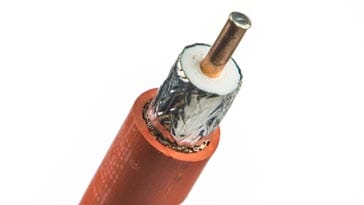
Typical coax cable feeder
Coax cable / feeder applications
Coaxial feeder / coax cable is used in many applications, just a few of which are mentioned below:
Domestic radio & television: Domestic televisions and some VHF FM or digital radio solutions sometimes have external antennas. These antennas need to be connected to the TVs or radios via a coaxial cable / feeder. For this application the standard characteristic impedance is 75Ω and often the quality is not particularly high as it is made for a very cost sensitive market. Often the braid is relatively thin.
Commercial radio communications: Coax feeder is used within commercial radio communications systems. Like al other RF feeders used in professional applications a standard of 50Ω has been adopted for the characteristic impedance. Cable loss can be an issue in these applications so a variety of thickness coax cables can be obtained.
Broadcasting: It is obviously necessary to transfer the transmitter signal from the transmitter to the antenna. With many broadcast transmitters being high powered the coax feeder used must be able to withstand these power levels. This often means using a large diameter coax cable.
Satellite antennas: It is not unusual to see sets of satellite antennas used for sending information up to satellites (this is apart from the direct broadcast satellites for domestic installation). These satellite antennas need to be fed and one of the ways that is often used is coaxial feeder. In view of the frequencies, low loss cable is required.
Test systems: Connecting equipment that uses high frequency signals often requires the use of coax cable. Many instances of electronics laboratories will see the use of coax cable for many links. In some instances it may be used mainly to provide screening of the required line.
Within equipment: Coax cable may be used within various pieces of test equipment where high frequency signals need to be linked from one place to another.
Data applications : Although not as prevalent as it used to be, some data links may use a coax cable to provide the required links between different points. Early versions of Ethernet used coax cable.
Many more . . . : There are vey many instances where coax cable is used apart from some of the specific examples given above.
Coax cable feeder
RF coax cable history
RF coaxial cable is a particularly important part of today's RF and electronics scene. It is a component that could easily be overlooked with little thought of how it appeared. In the late 1800s there were a huge number of basic discoveries being made in the field of electricity. Radio, or wireless as it was originally called was not understood well, and the first transmissions were made in the 1890s. Some transmissions were made earlier but not understood.
The first known implementation of coax cable was in 1884 when Ernst von Siemens (one of the founders of the Siemens empire) patented the idea, although there were no known applications at this time. It then took until 1929 before the first modern commercial coax cables were patented by Bell Laboratories, although its use was still relatively small. Nevertheless it was used in 1934 to relay television pictures of the Berlin Olympics to Leipzig. Then in 1936 an a coaxial cable was installed between London and Birmingham in the UK to carry 40 telephone calls, and in the USA an experimental coaxial cable was installed between New York and Philadelphia to relay television pictures.
With the commercial use of RF coax cable establishing itself, many other used the cable for shorter runs. It quickly established itself, and now it is widely used for both commercial and domestic applications.
What is coax cable? - the basics
Coax cable, coaxial feeder is normally seen as a thick electrical cable. The cable is made from a number of different elements that when together enable the coax cable to carry the radio frequency signals with a low level of loss from one location to another.
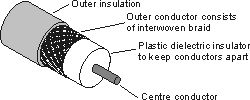
The overall construction of the coax cable or RF cable can be seen in the diagram below and from this it can be seen that it is built up from a number of concentric layers. Although there are many varieties of coax cable, the basic overall construction remains the same:
Centre conductor The centre conductor of the coax is almost universally made of copper. Sometimes it may be a single conductor whilst in other RF cables it may consist of several strands.
Insulating dielectric Between the two conductors of the coax cable there is an insulating dielectric. This holds the two conductors apart and in an ideal world would not introduce any loss, although it is one of the chief causes of loss in reality. This coax cable dielectric may be solid or as in the case of many low loss cables it may be semi-airspaced because it is the dielectric that introduces most of the loss. This may be in the form of long "tubes" in the dielectric, or a "foam" construction where air forms a major part of the material.
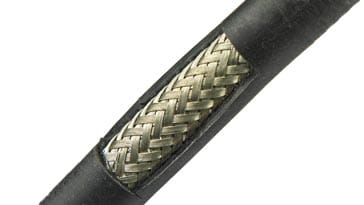
Outer conductor The outer conductor of the RF cable is normally made from a copper braid. This enables the coax cable to be flexible which would not be the case if the outer conductor was solid, although in some varieties made for particular applications it is.
Braid or outer conductor on some coax cable
To improve the screening double or even triple screened coax cables are sometimes used. Normally this is accomplished by placing one braid directly over another although in some instances a copper foil or tape outer may be used. By using additional layers of screening, the levels of stray pick-up and radiation are considerably reduced. The loss is marginally lower.
Outer protecting jacket or sheath Finally there is a final cover or outer sheath to the coax cable. This serves little electrical function, but can prevent earth loops forming. It also gives a vital protection needed to prevent dirt and moisture attacking the cable, and prevent the coax cable from being damaged by other mechanical means.
How RF coax cable works
A coaxial cable carries current in both the inner and the outer conductors. These current are equal and opposite and as a result all the fields are confined within the cable and it neither radiates nor picks up signals.
This means that the cable operates by propagating an electromagnetic wave inside the cable. As there are no fields outside the coax cable it is not affected by nearby objects.
Accordingly it is ideal for applications where the RF cable has to be routed through or around buildings or close to many other objects. This is a particular advantage of coaxial feeder when compared with other forms of feeder such as two wire (open wire, or twin) feeder.
Key coax cable topics
There are several topics that are particularly useful to understand when looking at coax cable. These include:
Coax impedance: The characteristic impedance of a feeder is of prime importance. There is maximum transfer of power from a source to a load, or vice versa when the impedance is the same. This is also true for coax feeder. The standard value for most coax used is 50Ω although 75Ω is used for domestic radio and television. . . . . . Read more about coax cable characteristic impedance.
Coax loss or attenuation: It is obviously important to ensure the loss introduced by any length of coax cable is minimised. However any length of coax will introduce some loss. . . . . . Read more about coax cable loss / attenuation.
Coax feeder power rating: Although it may not be an issue for receiving applications, where transmitters are involved, it is necessary to ensure that the power rating for the feeder is adequate. . . . . . Read more about coax cable characteristic power rating.
Coax cable velocity factor: The velocity factor for a length of coax feeder may be important in some instances, especially where the phase of the signal is important. . . . . . Read more about coax cable velocity factor.
Environmental facts for coax feeder: Coax cable is often run outside. Even of the outer sheathing remains intact, there are some environmental issues. . . . . . Read more about coax cable environmental factors.
Installation tips for coax cable: The way in which coax cable is installed can have a major impact on its short term and long term performance. . . . . . Read more about installation techniques & tips.
Coax types & standards: Although coax cable is manufactured by many different companies, there are standards that have been adopted to define the make-up and performance of various types of coax. . . . . . Read more about types & data.
Coaxial cable provides a very easy and convenient way of transporting radio frequency power. The coax cable or coaxial feeder is easy to use, but as with any form of feeder, care should be taken to ensure that it is able to operate at its best.
Fact of the day: On this day in 1791, Samuel Morse, the inventor of the Morse telegraph system, and very accomplished portrait painter was born in Charlestown (now Charleston) Massachusetts USA.
Quote:By always thinking unto them. I keep the subject constantly before me and wait till the first dawnings open little by little into the full light. Isaac Newton on how he made discoveries.
Point to ponder: The Eiffel Tower in Paris is 320.755 metres (1052 feet) high, including the television antennas, and it contains 2 500 000 rivets and contains 18 038 metal pieces.