PXI, PCI eXtensions for Instrumentation, has emerged as a major force in the test equipment and instrumentation industry.
PXI provides a rugged PC based platform for use in automated test, data acquisition and many other applications.
It successfully combines rugged mechanical elements with a high electrical performance specification and a low cost. Using standard PC technology, this makes PXI an ideal platform for a host of applications
What is PXI? - the basics
PXI is based on the popular PC based bus system, CompactPCI, used for embedded development and computer based platforms As such PXI is able provide the benefits of the PCI architecture: high level of performance, industry acceptance, wide availability of off the shelf units, etc. PXI adds a rugged Compact PCI mechanical form-factor, an there is an industry consortium that defines hardware, electrical, software, power and cooling requirements, enabling interconnectivity between items from different manufacturers.
In addition to this, the system adds a number of other capabilities required for test, measurement, data acquisition and control applications. These include aspects including: integrated timing and synchronization that is used to route synchronization clocks, and triggers internally.
A further advantage of PXI is that having been adopted by the industry it will remain in use for many years to come, thereby enabling any investment to be protected. These advantages make PXI an ideal standard for use as test equipment and for data acquisition applications. Read more about the PXI standard & specifications.
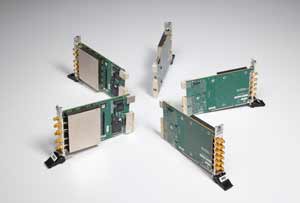
The PXI hardware is platform on which the overall PXI standard is based. It forms the platform for running the software and for the individual instruments. It forms a particularly flexible scheme allowing a very wide variety of instruments to operate within a chassis environment.
There are three basic elements to a PXI system:
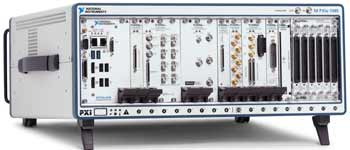
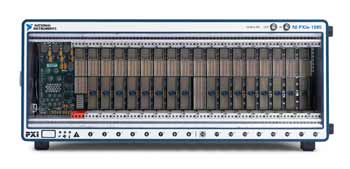
PXI Chassis: The chassis is the most visible element of the system. The PXI chassis literally provides the framework for the system and it normally can range in size from four slots up to eighteen.
The PXI chassis contains a high performance backplane enabling the cards in the system to be able to communicate rapidly with one another and in addition to this timing and triggering lines are also included.
To put this in context, a typical 3U PXI module measures approximately 100 x 160 mm (4x6 inches), and a typical 8-slot chassis is 4U high and half rack width, full width chassis contain up to 18 PXI slots.
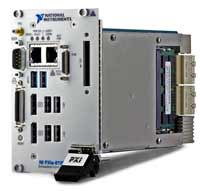
System controller: A system controller card is located in left hand slot in the rack, or alternatively control can be undertaken by a remote PC. The use of a standard PC provides a particularly cost effective, but powerful option for many users.
A typical Embedded Controller
In this way the convenience of a standard PC can be combined with the power that they are able to offer these days. However the use of a controller module is also convenient in many applications and these leverage on the wide variety of PC cards and modules that are available.
Modules or instruments that slot into the chassis: There is a very wide variety of modules that are available. They include test instruments for taking a wide variety of measurements, e.g. voltage, current, frequency as well as signal and waveform generators. However modules are also available to perform other functions including boundary scan testing, digital or analogue input and output, image acquisition, power supplies, switching and much more.
By choosing modules to meet the requirements of the overall PXI system it is possible to build up a flexible test or automation system that can be easily tailored to meet virtually any requirement.
Many PXI instrument modules or cards are register based items. They use software drivers that can be hosted on the central controller PC and these configure in the way that the PXI modules are set up for the particular application in question. By adopting this technique it enables them to provide considerably more flexibility as the controller PC is able access the instrument directly and this simplifies the embedded software in the modules while enabling a high level of flexibility to be obtained. The open architecture allows hardware to be reconfigured to provide new facilities and features that are difficult to emulate in comparable bench instruments.
In addition to this a number of vendors offer software to run the automated tests and data acquisition applications. These proprietary products provide a high degree of sophistication, while being designed to operate with PXI. In addition to this they can be configured to meet the requirements of an individual application, be it for automated test, or data acquisition.
The PXI system boasts many features that make it a flexible platform for many applications. The highlight features of the PXI standard are detailed in the table below:
What is PXI? - Major PXI Features
Feature
Specification
Operating speed
33MHz performance
Peripheral slots available per bus segment
7
Data transfers
32 bit and 64 bit
Peak data rates attainable
132 Mbytes/sec (32 bit) and 264 Mbytes/sec (64 bit) attainable
Installation
Plug and play capability
Card size
Eurocard standard cards
Connector performance
High performance connector specified
The PXI standard is a particularly successful open architecture test equipment standard that is widely used for a variety of applications. The system can be used to provide automated test, as well as fulfilling a variety of other data acquisition requirements. This makes PXI an ideal standard to be considered where automated test and data-logging are needed.
Fact of the day: It was on 26 Apr 1900 that Charles Richter was born. He was the seismologist who was the inventor of the Richter Scale that measures earthquake intensity.
Quote:The Bible tells us how to go to the heavens, not how the heavens go. Galileo Galilei (1564 - 1642) Italian physicist and astronomer
Point to ponder: Jack Kilby\'s first integrated circuit contained just one transistor. Today the Intel Itanium 2 contains 410 million.

 Read more about . . . . PXI modules.