What is Reciprocal Mixing: measurement & specification
Reciprocal mixing is a form of noise that is generated within radio receivers as a result of the phase noise appearing on the local oscillator signals.
Radio Receiver Sensitivity Includes:
Receiver sensitivity basics
Signal to noise ratio
SINAD
Noise Figure, NF
Noise floor
Reciprocal mixing
Reciprocal mixing is a form of radio receiver specification that may not be as obvious as some of the noise related specifications.
Reciprocal mixing arises from the fact that all signals, including the local oscillator signals within the receiver have a certain amount of phase noise in them.
Reciprocal mixing performance affects all forms of radio receiver ranging from cell-phones, through Wi-Fi and various forms of wireless data communications to all manner of other radio communications systems.
Reciprocal mixing results from the phase noise performance of the local oscillators within the radio receiver. In general the majority of the phase noise is generated by the main synthesizer within the receiver. As such its performance is critical to the reciprocal mixing performance of the equipment.
For receivers operating in the presence of local strong signals, the reciprocal mixing performance of the overall receiver is important. In turn this places requirements onto the synthesizers used within the receiver.
Reciprocal mixing basics
Reciprocal mixing occurs as a result of the phase noise which appears on all signals to a greater or lesser degree. The major problem for a receiver is that the phase noise spreads out either side of the local oscillator signal.
Note on the Phase Noise:
Phase noise consists of small random perturbations in the phase of the signal, i.e. phase jitter. These perturbations are effectively phase modulation and as a result, noise sidebands are generated. These spread out either side of the main signal and can be plotted on a spectrum analyzer as single sideband phase noise.
Read more about Phase Noise.
When the phase noise from the local oscillator signal is superimposed onto a strong off channel signal this can mask out a much lower level wanted signal that is within the receiver pass-band.
To look at how reciprocal mixing occurs take the case of a superheterodyne receiver tuned to a strong signal. The signal will pass through the radio frequency stages, and then in the mixer it will be mixed with the local oscillator to produce a new signal at the right frequency to pass through the IF filters. When the local oscillator is tuned away by ten kilohertz, for example the signal will no longer be able to pass through the IF filters.
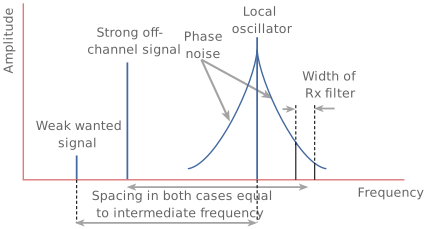
However it will still be possible for the phase noise on the local oscillator to mix with the strong incoming signal to produce a signal that will fall inside the receiver pass-band as shown. This could be sufficiently strong to mask out a weak signal within the receiver pass-band.
Reciprocal mixing measurement & specification
A number of different methods are used to define the level of reciprocal mixing. Generally they involve the response of the receiver to a large off channel signal. To perform a reciprocal mixing measurement is rarely easy. The signal generator must always be much better than the receiver, otherwise the performance of the signal generator will be measured! To overcome this many people use an old valve generator because their performance is often very good in this respect.
A measurement can be made by noting the level of audio with a BFO on from a small signal. The signal is then tuned off channel by a given amount, normally about 20 kHz and then increased until the audio level rises to the same level as a result of the phase noise from the receiver. As the noise level is dependent upon the bandwidth of the receiver this has to be specified as well. Generally a bandwidth useable for SSB is used i.e. 2.7 kHz.
For example a good HF communications receiver might have a figure of 95 dB at a 20 kHz offset using a 2.7. kHz bandwidth. This figure will improve as the frequency offset from the main channel is increased. At 100 kHz one might expect to see a figure in excess of 105 dB or possibly more.
Another way of measuring the phase noise response is to inject a large signal into the receiver and monitor the level needed to give a 3 dB increase in background noise level.
The reciprocal mixing performance of a radio receiver can be critical in some applications. The reciprocal mixing performance is particularly important in applications where weak signals are to be receiver in the presence of stronger off channel ones. Although it is a radio receiver specification or parameter which is not often quoted in the specifications, it is nevertheless still very important in some applications.
More Essential Radio Topics:
Radio Signals
Modulation types & techniques
Amplitude modulation
Frequency modulation
OFDM
RF mixing
Phase locked loops
Frequency synthesizers
Passive intermodulation
RF attenuators
RF filters
RF circulator
Radio receiver types
Superhet radio
Receiver selectivity
Receiver sensitivity
Receiver strong signal handling
Receiver dynamic range
Return to Radio topics menu . . .