Bipolar Transistor RF Mixer
Bipolar transistors, BJTs are often used to provide simple and low cost active devices for RF mixers in various RF circuit designs.
RF Mixers & Mixing Tutorial Includes:
RF mixing basics
Theory & math
Specs & data
How to buy select mixer
Transistor mixer
FET mixer
Double balanced mixer
Gilbert cell mixer
Image reject mixer
Bipolar transistors can be found in many RF mixer applications for a variety of radio and other RF circuit design applications.
The bipolar transistor mixer has been typified by the circuit designs seen in low cost radios where a single transistor is used, sometimes providing RF gain and local oscillator functions as well as being an RF mixer. Although the electronic component count and cost is low for this functionality, performance is also poor.
Bipolar transistor mixers can also be found in some RF integrated circuits and often these mixers can provide good levels of performance, even forming the basis of double balanced mixers.
Bipolar transistors are very useful as the basis of RF mixers and as such they are seen in many forms of RF mixer and in many RF designs.
Basic BJT transistor mixers
It is possible utilise a variety of different circuit configurations for a transistor mixer. Possibly the most obvious method is to apply both signals to the base of the transistor.
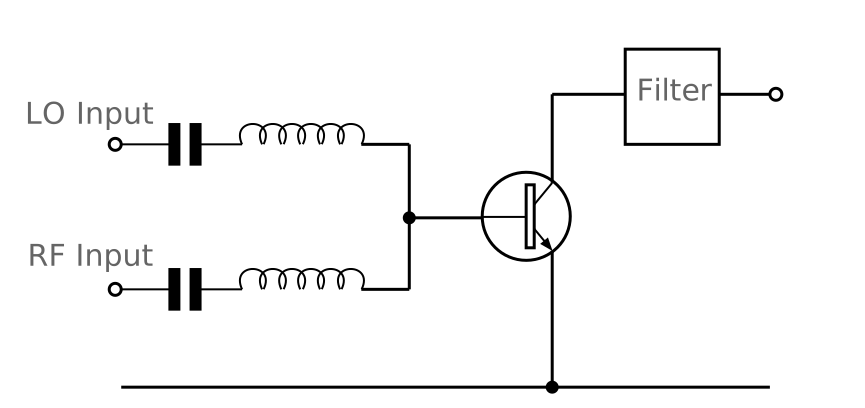
In this circuit the filter on the output is required to remove any of the high frequency LO and RF signals. Typically this circuit will be used to convert signals from a high frequency down to a much lower frequency. If the filter consists of a capacitor this can be chosen to present a short circuit to the LO and RF inputs, whilst not affecting the IF signals.
Additionally the tuned circuits on the input prevent the LO and RF signals coupling in to the opposite sources. It can be seen that these two circuits are series resonant, allowing signals through on their resonant frequency. As a result they should be be tuned to the frequency of the signal connected to it, i.e. RF input or local oscillator. This will also prevent the RF and LO leaking back into the the other input port.
A more common circuit for a transistor mixer applies the local oscillator to the base and the RF input to the emitter of the transistor.
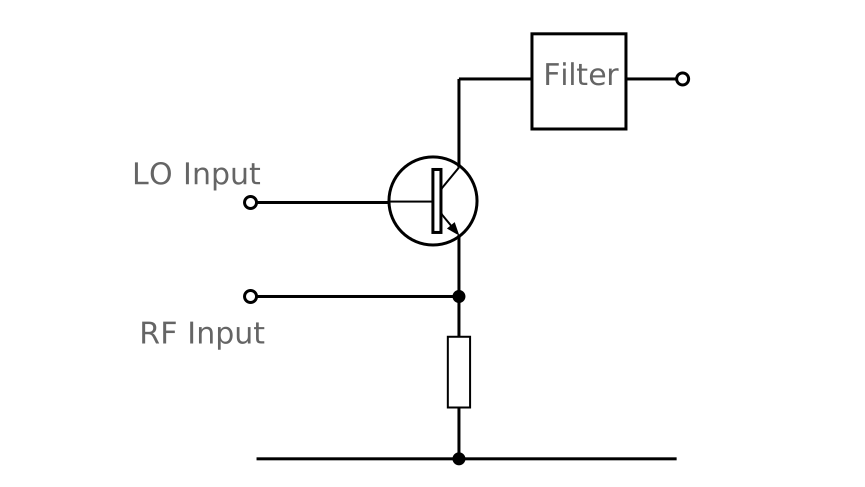
It is worth noting that the LO and RF inputs are interchanged on some circuits - the levels of the LO and the input circuitry for the two signals will need to be adjusted accordingly within the RF circuit design.
Bipolar transistor RF mixer circuits
The BJT or bipolar junction transistor is often used in many low cost applications. Here a single transistor forms the basis of the mixer in many older transistor portable radios.
The bipolar transistor mixer was ideal because it used comparatively few electronic components, and none of them were particularly expensive. t also required comparatively little local oscillator drive - an advantage in many RF design applications.
That said, the performance of the very basic one transistor RF mixer is not particularly good, but it serves well in many domestic radios where its performance is quite adequate.
The basic circuit for the mixer sees a transistor biassed using a potential divider network for the base. The RF input signal is also applied to the base.
The local oscillator signal is injected into the emitter connection of the circuit design, and hence there is no emitter bypass for additional RF gain.
The collector of this RF circuit design for the single transistor mixer has a tuned circuit - this is normally the first IF transformer and it provides selectivity to remove the unwanted signals.
This circuit is not balanced and as a result, high levels of both the local oscillator and the RF signal will appear at the output, and as they are not required, they are removed by the RF tuning on the output.
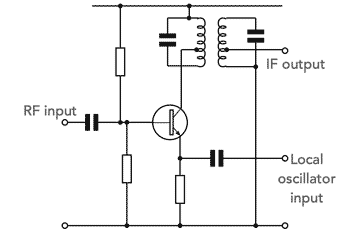
Often for long and medium wave domestic broadcast radios, the front end transistor was multipurpose providing some RF gain, local oscillator, and mixer.
It is this transistor mixer circuit that forms the basis of many circuits within transistor radios using discrete transistors. Often a self oscillating mixer is used, where a single transistor circuit based around this configuration acts as an RF amplifier with preselection, oscillator and mixer.
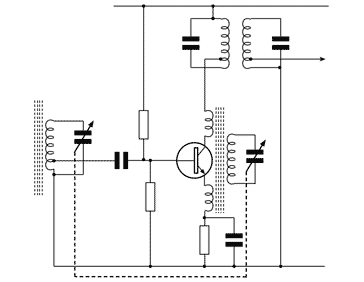
In this RF circuit design, the signal is typically picked up by a ferrite rod antenna. This coil of this electronic component together with the variable capacitor forms a tuned circuit to enable the input to be tuned and limit the reception of out of band signals.
This is applied to the base of the transistor where it is amplified and where it enters the mixing process.
The local oscillator signal is generated by the coil assembly connected to the emitter and collector circuits. Feedback from the collector to the emitter is tuned via the additional resonant circuit. The variable capacitor for this is ganged with that of the RF front end so that when the radio is tuned, both the local oscillator and RF tuning remain (almost) optimised for the frequency in use.
The transformer int he collector circuit is tuned to the intermediate frequency of the radio, and in this way the local oscillator and RF signals are removed as well as providing the adjacent channel selectivity for the radio, with the selectivity provided by further IF stages.
Again this circuit offers a high level of conversion gain, making it ideal for very low cost domestic radios. However the mixing process is not linear and it generates a lot of spurious signals, which is hardly surprising as the circuit design has to perform so many functions and it cannot be optimised for any one of them.
Other transistor mixer configurations
Although transistor mixers built around a single transistor would not be expected to provide the highest level of performance, however it is possible to considerably improve on the performance of a single bipolar transistor mixer by using more advanced circuit topologies.
One form of transistor mixer that works very well is known as the Gilbert cell. This RF mixer topology was developed in the 1960s but uses a number of transistors and other electronic components.
Using double balanced approaches, the Gilbert cell is able to offer very high levels of performance.
The Gilbert cell mixer has come into its own, being incorporated into many integrated circuits as its circuitry enables it to be incorporated very easily.
Bipolar junction transistors can be very successfully used as frequency or RF mixers. The performance naturally depends upon the electronic circuit design used, the very simple mixer oscillator circuit designs provide adequate performance, especially considering the number of electronic components used for all that functionality.
However to obtain better performance, more complex circuits are needed using additional electronic components. Circuit configurations providing double balanced mixer capabilities and the like are possible, and under these circumstances bipolar junction transistors are able to give excellent performance in RF mixer circuit designs.
More Essential Radio Topics:
Radio Signals
Modulation types & techniques
Amplitude modulation
Frequency modulation
OFDM
RF mixing
Phase locked loops
Frequency synthesizers
Passive intermodulation
RF attenuators
RF filters
RF circulator
Radio receiver types
Superhet radio
Receiver selectivity
Receiver sensitivity
Receiver strong signal handling
Receiver dynamic range
Return to Radio topics menu . . .