Image Rejection Mixer
The Image Rejection mixer is used in specialist applications where only one mix product is needed - typically to reduce filtering.
RF Mixers & Mixing Tutorial Includes:
RF mixing basics
Theory & math
Specs & data
How to buy select mixer
Transistor mixer
FET mixer
Double balanced mixer
Gilbert cell mixer
Image reject mixer
Image rejection mixers as they are sometimes known are used in a number of RF and microwave applications.
Although they are more complicated and more expensive than standard mixers, image reject mixers are can be particularly useful in reducing the overall system cost by enabling the complexity of filters to be reduced.
Image rejection mixers remove one of the two output signals from the mix process by phase cancelling techniques.
RF mixer image output
In any RF mixing or multiplication process two signals are produced, namely the sum and difference signals:
This can be seen diagrammatically:
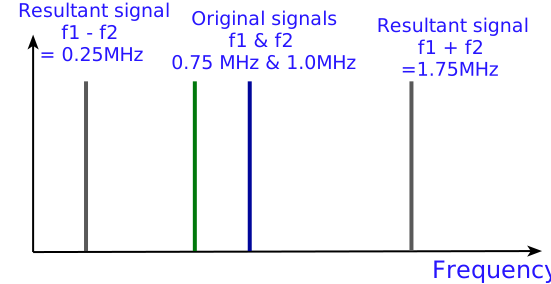
Of the two products from a mixer, normally only one is required. Often the unwanted one will fall well outside the required bandwidths and can often be removed very easily. However in some applications this is not the case and the unwanted or image product can be close to the wanted signal and can require complicated filtering to remove it sufficiently. There may also be other instances where the image signal may cause a problem.
Image reject mixer basics
In order to be able to operate, image reject mixers, image rejection mixers utilise the phasing techniques to cancel out the unwanted mix products. To achieve this an image reject mixer utilises two balanced mixers and the quadrature (90°) hybrids as shown below.
The two balanced mixers within the image reject mixer are driven in quadrature by the RF signal. The LO drive to each mixer is in-phase and the IF output is combined in quadrature.
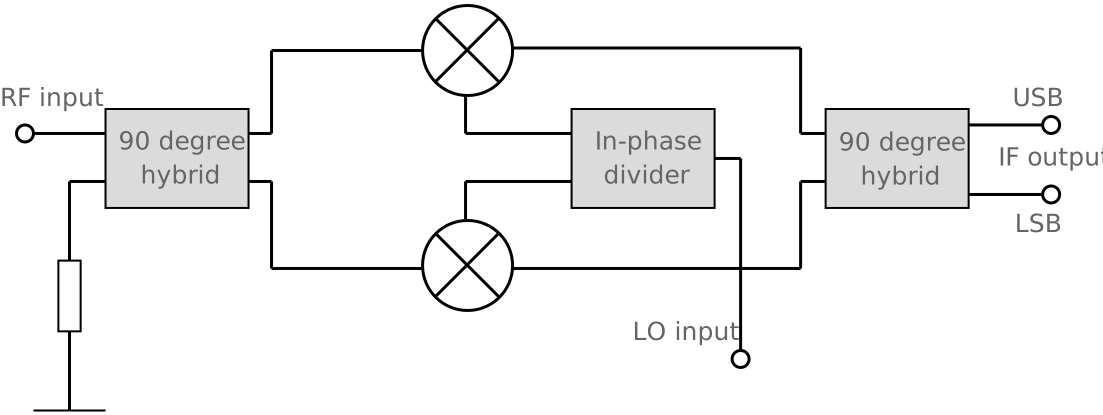
It is not possible to achieve perfect cancellation in a real image reject mixer - the mixers must be identical and as must the amplitude balance and phase shift of all the quadrature and in-phase power splitters.
Often integrated or modular image reject mixers are employed as these offer the best performance. However it is possible to achieve reasonable results with one manufactured from discrete components - levels of image rejection of around 20 dB should be obtainable using this approach. Using commercially available units levels of 35 to 40 dB should be obtained.
Image reject mixer considerations and performance
There are a number of considerations to be taken into account when using an image reject mixer.
- Level of image rejection levels: Typical levels of image rejection will vary according to the product. However typical levels of image rejection that may be achieved are often in the region of 20 - 40 dB.
- Conversion loss: The conversion loss of an image rejection mixer will be higher than that of a standard mixer as the overall loss will need to include that of the quadrature hybrids, power splitters, etc. The additional loss introduced by the these components will need to be added into the overall equation. However the level of loss is still normally acceptable - typical figures expected may be around 8 - 10 dB.
- Frequency dependence: The level of image rejection obtained with an image reject mixer is largely determined by the amplitude and phase balance within the image rejection mixer circuitry. These parameters are frequency dependent to a degree and therefore the performance of an image rejection mixer will also be frequency dependent.
Image rejection mixers tend to be a more specialist form of RF mixer. Whilst they can reduce the need for filtering in many instances, the reduction in the requirement for the filter and the resultant cost saving has to be balanced against the increased cost of the image rejection mixer. Performance also needs to be assessed. The image rejection mixer can typically provide 20 - 40 dB (as detailed above) of rejection and this may not be as much as a filter could provide. Also the insertion loss of the overall image rejection mixer needs to be considered as this is not insignificant.
Once the performance and cost aspects of using an image rejection mixer have been assessed, then it is possible to make an informed decision about the use of one.
More Essential Radio Topics:
Radio Signals
Modulation types & techniques
Amplitude modulation
Frequency modulation
OFDM
RF mixing
Phase locked loops
Frequency synthesizers
Passive intermodulation
RF attenuators
RF filters
RF circulator
Radio receiver types
Superhet radio
Receiver selectivity
Receiver sensitivity
Receiver strong signal handling
Receiver dynamic range
Return to Radio topics menu . . .