What are Electromagnetic Waves: e/m radiation
Electromagnetic waves or E/M radiation are the basic wave type that are used for radio waves, light and many more forms of radiation.
Electromagnetic Waves Tutorial Includes:
Electromagnetic waves
Radio spectrum
Microwaves & millimetre waves
Radar / IEEE band designations
Polarisation
Radio signals exist as a form of electromagnetic wave. This is the same form of radiation as light, ultra-violet, infra-red, etc., differing only in the wavelength or frequency of the radiation.
Electromagnetic waves are key to modern life. They are used in a vast number of areas, and modern life would be totally different if we were not able use them. modem communications systems, radar, and a host of other things would just be possible without them.
Electromagnetic radiation can travel through many forms of medium. Air and free space form ideal media. However conductive media like metals form a barrier through which they do not travel. There are also some media through which they can travel but are attenuated.
Electromagnetic wave applications
There is a huge level of usage of electromagnetic waves these days. They are used for applications like radio communications and broadcasting where radio signals are used to carry data in one form or another from a transmitting location to another.
The electromagnetic waves are used for everything from traditional broadcasting and radio communications to the latest mobile communications with short range 5G mmwave high data rate links as well as Wi-Fi wireless LANs and very much more.
Another application for electromagnetic waves is for navigation. There are many different techniques and systems used from the old hyperbolic systems to modern satellite navigation. These all use electromagnetic waves.
Electromagnetic waves are used for detection and monitoring. Radar is a key example of this. Radar is used for everything from position monitoring on traditional radar screens for aviation and maritime uses, to speed monitoring with doppler radars and also another applications like geophysical radar for detecting what is under the ground.
Electromagnetic waves – e/m radiation basics
Electromagnetic waves or e/m radiation has two constituents. The radiation is made from electric and magnetic components that are inseparable. The planes of the fields are at right angles to each other and to the direction in which the wave is travelling.
A traditional way of understanding what electromagnetic waves are is to think of them as synchronised oscillations of electric and magnetic fields - in other words a field consisting of both electrical and magnetic fields that oscillate together.
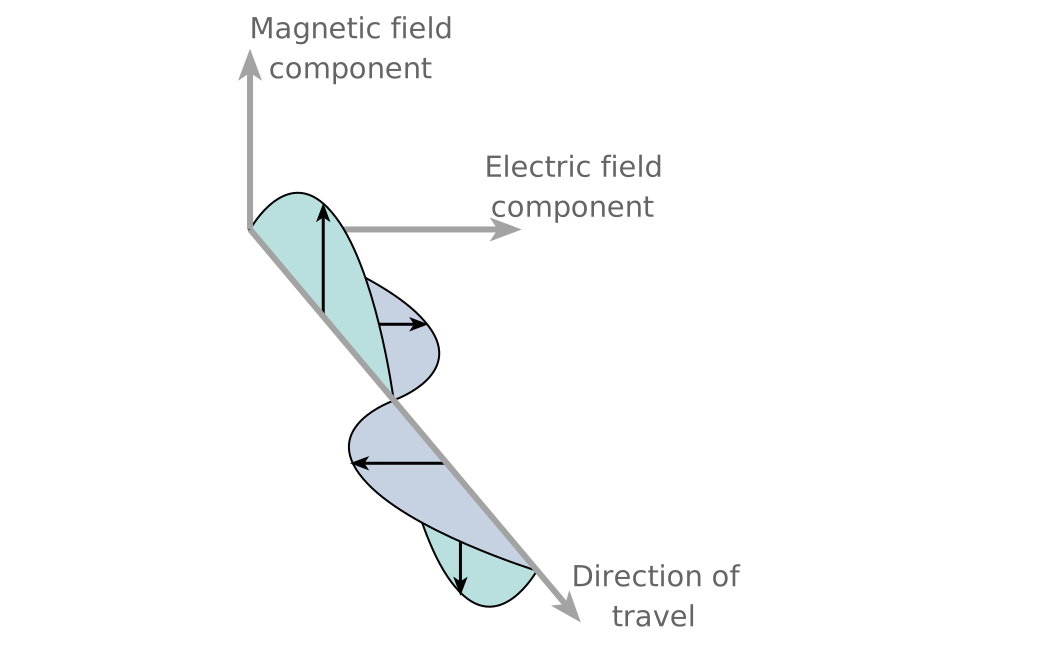
It is useful to see where the different elements of the wave emanate from to gain a more complete understanding of electromagnetic waves. The electric component of the wave results from the voltage changes that occur as the antenna element is excited by the alternating waveform.
The lines of force in the electric field run along the same axis as the antenna, but spreading out as they move away from it. This electric field is measured in terms of the change of potential over a given distance, e.g. volts per metre, and this is known as the field strength.
This measure is often used in measuring the intensity of an electromagnetic wave at a particular point. The other component, namely the magnetic field is at right angles to the electric field and hence it is at right angles to the plane of the antenna. It is generated as a result of the current flow in the antenna.
Like other forms of electromagnetic wave, radio signals can be reflected, refracted and undergo diffraction. In fact some of the first experiments with radio waves proved these facts, and they were used to establish a link between radio waves and light rays.
Key aspects of electromagnetic waves
There are a number of basic properties of electromagnetic waves, or any repetitive waves for that matter that are particularly important.
Frequency, wavelength and speed are three key parameters for any electromagnetic wave.
E/m wave speed
the speed of an electromagnetic waves was something that scientist found difficult to measure for many years. Initially they were only interested in the speed of light because the nature of electromagnetic waves was not understood.
Methods were devices and the speed of light was measured surprisingly accurately. When radio waves were discovered, one of the first measurements made was that of the speed which they travelled. This was one confirmation that they were the same form of radiation as light.
Radio waves travel at the same speed as light. For most practical purposes the speed is taken to be 300 000 000 metres per second although a more exact value is 299 792 500 metres per second.
Although exceedingly fast, they still take a finite time to travel over a given distance. With modern radio techniques, the time for a signal to propagate over a certain distance needs to be taken into account.
Radar for example uses the fact that signals take a certain time to travel to determine the distance of a target. Other applications such as mobile phones also need to take account of the time taken for signals to travel to ensure that the critical timings in the system are not disrupted and that signals do not overlap.
E/m wave wavelength
This is the distance between a given point on one cycle and the same point on the next cycle as shown. The easiest points to choose are the peaks as these are often the easiest to locate.
The wavelength was used in the early days of radio or wireless to determine the position of a signal on the dial of a radio set. Although it is not used for this purpose today, it is nevertheless an important feature of any radio signal or for that matter any electromagnetic wave.
The wavelength of a radio wave determines many aspects of electronic circuit design and RF design. Everything from the size of radio antennas to the distances allowable in printed circuit boards.
Frequency
The frequency of electromagnetic wave and in particular a radio signal is what determines its position within the radio spectrum. It is seen on the dials of radio receivers, as well as very many other items of electronic equipment
The frequency of a signal is the number of times a particular point on the wave moves up and down in a given time (normally a second). The unit of frequency is the Hertz and it is equal to one cycle per second.
This unit is named after the German scientist who discovered radio waves. The frequencies used in radio are usually very high. Accordingly the prefixes kilo, Mega, and Giga are often seen. 1 kHz is 1000 Hz, 1 MHz is a million Hertz, and 1 GHz is a thousand million Hertz i.e. 1000 MHz. Originally the unit of frequency was not given a name and cycles per second (c/s) were used. Some older books may show these units together with their prefixes: kc/s; Mc/s etc. for higher frequencies.
Frequency to Wavelength Conversion
Although wavelength was used as a measure for signals, frequencies are used exclusively today. It is very easy to relate the frequency and wavelength as they are linked by the speed of light as shown:
Where
λ = the wavelength in metres
f = frequency in Hertz
c = speed of radio waves (light) taken as 300 000 000 metres per second for all practical purposes.
Maxwell's equations
Maxwell's equations are the way in which electromagnetic waves are described mathematically.
The equations detail the way in which electromagnetic waves exist and in fact James Clerk Maxwell devised the equations before anyone knew what electromagnetic waves were.
It was not until Heinrich Hertz undertook experiments that he was able to prove that some waves he detected were the electromagnetic waves of Maxwell's equations.
As time went on, a much greater understanding was gained of these waves and it was understood that light and other forms of radiation were all the the same and were electromagnetic waves: radio waves, light, infra-red, ultraviolet, etc.
Electromagnetic waves are the key to radio and wireless communications. The fact that they can travel over vast distances as well as being reflected, refracted and diffracted means that they have been used for many years as the basis for radio communications over all distances from a few centimetres to many hundreds of thousands or millions of miles.
More Antenna & Propagation Topics:
EM waves
Radio propagation
Ionospheric propagation
Ground wave
Meteor scatter
Tropospheric propagation
Antenna basics
Cubical quad
Dipole
Discone
Ferrite rod
Log periodic antenna
Parabolic reflector antenna
Phased array antennas
Vertical antennas
Yagi
Antenna grounding
Installation guidelines
TV antennas
Coax cable
Waveguide
VSWR
Antenna baluns
MIMO
Return to Antennas & Propagation menu . . .