Standard Resistor Values: E3, E6, E12, E24, E48 & E96: E-Series
Understand the E3, E6, E12, E24, E48 & E96 series of standard resistor values: what they are, tables of values, why they are used, how they were derived, etc.
Resistor Tutorial Includes:
Resistors overview
Carbon composition
Carbon film
Metal oxide film
Metal film
Wirewound
SMD resistor
MELF resistor
Variable resistors
Light dependent resistor
Thermistor
Varistor
Resistor colour codes
SMD resistor markings & codes
Resistor specifications
Where & how to buy resistors
Standard resistor values & E series
Resistor values are organised into a set of different series of preferred values or standard resistor values.
These standard resistor values have a logarithmically based sequence and this enables the different values to be spaced in such a way that they relate to the component tolerance or accuracy.
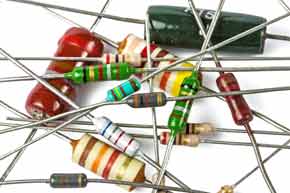
Resistor tolerances are generally ±20%, ±10% ±5%, ±2% and ±1%. More accurate tolerances are available for some resistors, but these are not as widely available and costs are higher.
By having these standard resistor values, electronic components from a variety of manufacturers can be chosen, making sourcing much easier and the cost of the components much less.
Interestingly the same approach and sets of value ranges are used by a number of other electronic components including capacitors, Zener diodes, inductors, etc.
By keeping to the more commonly used values in any electronic circuit design, not only are they more easily available from electronic component distributors, but costs can be reduced because the number of component types on any printed circuit board or other assembly can be reduced, and this make significant cost savings in manufacture.
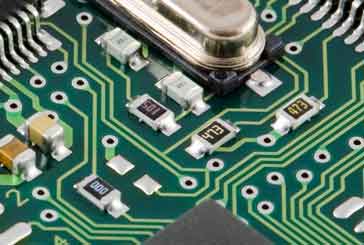
Even SMD components follow the E-Series values
E series resistor values
The standard resistor values are organised into a set of series of values known as the E-series. The different values are spaced such that the top of the tolerance band of one value and the bottom of the tolerance band of the next one do not overlap.
Take as an example a resistor that has a value of 1 ohm and a tolerance of ±20%. The actual resistance at the top of the tolerance band is 1.2 ohms. Take then a resistor with a value of 1.5 ohms. The resistance of this component at the bottom of its tolerance band is 1.2 ohms. This process is followed through for all the values in a decade, creating a set of standard resistor values for each tolerance.
The different sets of standard resistor values are known by their E-series numbers: E3 has three resistors in each decade, E6 has six, E12 has twelve, and so forth.
The most basic series within the E range is the E3 series which has just three values: 1, 2.2 and 4.7. This is seldom used as such because the associated tolerance is too wide for most of today's applications, although the basic values themselves may be used more widely to reduce stock holding.
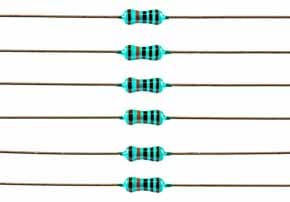
The next is the E6 series with six values in each decade for a ±20% tolerance, E12 series with 12 values in each decade for a ±10%, E24 series with 24 values in each decade for a ±5% tolerance. Values for resistors in these series are given below. Further series (E48 and E96) are available, but are not as common as the ones given below.
The E6 and E12 resistors are available in virtually all types of resistor. However the E24 series, being a much closer tolerance series is only available in the higher tolerance types.
The metal film resistors that are in common use today as well as metal oxide film resistors are available in the E24 series as are several other types. Carbon types are rarely available these days and in any case would only available in the lower tolerance ranges as their values cannot be guaranteed to such a close tolerance.
The E series preferred or standard resistor value ranges are internationally accepted and have been adopted by international standards organisations. The EIA (Electrical Industries Association) which is based in North America is one organisation that has adopted the system and as a result the resistor value series are often referred to as the EIA standard resistor values.
| Summary of EIA Preferred or Standard Resistor value Series | ||
|---|---|---|
| E Series | Tolerance (Sig Figs) |
Number of values in each decade |
| E3 | >20% | 3 |
| E6 | 20% | 6 |
| E12 | 10% | 12 |
| E24 | 5% [normally also available in 2% tolerance] |
24 |
| E48 | 2% | 48 |
| E96 | 1% | 96 |
| E192 | 0.5%, 0.25% and higher tolerances | 192 |
Note: The metal film resistors now widely used for axial resistors and the surface mount resistors are normally available in 1% and 2% tolerance ratings even when included in the E24, E12, E6 and E3 ranges.
The E series values are split into two groups which have slightly different numbering, although they follow the same basic numerology:
- Up to E24: For this lower end of the E series used for resistors, capacitors and other component values, the main difference is that the numbers have only two significant figures as this is all that is really needed
- E48 to E192: For the E48 to E192 series there significant figures are used for all the values as it is necessary to defined them more accurately in view of the higher number of values needed.
It can be seen that some of the values in the E24 series do not exist in E48 to E192 series. This arises dues to the different rounding rules used.
Preferred and standard values of other components
The system for adopting standard electronic component values works very well for resistors. It is also equally applicable for other electronic components. The same concept of using values in a standard list that are determined by the tolerance of the components is equally applicable.
The E-series is also used for capacitors, inductors and a number or some other electronic components and it applies to both leaded and surface mount devices.
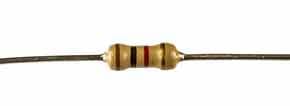
Typically for capacitors some of the lower order series are used - E3, E6 as the values on many capacitors do not have a high tolerance. Electrolytic capacitors typically have a very wide tolerance, although others such as many ceramic types have a much tighter tolerance and many be available in ranges conforming to the E12 or even E24 values.
Another example of electronic components that follow the EIA E series preferred values is Zener diodes for their breakdown voltages. The Zener diode standard voltages typically conform to the E12 values although E24 series voltage values are also available - especially 5.1 volt Zener diode for 5 volt rails. Again, this applies to both styles of electronic component: leaded and surface mount devices.
As with other electronic components, opting for Zener diode values in the E12 rather than E24 range will generally mean that the values are more widely available from sources like electronic component distributors. That said the 5.1 volt Zener diodes that have an E24 value are commonly used as this corresponds to the standard logic supply rail voltage.
Resistor E series
The EIA preferred values or standard resistor values can be summarised in a tabular form to give the different values within each decade.
Current resistor technology enables very close tolerance levels to be achieved, yet there is still a great benefit in using resistors even from the E3 series.
By using resistors from the E3 series or even E6, this reduces the number of different types of resistor used in a design and this considerably simplifies purchasing and manufacturing processes as wella s reducing costs. Often designs try to keep to the E3 or E6 standard resistor values, only using those in the E12, E24, E48 or E96 if absolutely necessary.
One example where values can be kept within the E3 series occurs with digital design where a pull up or pull down resistor is needed. The exact value is of little consequence - only a value within the approximate region is needed. For these resistors the value can be selected within the E3 series.
For analogue designs a little more flexibility is often needed, but even E6 or E12 standard resistor values can be used without difficulty in most electronic circuit designs. Occasionally E24, E48, E96 or even E192 series values may needed for high accuracy and close tolerance requirements: filters, oscillators, measurement applications, etc.
Resistor E series tables of values
Below are the common resistor values used in electronic circuit designs. They are the standard E3, E6, E12, E24, E48 and E96 resistor values.
| E3 Standard Resistor Series | ||
|---|---|---|
| 1.0 | 2.2 | 4.7 |
The E3 series resistors are the most widely used and hence these values will be the most common resistor values used within the electronics industry. They are particularly useful for resistor values that are not in any way critical. By keeping to this series, the number of different components in any electronic circuit design can be reduced and this can help reduce manufacturing costs by reducing inventory and the additional management and set up required for additional component types in a design.
| E6 Standard Resistor Series | ||
|---|---|---|
| 1.0 | 1.5 | 2.2 |
| 3.3 | 4.7 | 6.8 |
The E6 series resistor values are also widely used within the industry. They provide a wider range of common resistor values that can be used in electronic circuit designs and this can be essential for many analogue designs.
| E12 Standard Resistor Series | ||
|---|---|---|
| 1.0 | 1.2 | 1.5 |
| 1.8 | 2.2 | 2.7 |
| 3.3 | 3.9 | 4.7 |
| 5.6 | 6.8 | 8.2 |
| E24 Standard Resistor Series | ||
|---|---|---|
| 1.0 | 1.1 | 1.2 |
| 1.3 | 1.5 | 1.6 |
| 1.8 | 2.0 | 2.2 |
| 2.4 | 2.7 | 3.0 |
| 3.3 | 3.6 | 3.9 |
| 4.3 | 4.7 | 5.1 |
| 5.6 | 6.2 | 6.8 |
| 7.5 | 8.2 | 9.1 |
| E48 Standard Resistor Series | ||
|---|---|---|
| 1.00 | 1.05 | 1.10 |
| 1.15 | 1.21 | 1.27 |
| 1.33 | 1.40 | 1.47 |
| 1.54 | 1.62 | 1.69 |
| 1.78 | 1.87 | 1.96 |
| 2.05 | 2.15 | 2.26 |
| 2.37 | 2.49 | 2.61 |
| 2.74 | 2.87 | 3.01 |
| 3.16 | 3.32 | 3.48 |
| 3.65 | 3.83 | 4.02 |
| 4.22 | 4.42 | 4.64 |
| 4.87 | 5.11 | 5.36 |
| 5.62 | 5.90 | 6.19 |
| 6.49 | 6.81 | 7.15 |
| 7.50 | 7.87 | 8.25 |
| 8.66 | 9.09 | 9.53 |
Resistors and indeed, other forms of electronic component within the E96 series are rarely used, although they are needed in certain electronic designs for very close tolerance requirements. Being less commonly used, they may not be as widely available though electronic component distributors and they are likely to be more expensive, although there should not be too much difficulty in obtaining them.
| E96 Standard Resistor Series | ||
|---|---|---|
| 1.00 | 1.02 | 1.05 |
| 1.07 | 1.10 | 1.13 |
| 1.15 | 1.18 | 1.21 |
| 1.24 | 1.27 | 1.30 |
| 1.33 | 1.37 | 1.40 |
| 1.43 | 1.47 | 1.50 |
| 1.54 | 1,58 | 1.62 |
| 1.65 | 1.69 | 1.74 |
| 1.78 | 1.82 | 1.87 |
| 1.91 | 1.96 | 2.00 |
| 2.05 | 2.10 | 2.16 |
| 2.21 | 2.26 | 2.32 |
| 2.37 | 2.43 | 2.49 |
| 2.55 | 2.61 | 2.67 |
| 2.74 | 2.80 | 2.87 |
| 2.94 | 3.01 | 3.09 |
| 3.16 | 3.24 | 3.32 |
| 3.40 | 3.48 | 3.57 |
| 3.65 | 3.74 | 3.83 |
| 3.92 | 4.02 | 4.12 |
| 4.22 | 4.32 | 4.42 |
| 4.53 | 4.64 | 4.75 |
| 4.87 | 4.99 | 5.11 |
| 5.23 | 5.36 | 5.49 |
| 5.62 | 5.76 | 5.90 |
| 6.04 | 6.19 | 6.34 |
| 6.49 | 6.65 | 6,81 |
| 6.98 | 7.15 | 7.32 |
| 7.50 | 7.68 | 7.87 |
| 8.06 | 8.25 | 8.45 |
| 8.66 | 8.87 | 9.09 |
| 9.31 | 9.53 | 9.76 |
The E192 series of standard resistor values also exist, but their use is much smaller than those in the other ranges given above. Their tolerance is either 0.5 or 0.25% and this results in increased costs along with the fact that there is a much higher number of resistors in the range.
Although resistors in ranges up to E24 are widely available, it often helps in any design to focus on using as small a number of resistor values as possible. This will reduce the number of different components in a design and for large scale production, this will help reduce costs.
Development of E-series values
In the early days of radio and electronics, in the first half of the twentieth century, there was little or no standardisation of values. The values chosen for electronic components like resistors and capacitors were determined by different manufacturers.

This created a number of difficulties for electronic circuit design because often the supplier needed to be identified so that the electronic component value could then be chosen.
With the onset of the Second World War and a great increase in the manufacture of radio and electronic devices and equipment, developers and manufacturers needed use specific component values for their designs rather than the multiplicity of variations available from different component manufacturers.
A further impetus came about after the Second World War with the introduction and the significant rise in the use of consumer electronic devices and equipment.
To meet the demand for the standardisation needed, an organisation known as the International Electrotechnical Organisation started work on a standard in 1948. The first release of their document was in 1952 and then this was later updated to become document IEC 60063:nnnn, where nnnn is the date of the latest release.
The E series resistor values are used universally and provide a very useful selection of resistors to meet the requirements of any situation. The series is also used as the basis for other electronic components including capacitors, and inductors, etc
Resistors of all types use the E series values, both SMD resistors as well as leaded ones. In fact the E series is used for all electronic components like resistors capacitors and inductors whether leaded or surface mount devices.
More Electronic Components:
Batteries
Capacitors
Connectors
Diodes
FET
Inductors
Memory types
Phototransistor
Quartz crystals
Relays
Resistors
RF connectors
Switches
Surface mount technology
Thyristor
Transformers
Transistor
Unijunction
Valves / Tubes
Return to Components menu . . .