
IEEE 802.11a Wi-Fi Standard
IEEE 802.11a was one of the first Wi-Fi standards to be launched - it provided the capability for raw data speeds of up to 54 Mbps at 5 GHz.
WiFi IEEE 802.11 Types Includes:
Standards
802.11a
802.11b
802.11g
802.11n
802.11ac
802.11ad WiGig
802.11af White-Fi
802.11ah Sub GHz Wi-Fi
802.11ax Wi-Fi 6
802.11be Wi-Fi 7
802.11 topics:
Wi-Fi IEEE 802.11 basics
Standards
Wi-Fi Alliance generations
Security
Wi-Fi Bands
Router location & coverage
How to buy the best Wi-Fi router
IEEE 802.11a was the first version in the IEEE 802.11 series of Wi-Fi or Wireless Fidelity system. It defined a Wi-Fi format for providing wireless connectivity in the 5 GHz ISM band to give raw data speeds of up to 54Mbps.
Although, alphabetically it is the first standard in the 802.11 series, it was released in 1999 at the same time as IEEE 802.11b which was aimed at connectivity using the 2.4 GHz ISM band.
Using the technology of the time, IEEE 802.11a was more costly and a little more difficult to implement as it operated at 5 GHz rather than 2.4 GHz and as a result it was less widely used.

Nevertheless, 802.11a provided a very high level of performance for its day, enabling wireless LAN technology to be implemented and used for the first time in a meaningful way.
As time progressed more devices started to use 802.11a, but when this started to occur, new versions of the standard like 802.11n appeared which overtook the "a" version. In fact 802.11n was a dual band version of the standard operating on both 2.4 and 5 GHz and offering data speeds of up to 600 Mbps.
Not surprisingly, 802.11a is rarely used these days and very few devices are operational, although many modern devices can link to such devices in a legacy mode.
802.11a specification
802.11a boasted an impressive level of performance for its time. It was able to transfer data with raw data rates up to 54 Mbps and at the time it was thought to have a good range, although it could not provide the maximum data rate at its extremes.
Even though the raw data rate of 54 Mbps was the headline rate, this was for all the data being transferred over an ideal link and it included all the management overhead data as well.
In reality the data rates for the payload data itself were much less, and rates achieved were normally much less than half the headline rate. Nevertheless, the rates were still very good for the day and way above what other wireless communications systems and wireless networks could achieve.
It must be remembered that this variant was launched in 1999 when the wireless communications landscape was very different to what it is today.
The main specifications and parameters for 802.11a are summarised in the table below.
| Summary of 802.11a Wi-Fi Specification Parameters |
|
|---|---|
| Parameter | Value |
| Date of standard approval | July 1999 |
| >Maximum data rate (Mbps) | 54 |
| Typical data rate (Mbps) | 25 |
| Typical range indoors (Metres) | ~30 |
| Modulation | OFDM |
| RF Band (GHz) | 5 |
| Number of spatial streams | 1 |
| Channel width (MHz) | 20 |
The 802.11a standard uses basic 802.11 concepts as its base, and it operated within the 5GHz Industrial, Scientific and Medical, ISM, band enabling it to be used worldwide in a licence free band. The modulation format used was Orthogonal Frequency Division Multiplexing (OFDM) to enable it to transfer raw data at a maximum rate of 54 Mbps, although a more realistic practical level is in the region of the mid 20 Mbps region.
The data rate could be reduced to 48, 36, 24, 18, 12, 9 then 6 Mbit/s if required. 802.11a had 12 non-overlapping channels, 8 dedicated to indoor and 4 to point to point.
802.11a modulation format
802.11a used orthogonal frequency division multiplex. In using this type of waveform for a wireless communications system, it was well ahead of its time.
The mobile phone or mobile communications technology of the day was aiming to use CDMA for the forthcoming 3G system, and CDMA was the accepted approach fort he time for many systems.
OFDM used a large number of close spaced carriers, each carrying a low data rate signal and spaced by 1/T where T was the time for the data rate. This significantly reduced the intercarrier interference.
In fact it can be seen that the contributions from the sidebands of the different carriers fall to zero on the frequencies for the adjacent carriers./p>
The other advantage of OFDM was that if selective fading affected some of the carriers, then the overall sinal was able to accommodate this.
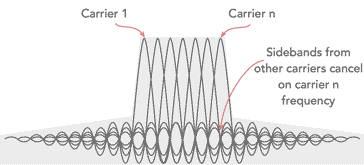
OFDM had many advantages as it enabled the overall signal to carry high data rates, while each of the many carriers in the waveform carried a low data rate. This approach made the signal resilient to reflections and unequal propagation for all the carriers.
Note on OFDM:
Orthogonal Frequency Division Multiplex, OFDM is a form of signal format that uses a large number of close spaced carriers that are each modulated with low rate data stream. The close spaced signals would normally be expected to interfere with each other, but by making the signals orthogonal to each other there is no mutual interference. The data to be transmitted is shared across all the carriers and this provides resilience against selective fading from multi-path effects.
Read more about OFDM, Orthogonal Frequency Division Multiplexing.
The OFDM signal used for 802.11 comprised 52 subcarriers. Of these 48 were used for the data transmission and four were used as pilot subcarriers.
The separation between the individual subcarriers was 0.3125 MHz. This resulted from the fact that the 20 MHz bandwidth was divided by 64. Although only 52 subcarriers were used, occupying a total of 16.6 MHz, the remaining space was used as a guard band between the different channels.
A variety of forms of modulation were used on each of the 802.11a subcarriers. BPSK, QPSK, 16-QAM, and 64 QAM were employed as the conditions permit. For each set data rate there was a corresponding form of modulation that is used.
Within the signal itself the symbol duration was 4 microseconds, and there was a guard interval of 0.8 microseconds.
| Data rate (Mbps) | Modulation | Coding rate |
|---|---|---|
| 6 | BPSK | 1/2 |
| 9 | BPSK | 3/4 |
| 12 | QPSK | 1/2 |
| 18 | QPSK | 3/4 |
| 24 | 16-QAM | 1/2 |
| 36 | 16-QAM | 3/4 |
| 48 | 64-QAM | 1/2 |
| 54 | 64-QAM | 3/4 |
As with many data wireless communications systems, the generation of the signal was performed using digital signal processing techniques and a baseband signal was generated.
This signal was then upconverted to the final frequency. Similarly for signal reception, the incoming 802.11a signal was converted down to baseband and converted to its digital format after which it was processed digitally.
Although the use of OFDM for a mass produced systems such as 802.11a may appear to have been particularly complicated, it offered many advantages. The use of OFDM provides a significant reduction in the problems of interference caused by multipath effects.
The use of OFDM also ensured that there was efficient use of the radio spectrum, which even in these early days of wireless LANs and general wireless communications could be an issue.
802.11 frequency spectrum
802.11a used the 5 GHz ISM band which was relatively sparsely used in its day. The 802.11b wireless LAN standard used 2.4 GHz and even though it was much less used than it is today, congestion could still be an issue. The 802.11b signals competed with Bluetooth, other wireless communications systems including Zigbee and a number of others. Tis was on top of interference caused by the use of microwave ovens which also used this spectrum.
802.11a originally had 12 or 13 non-overlapping channels, 12 that were used indoor wireless connectivity and 4 or 5 that were intended for outdoor point to point configurations.
Originally not all the channels were available in all countries in view of the radio regulatory differences, but as time has advanced the 5 GHz band has become increasingly important for wireless communications and has been widened in soem countries.
In terms of the radio propagation characteristics themselves of the 5 GHz band used by 802.11a WLAN system the wider bandwidth meant that higher data rates could be achieved, but the 5 GHz signals suffered greater elvels of attenuation when penetrating walls and other objects. This meant that the range for wireless communications systems using these frequencies could be slightly less
The adoption of the IEEE 802.11a standard was less than that of 802.11b as a result of the higher frequencies involved. Although technology has moved on significantly since then the 5GHz requirement for 802.11a meant that it was considerably less widely deployed than the “b” version which operated at 2.4 GHz. Also Wi-Fi hotspots tended to focus less on 802.11a. Despite this Wi-Fi as a whole moved forwards considerably and 802.11a was used, but less than other versions.
Wireless & Wired Connectivity Topics:
Mobile Communications basics
2G GSM
3G UMTS
4G LTE
5G
Wi-Fi
Bluetooth
IEEE 802.15.4
DECT cordless phones
Networking fundamentals
What is the Cloud
Ethernet
Serial data
USB
LoRa
VoIP
SDN
NFV
SD-WAN
Return to Wireless & Wired Connectivity