As technology has developed, so too spectrum analyzer technology has moved on.
Today there are several different types of spectrum analyzer technology that can be used. Selecting the required type of spectrum analyzer enables the best test instrument to be chosen for the given application, whilst also not incurring an unnecessary outlay.
Spectrum analyser types & technologies
Like any item of test equipment, there are several types of spectrum analyzer that can be found. The various types of analyzer perform in different ways, although their purpose is the same: to analyze the frequency spectrum, looking at the signals.
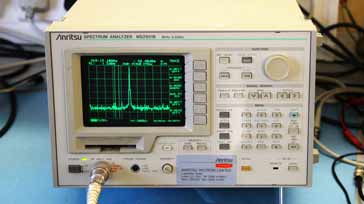
Swept or superheterodyne spectrum analyzer: A swept or superheterodyne spectrum analyzer is the traditional form of test instrument. This type of spectrum analyzer formed the mainstay of spectrum analysis testing for many years and relied on analogue techniques in the main until recent years. Although many modern types of spectrum analyzer include a down-conversion to place the signal into the required range for digitising the signal, they use digital techniques in the main. The older swept types of spectrum analyzer rely on analogue techniques. Superheterodyne / swept type of spectrum analyzer
Using analogue techniques it converts the frequency down to a fixed intermediate frequency which has filters of the required bandwidths. These can be switched to the required value. The scan is generated by a saw tooth generator that drives the scan across the screen at the same time as varying the local oscillator linearly across the frequency band. The amplitude of the signal at any frequency is displayed in the vertical axis. . . . . . Read more about the superheterodyne or swept spectrum analyzer.
Digital FFT spectrum analyzer: Digital technology is now widely used in spectrum analyzers. It is more cost effective and can provide better performance than ones using all analogue techniques. In a digital spectrum analyzer, the signals are converted into a digital format, and the signals analysed using Fast Fourier Transforms, FFTs. The signals are then converted into a format to be displayed or analysed further by a test system. . . . . . Read more about the FFT spectrum analyzer.
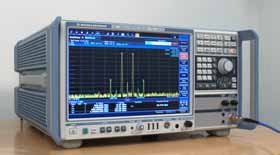
Real time spectrum analyzer: A real time spectrum analyzer is one in which the manipulation of the FFTs is undertaken very fast, i.e. virtually in real time. This enables many signals to be captured and detected that may not otherwise be visible. Real time spectrum analyzer
This form of analyzer continually captures a band of frequencies which it then analyses to display the spectrum - capturing a whole band at once enables transient effects to be seen.
. . . . . Read more about the Real time spectrum analyzer.
PXI spectrum analyzer: Many test instruments are available in a PXI format. PXI is a standard in which test instruments are contained on a card that can be incorporated into a PXI rack. PXI, or PCI eXtensions for Instrumentation is a rack format that is widely used for test instrumentation, data acquisition and control.
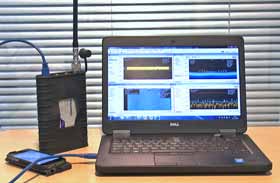
USB spectrum analyzer: Many lower cost instruments have been developed that are connected to a PC via a USB interface. This enables them to use the processing power of the computer to perform the processing and display the results, thereby saving a considerable degree of cost.
Typical USB spectrum analyzer . . . . . Read more about the USB spectrum analyzer.
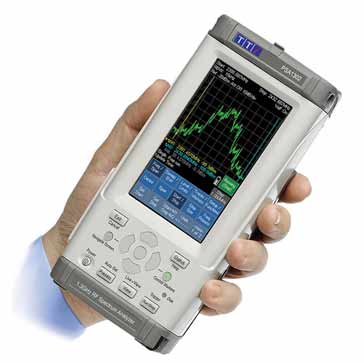
Handheld spectrum analyzer: Spectrum analyzer are also made in small handheld formats. This type of spectrum analyzer obviously does not have the same performance as the larger bench top instruments. However this type of spectrum analyzer is very useful for field service applications where radio or wireless transmissions or other radio frequency signals need to be monitored and the spectrum needs to be checked.
Typical handheld type of spectrum analyzer
Audio analyzer: This type of spectrum analyzer is focussed on analysing audio spectra. As such their upper frequency limits are much lower.
These are the most widely used forms of spectrum analyse that are available. Although the swept spectrum analyzer using only analogue techniques is largely out dated, some are still available on the second hand market and are still able to provide good service.
Like the choice of any test instrument, the selection of a spectrum analyzer depends upon many factors: performance, cost; availability and many other factors all come into play. Understanding the different types of analyzer and how they work enables the correct test instrument to be chosen.
Fact of the day: It was on 26 Apr 1900 that Charles Richter was born. He was the seismologist who was the inventor of the Richter Scale that measures earthquake intensity.
Quote:I suppose leadership at one time meant muscles; but today it means getting along with people. Mahatma Gandhi
Point to ponder: In 1922 the RCA company sold about 1.25 million receiving valves (tubes). By 1924 this rose to 11.35 million.