Signature Analyzer : signature analysis
The signature analyzer was used to provide a simple and easy way of fault finding on logic boards by utilising known patterns or signatures on a data line
Signature analyzer includes:
Signature analyzer basics
The signature analyzer was a form of test instrument that was used in the 1980 and 1990s to analyzer the patterns of data on a line. With a known input, a set pattern or signature would appear at given points on the circuit if it was working correctly.
The signature analyzer was a useful tool when boards consisted of logic ICs, but with increasing complexity the signature analyzer has fallen out of favour.
In its day, the signature analyzer was a test instrument that provided an easy means of testing logic boards, especially in the field to check their operation and undertake basic fault finding.
Digital testing / logic analysis options
When testing and analysing digital or logic circuits there are several options that are available. Each of these has its own advantages and limitations and a choice can be made dependent upon these.
- Logic probe: This is a very simple instrument used to detect logic states, or give a very basic indication of a changing logic state. It typically has a single LED to indicate the logic state. However it gives no real indication whether any logic pattern is correct.
- Oscilloscope: Oscilloscopes can see the waveforms present at various points of a circuit. They are excellent for looking at waveforms, and waveform shapes, but they are not so convenient for looking at logic patterns.
- Logic analyzer: A logic analyser is the ultimate tool for analysing logic patterns. However they can be expensive and more complicated to drive. Often their operation requires a more in-depth knowledge of processor and logic circuitry in general and the particular board in question. Typically a logic analyzer may be used with an associated computer to undertake all the testing required.
- Signature analyzer: Signature analysers are able detect digital waveform patterns. These are typically indicated by their hex value making it easy to define the pattern at a given point in the circuit under given conditions. These analysers are idea for field repair and other similar applications where simple analysis of complex waveforms is required.
The signature analyser was a useful form of test instrument for analysing digital or logic patterns in a circuit in some circumstances. It was often ideal for field repair and applications where it could detect logic patterns in a circuit under given conditions, thereby enabling detection of correct or incorrect operation of a circuit or board.
Signature analyzer basics
A signature analyzer is normally used for checking data on given nodes within a logic system such as a microprocessor board. A known operational scenario is set up, e.g. a test mode, and the data on various nodes may be monitored. The signature analyzer converts the serial data into a hexadecimal equivalent of the data pattern - this is the signature. Typically this signature is four digits long, although different signature analyzers may have different lengths.
The basic signature analyser takes in the input from the node under test and using a clock from the system. Start and stop pulses are captured to start and end the sample. The pulses from the node under test are then passed into a shift register to provide the hexadecimal equivalent of the waveform.
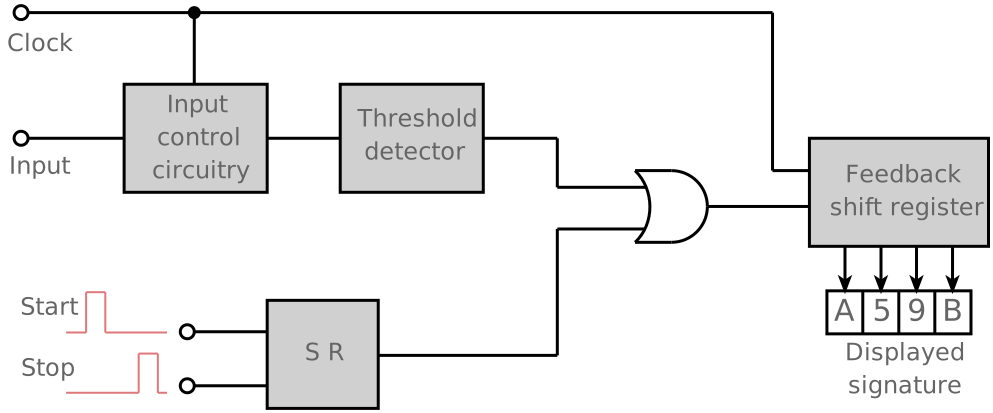
If the signature captured by the signature analyzer aligns with that of the same node on a known good board, then this indicates this area is operating correctly.
By probing different areas of a board with the signature analyzer, and comparing the results with expected values, often detailed in a repair and service manual, it is possible to locate the problem area.
Signature analyser test instrument
A typical signature analyser will consist of the basic instrument with a number of switches, inputs, outputs and a display like the image shown below.
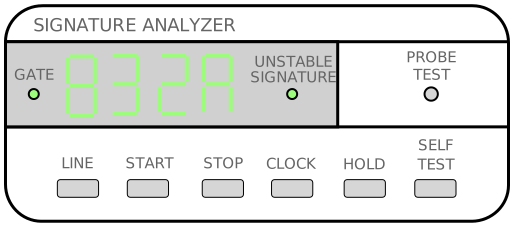
On the front panel are several different items:
- Gate: This indicates the input gate of the signature analyser is open and samples are being taken.
- Display: The display indicates the signature taken, and in this case it shows the value '832A' corresponding to the hex value of the signature of the data being sampled.
- Unstable signature: As the name implies, this indicates that the signature is unstable, i.e. varying and the data is not satisfactory.
- Probe test: This is a connection and it is used for testing the probe to ensure the correct operation of the probe and the system.
- Line: This is the power On / Off switch
- Start: This is used to select which edge is required to initiate the sampling period - positive or negative going edge.
- Stop: Like the start, this is used to select which edge is required to terminate the sampling period - positive or negative going edge.
- Clock: This is used for selecting which edge of the clock pulse is used for sampling the line state.
- Hold: This is used to hold a single signature regardless of any changes in the incoming date, for example if the input conditions change, etc..
- Self-Test: This is used to put the test instrument into a self-test mode for checking he operation of the instrument as well as the probes.
In addition to the test instrument itself, a special test pod may also be used. Using a specific test pod and enables the circuitry to be minimally loaded and the signal integrity to be maintained as best as is possible reducing issues caused by the effects of loading and long leads on rise times, etc..
The test pod includes the test probe for the points to be monitored as well as the clock input, etc.
Although signature analyzers are not normally used for new equipment, there is always the possibility that they may be used for older equipment that was designed when signature analyzers were used.
The concept of the signature analyzer enabled a simple to use test instrument to be used for fault finding, and ascertaining the operation of complex logic boards. Typically the operation of the board could be verified and if faulty it could be returned to base for a full test, possibly on an automatic functional tester.
More Test Topics:
Data network analyzer
Digital Multimeter
Frequency counter
Oscilloscope
Signal generators
Spectrum analyzer
LCR meter
Dip meter, GDO
Logic analyzer
RF power meter
RF signal generator
Logic probe
PAT testing & testers
Time domain reflectometer
Vector network analyzer
PXI
GPIB
Boundary scan / JTAG
Data acquisition
Return to Test menu . . .