Phase Noise in PLL Frequency Synthesizers
Phase noise is an important factor in PLL frequency synthesizer design - it emanates from different elements of the circuit.
Frequency Synthesizer Tutorials Includes:
Synthesizer basics
PLL / indirect synthesizer
PLL digital synthesizer
PLL analogue synthesizer
Multiloop synthesizer
Fractional N synthesis
Synthesizer phase noise
How to design synthesizer for low phase noise
Direct digital synthesizer, DDS
Phase noise is a very important factor in PLL synthesizer design as it can have a major effect on the overall performance of the system using the synthesizer.
Phase noise in PLL frequency synthesizers can affect performance factors like reciprocal mixing, bit error rate and overall spectral purity. Noise from a signal in one channel can spill over into adjacent channels causing interference to other users.
With pressure on spectrum increasing, it is necessary to ensure that the phase noise performance meets the requirements for the system, and as such it is normally a key design parameter for any PLL frequency synthesizer.
Understanding how the phase noise is generated and how it affects systems enables the careful balances to be made between a variety of issues when the RF design of the synthesizer is undertaken.
What is phase noise?
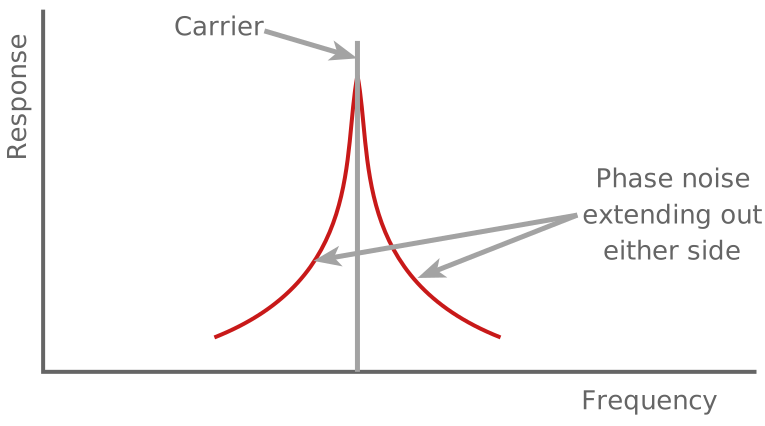
Phase noise is present on all signals to some degree and it is caused by small phase (and hence frequency) perturbations or jitter on the signal. It manifests itself as noise spreading out either side from the main carrier
For most free running oscillators, the phase noise is generally higher the closer to the carrier and then it decreases as the frequency offset from the carrier increases.
Note on the Phase Noise:
Phase noise consists of small random perturbations in the phase of the signal, i.e. phase jitter. These perturbations are effectively phase modulation and as a result, noise sidebands are generated. These spread out either side of the main signal and can be plotted on a spectrum analyzer as single sideband phase noise.
Read more about Phase Noise.
Some signal sources are better than others. Crystal oscillators are very good and have very low levels of phase noise. Free running variable frequency oscillators normally perform well. Unfortunately synthesizers, and especially those based around phase locked loops, do not always fare so well unless they are well designed.
If significant levels of phase noise are present on a synthesizer used as a local oscillator in a receiver, it can adversely affect the performance of the radio in terms of reciprocal mixing.
Phase noise in synthesizers
Each of the components in a frequency synthesizer produces noise that will contribute to the overall noise that appears at the output. The actual way in which the noise from any one element in the loop contributes to the output will depend upon where it is produced. Noise generated by the VCO will affect the output in a different way to that generated in the phase detector for example.
It is very important to consider the phase noise performance during the RF design of the synthesizer as it can have a major impact on the performance of the final unit, whatever it may be.
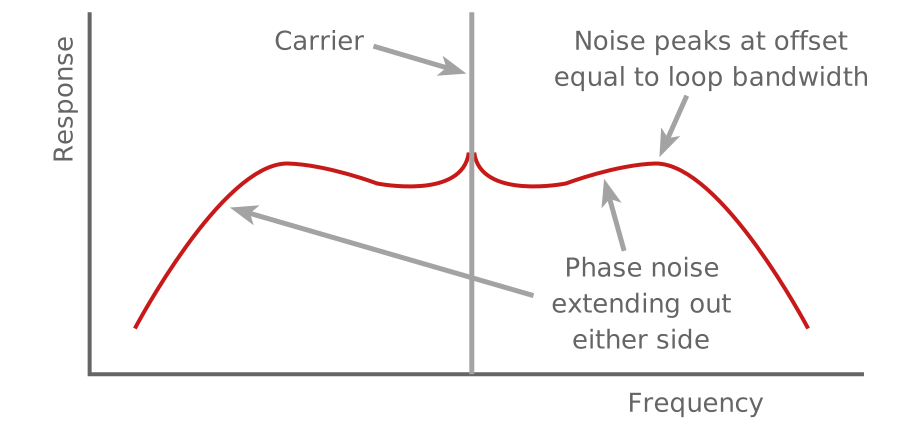
To see how noise from the different elements within the phase locked loop, it is necessary to consider each element in turn to see how the noise is affected by the loop.
Voltage controlled oscillator: First let's consider the noise generated by the voltage controlled oscillator. This will pass through the divider chain and appear at the output of the phase detector. It will then have to pass through the loop filter.
The loop filter will only allow through those components of the noise that are below the loop cut-off frequency. These will appear on the error voltage and have the effect of cancelling out the noise on the voltage controlled oscillator. As this effect will only take place within the loop bandwidth, it will reduce the level of noise within the loop bandwidth and have no effect on noise outside the loop bandwidth. In other words, noise from the VCO will be reduced within the loop bandwidth, but not outside it.
Phase detector Noise generated by the phase detector is affected in a different way. Again only the components of the noise below the loop bandwidth will pass through the low pass filter.
This means that there will be no components outside the loop bandwidth appearing on the tune voltage at the control terminal of the voltage controlled oscillator, and there will be no effect on the oscillator. Those components inside the loop bandwidth will appear at the oscillator control terminal. These will affect the oscillator and appear as phase noise on the output of the voltage controlled oscillator.
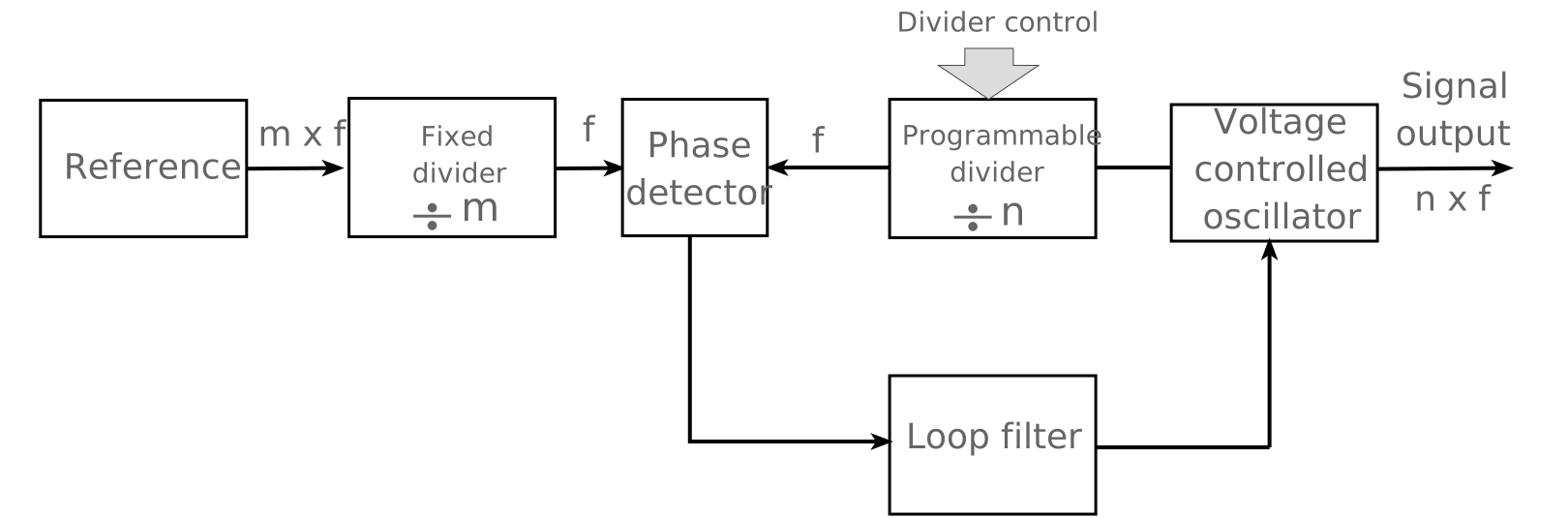
Matters are made worse by the fact that the division ratio has the effect of multiplying the noise level. This arises because the synthesizer effectively has the effect of multiplying the frequency of the reference. Consequently the noise level is also multiplied by a factor of 20 log N, where N is the division ratio.
In other words, noise generated by the phase detector will appear on the output signal for offsets within the loop bandwidth. It is also multiplied by a factor of 20logN where N is the division ratio of the synthesizer divider.
Frequency reference Noise generated by the reference undergoes exactly the same treatment as that generated by the phase detector. It too appears within the loop bandwidth and it is also multiplied by the division ratio of the loop in the same way that the phase detector noise is.
This means that even though the reference oscillator may have a very good phase noise performance this can be degraded significantly, especially if division ratios are high.
Digital frequency divider: The dividers normally do not produce a significant noise contribution. Any noise they produce may be combined with that of the phase detector.
Overall loop noise The combined noise of the loop at the output generally looks like that shown above.
Here it can be seen that the noise within the loop bandwidth arises from the phase detector and the reference. Outside the loop bandwidth it arises primarily from the voltage controlled oscillator.
From this it can be seen that optimisation of the noise profile within the RF design of the synthesizer is heavily dependent upon the choice of the loop bandwidth. It is also necessary to keep the division ratio in any loop down to reasonable levels. For example a 150 MHz synthesizer with a 12.5 kHz step size will require a division ratio of 12000. In turn this will degrade the phase detector and reference phase noise figures by 81 dB inside the loop bandwidth - a significant degradation by anyone's standards! Provided that division ratios are not too high then a wide loop bandwidth can help keep the voltage controlled oscillator noise levels down as well.
It can be seen that the RF design of the frequency synthesizer requires a careful balance between loop bandwidth, division ratio, performance of the frequency reference and the like.
Effects of PLL phase noise
PLL phase noise can affect different systems in different ways. However it is important that for all applications the phase noise on the signal is known and within the required limits. However phase noise can give rise to a number of different problems:
Wideband transmitted noise: When PLL frequency synthesizers are used within a transmitter, a local oscillator source with large amounts of phase noise can be radiated away from the wanted frequency band. This is transmitted as wideband noise and can cause interference to other users nearby.
With ever tighter requirements being placed upon the spurious emissions from radio transmitters, it is necessary to ensure that the RF design enables the performance to meet the required parameters.
- Increase in bit error rate: For transmissions using phase modulation, the phase jitter or phase noise can cause errors in the reception of the data. PLL phase noise in both the transmitter and receiver can increase the occurrence of bit errors. It is therefore essential that the PLL phase noise is kept to acceptable limits within both the transmitter and receiver.
Reciprocal mixing: This is a problem that occurs when the phase noise from the local oscillator signal is superimposed onto a strong off channel signal. This phase noise then masks out the much lower level weaker signal.
This receiver specification is often referred to as a dynamic specification because the issue of reciprocal mixing only occurs when strong off-channel signals are present. If no other signals are present, then it does not become an issue. However in the real world, strong signals are often present, so it is important to ensure the reciprocal mixing performance is up to the required level.
The phase noise generated by a PLL based frequency synthesizer is particularly important. Accordingly the phase noise performance of the synthesizer must be a major consideration at the outset of its design as the phase noise performance is greatly governed by the overall topology of the circuit. If the wrong approach is taken then it may not possible to improve the performance by the required degree.
More Essential Radio Topics:
Radio Signals
Modulation types & techniques
Amplitude modulation
Frequency modulation
OFDM
RF mixing
Phase locked loops
Frequency synthesizers
Passive intermodulation
RF attenuators
RF filters
RF circulator
Radio receiver types
Superhet radio
Receiver selectivity
Receiver sensitivity
Receiver strong signal handling
Receiver dynamic range
Return to Radio topics menu . . .