PLL Frequency Synthesizer Tutorial
PLL based frequency synthesizers insert an extra element into the loop to alter the frequency
Frequency Synthesizer Tutorials Includes:
Synthesizer basics
PLL / indirect synthesizer
PLL digital synthesizer
PLL analogue synthesizer
Multiloop synthesizer
Fractional N synthesis
Synthesizer phase noise
How to design synthesizer for low phase noise
Direct digital synthesizer, DDS
The indirect form of RF frequency synthesizer based around the phase locked loop or PLL is the most commonly used form of RF synthesizer.
By placing either a digital divider of mixer into the phase locked lop it is possible to synthesize signals on new frequencies. In view of the fact this is done indirectly, i.e. using a phase locked loop, these synthesizers are known as indirect frequency synthesizers.
Synthesizers using a digital divider in the loop are known as digital PLL synthesizers and those using an analogue mixer are known as analogue PLL synthesizers.
Although analogue synthesizer loops may be used on their own, they are also widely used within larger synthesizers and can act as a frequency translation loop.
In view of their ease of use and performance, PLL synthesizers are used in countless different radio based products and the different techniques used in different ways in the RF circuit design.
Phase locked loop summary
This type of RF frequency synthesizer is based around a phase locked loop. Accordingly it is worth giving a quick summary of how a PLL works before proceeding with the explanation of the synthesiser operation and the RF circuit design.
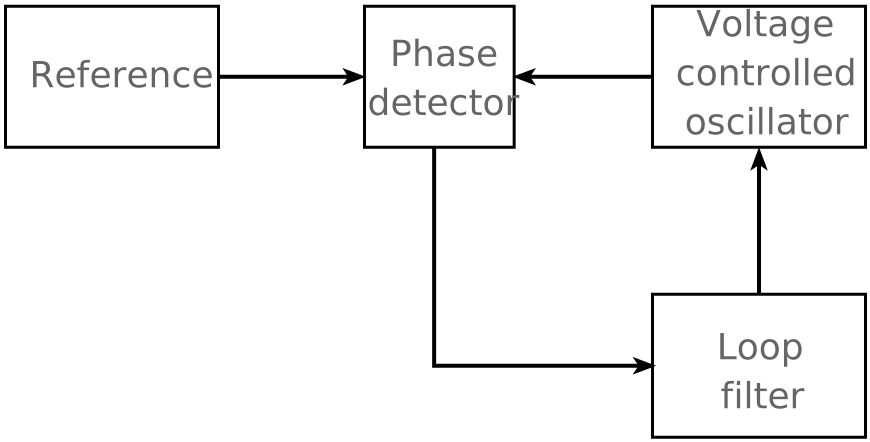
Having a good understanding of the operation of phase locked loops will not only help in understand the operation of the synthesizer, but it is essential for the RF circuit design of any of these electronic circuits.
The concept of a phase locked loop is base around the fact that the phase of two frequencies can be compared. When the phase difference is changing, there is a frequency difference between them (frequency by its very definition corresponds to a change in phase). However when the phase difference is steady but not changing, the frequency of the signals being compared is exactly the same.
If an electronic circuit is set up whereby the signals from a voltage controlled oscillator and a stable oscillator such as a crystal oscillator are fed into a phase detector, then the output will be proportional to the phase difference between them.
The output from the phase detector output is effectively an error voltage and this can be fed back to the control terminal of the VCO to pull it towards the frequency of the reference. Eventually a point will be reached where the error voltage is steady and this means there is a constant (but not changing) phase difference between the reference oscillator frequency and that of the VCO, i.e the reference and the VCO are on the same frequency and the loop is in lock.
To complete the loop, a filter is placed between the phase detector and the VCO terminal. This provides many functions: filtering out unwanted elements of the reference frequency, controlling the phase noise characteristics of the loop and being a major element in the determination of the loop stability.
Note on the Phase Locked Loop, PLL:
The phase locked loop, PLL is a very useful RF building block. The PLL uses the concept of minimising the difference in phase between two signals: a reference signal and a local oscillator to replicate the reference signal frequency. Using this concept it is possible to use PLLs for many applications from frequency synthesizers to FM demodulators, and signal reconstitution.
Read more about Phase Locked Loop, PLL
PLL frequency synthesizer basics
A phase locked loop, PLL, needs some additional circuitry if it is to be converted into a frequency synthesizer.
The loop is broken and additional blocks added to provide the frequency synthesizer action. These blocks enable the output of the phase locked loop to produce a signal on a different frequency to that of the reference signal.
The basic action of the loop remains. The phase detector produces an error voltage proportional to the phase difference between its two input signals. This means that the voltage controlled oscillator will run at a different frequency to that of the phase detector or comparison frequency.
There are two main ways in which frequency synthesizers can be made from phase locked loops:
Digital PLL synthesizer: This is the concept that is at the root of most single loop synthesizers. It involves placing a digital divider in the loop between the voltage controlled oscillator. This means that the voltage controlled oscillator frequency will be divided by the division ratio of the divider, e.g. n, and the VCO will run at n times the phase comparison frequency. By changing the division ratio of the divider, the output frequency of the oscillator can be changed. This makes the frequency synthesizer programmable.
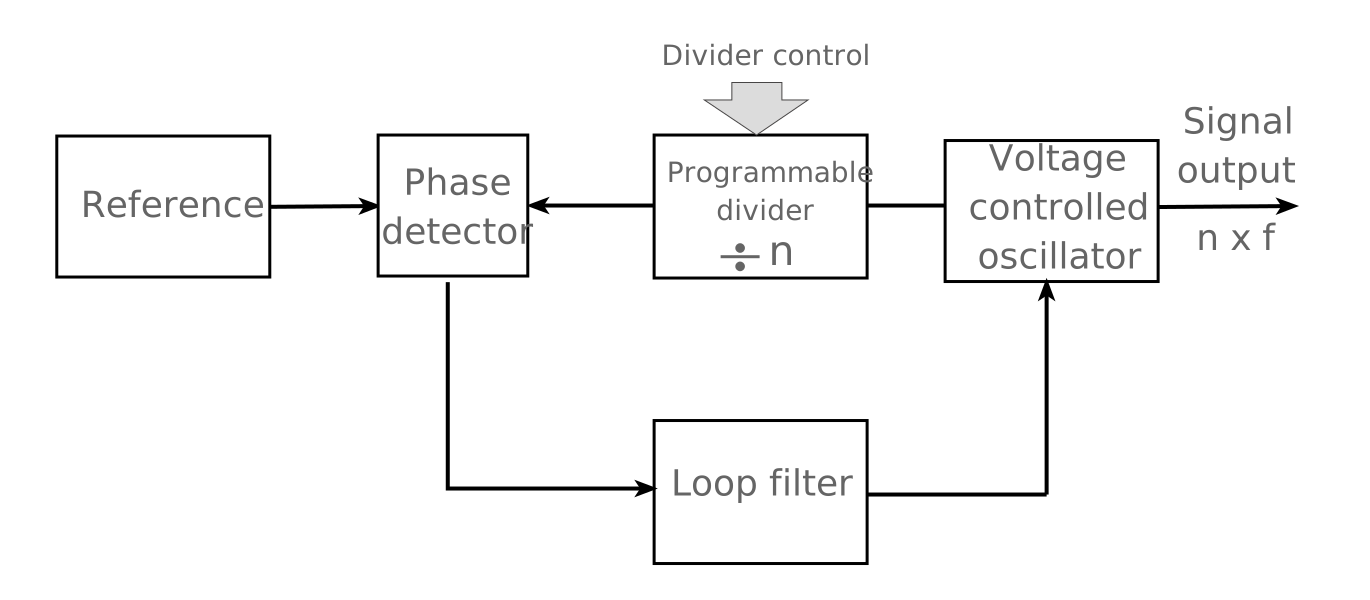
Basic digital frequency synthesizer These digital frequency synthesizers are ideal for many applications on their own. They perform well where the differences between channels are relatively high. Where virtual continuous tuning using steps of 1 Hz or 10Hz may be needed, this requires very high division ratios and this can degrade the phase noise performance and give rise to other issues. To achieve the required performance, it may be necessary to combine a digital PLL synthesizer with some analogue techniques as described below.
Read more about . . . . Digital PLL synthesizer.
Analogue PLL synthesizer: This form of frequency synthesizer introduces a mixer into the PLL between the voltage controlled oscillator and the phase detector. By introducing an external signal into the other terminal of the mixer, a fixed offset equal to that of the external frequency is introduced into the loop.
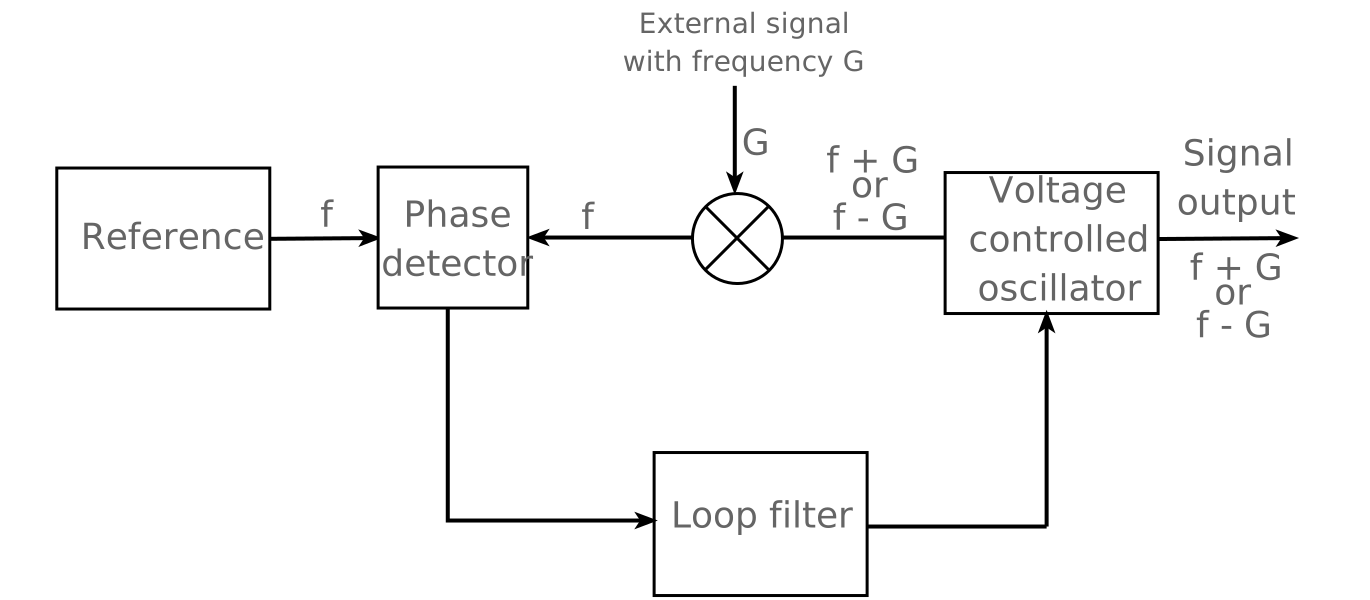
Basic analogue frequency synthesizer Care is needed when designing analogue synthesizers as there can be issues with the image signal. Although phases for the phase detector are reversed, it is still necessary to ensure that only the correct mix scenario is seen by the system. Sometimes steering voltages may be applied to the VCO to ensure the correct operation.
Read more about . . . . Analogue PLL synthesizer.
PLL synthesizer applications
The two types of PLL synthesizer tend to be used in different applications. Their different attributes lend them to slightly different uses and in different RF designs, although they may often be found working alongside each other in a multiloop synthesizer.
Digital PLL synthesizer: The digital PLL sythesizer is the most common. It can provide an oscillator that can provide a very stable output for use as a local oscillator in a radio, signal source in a signal generator, etc. The PLL synthesizer will give its output on frequencies separated by the step size determined by the phase comparison frequency. This is ideal where channelised oepration is envisaged such as in broadcast radios where the different channels are separated by set amount, VHF UHF radio communications where there are distinct channels, and also mobile communications, Wi-Fi and many other uses where there are again set channels.
Where continuous tuning is needed, radios may have a selector for the tuning increment. However for very small step sizes and high frequencies this type of frequency synthesizer does have its limitations because of the enormous division ratios.
Analogue PLL synthesizer: The analogue PLL synthesizer loop tends to be used as a translation loop where the offset provided by signal that is mixed into the loop.
This could be used alongside a relatively low frequency free running oscillator to enable the variable feature of variable oscillator to be translated to a much higher frequency. This would combine the stability of the low frequency oscillator with the high frequency capability provided by the synthesizer loop.
Alternatively it could be used alongside a digital synthesizer loop to have the digital loop running at a much lower frequency to reduce the division ratio required and improve the performance. The analogue loop could then translate its frequency to the required high frequency range.
It can be see that both types of PLL sythesizer have their attributes that can be used to good effect in different RF circuit designs.
The analogue and digital PLL synthesizers are used in different ways, but are both able to provide very high levels of performance.
It is also possible to build up multiple loop RF synthesizers - these multi-loop RF synthesizers are able to provide increased levels of flexibility and overall performance, although the design has to be undertaken carefully. Sometimes both analogue and digital synthesizer loops may be combined.
More Essential Radio Topics:
Radio Signals
Modulation types & techniques
Amplitude modulation
Frequency modulation
OFDM
RF mixing
Phase locked loops
Frequency synthesizers
Passive intermodulation
RF attenuators
RF filters
RF circulator
Radio receiver types
Superhet radio
Receiver selectivity
Receiver sensitivity
Receiver strong signal handling
Receiver dynamic range
Return to Radio topics menu . . .