Flicker, 1/f Noise
Flicker noise or 1/f noise is a form of electronic noise that dominates at low frequencies or low frequency offsets from oscillators.
Electronic & RF Noise Includes:
Noise basics
Noise measurement
RF noise topics:
Avalanche noise
Burst noise
Flicker noise
Phase noise
Shot noise
Thermal noise
Flicker noise is also known as 1/f noise in view of the fact that is power density decreases with increasing frequency or increasing offset from a signal. It follows a 1/f characteristic, having what is termed a pink noise spectrum.
Flicker noise or 1/f noise occurs in almost all electronic devices, and it has a variety of different causes, although these are usually related to the flow of direct current.
It is important in many areas of electronics and it is particularly important within oscillators used as RF sources. For RF oscillators overall noise performance is important, and 1/f noise forms one element of this.
What is Flicker Noise: basics
Flicker noise occurs in virtually all electronic components (as well as in many other physical items in everyday life from the earth's rotation to undersea currents and many other items).
Often, Flicker noise, 1/f noise is mentioned in relation to semiconductor devices such as transistors and especially MOSFET devices.
It can show up as a variety of effects, but often occurs as a resistance fluctuation.
Flicker noise or 1/f noise can be expressed in the form:
Flicker noise in oscillators
Flicker noise is proportional to the inverse of the frequency, i.e. 1/f and in many applications such as within RF oscillators there are regions in which the flicker noise, 1/f noise dominates and other regions where the white noise from sources such as shot noise and thermal noise dominate.
Within the oscillator the flicker noise manifests itself as sidebands that are close to the carrier, the other forms of noise extending out from the carrier with a flatter spectrum, although decaying the greater the offset from the carrier.
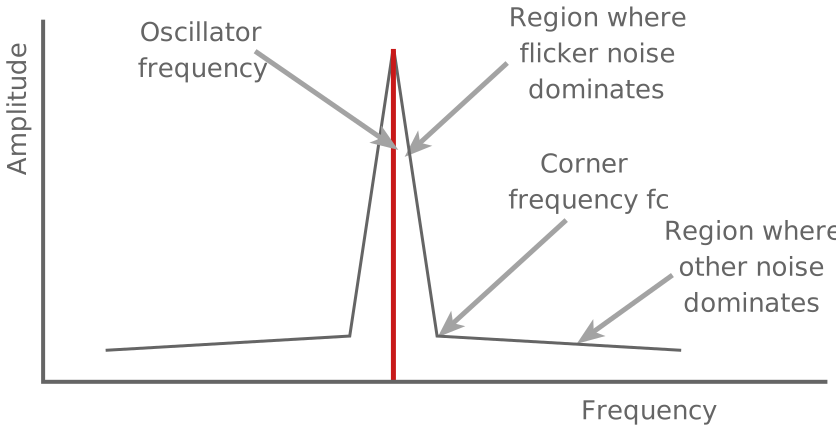
In view of this, there is a corner frequency, fc, between the regions dominated by the different forms of noise.
For a system such as an oscillator it is generally found that the noise outside that where the flicker noise predominates is phase noise. This decays with increasing offset from the carrier until flat white noise predominates.
MOSFETs have a higher fc (can be in the GHz range) than JFETs or bipolar transistors which is usually below 2 kHz for the latter.
Flicker noise of 1/f noise is an important form of noise, especially when designing RF oscillators. Often it is overlooked, but by choosing the correct device, its impact can be minimised.
More Basic Electronics Concepts & Tutorials:
Voltage
Current
Power
Resistance
Capacitance
Inductance
Transformers
Decibel, dB
Kirchoff's Laws
Q, quality factor
RF noise
Waveforms
Return to Basic Electronics Concepts menu . . .