RF directional coupler basics tutorial
RF directional couplers are passive devices that couple power travelling through the device to another port enabling the signal to be used in another circuit.
RF Combiner Splitter Couplers & Hybrids Includes:
Combiner, splitter, coupler hybrids overview
Splitters & Combiners
Resistive splitter & combiner
Hybrid splitter & combiner
Wilkinson splitter & combiner
Directional coupler
RF directional couplers are electronic items that couple a defined amount of the electromagnetic power in a transmission line to a port enabling the signal to be used in another circuit.
One key feature of directional couplers is that they only couple power flowing in one direction. In this way, power entering the output port is coupled to the isolated port but not to the coupled port.
RF directional couplers can be implemented using a variety of techniques including stripline, coaxial feeder and lumped or discrete elements. They may also be contained within a variety of packages from blocks with RF connectors, or solder pins, or they may be contained on a substrate carrier, or they may be constructed as part of a larger unit containing other functions.
RF directional coupler basics
An RF directional coupler has four ports and these are normally defined as in the list below:
- Input (Port 1, Incident)
- Transmitted (Port 2, Output)
- Coupled (Port 3, Forward coupled port)
- Isolated (Port 4, Reverse coupled port)
Terms in brackets refer to alternative names for the ports that may be seen on occasions- they give a little more explanation of the function of the coupler port than just the name.
Typically the main line is the one between ports 1 and 2. Normally this may be more suited to carry high power levels and it may have larger RF connectors, if it is a unit with RF connectors.
The other ports on the directional coupler are normally more suited for lower powers as they are only intended to carry a small proportion of the main line power. Ports 3 and 4 may even have smaller connectors to distinguish them from the main line ports of the RF coupler. Often the isolated port is terminated with an internal or external matched load which would typically be 50 ohms.
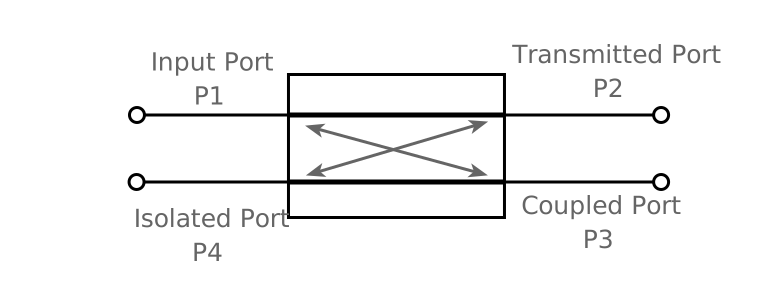
While specific ports are given labels on a device, this is normally more of a physical constraint as some ports will be manufactured to carry higher powers than others. In fact any port can be the input, and this will result in the directly connected port being the transmitted port, the adjacent port being the coupled port, and the diagonal port being the isolated port.
RF directional coupler specifications
As with any component or system, there are several specifications associated with RF directional couplers. The major RF directional coupler specifications are summarised in the table below.
Terminology / Terminology |
Description of Directional Coupler Specification |
|---|---|
| Main line loss | Resistive loss due to heating (separate from coupling loss). This value is added to the theoretical reduction in power that is transferred to the coupled and isolated ports (coupling loss). |
| Coupling Loss | Amount of power lost to the coupled port (3) and to the isolated port (4). Assuming a reasonable directivity, the power transferred unintentionally to the isolated port will be negligible compared to that transferred intentionally to coupled port. |
| Isolation | Power level difference between Port 1 and Port 4 (related to directivity). |
| Directivity | Power level difference between Port 3 and Port 4 (related to isolation). This is a measure of how independent the coupled and isolated ports are. Because it is impossible to build a perfect coupler, there will always be some amount of unintended coupling between all the signal paths. |
Couplers are not as widely used as some RF components like attenuators, mixers and the like, but in areas closer to the antenna where power may need to be sampled, they are widely used. For example a directional coupler may be used within a meter detecting the standing wave ratio, but they also have many other applications.
More Essential Radio Topics:
Radio Signals
Modulation types & techniques
Amplitude modulation
Frequency modulation
OFDM
RF mixing
Phase locked loops
Frequency synthesizers
Passive intermodulation
RF attenuators
RF filters
RF circulator
Radio receiver types
Superhet radio
Receiver selectivity
Receiver sensitivity
Receiver strong signal handling
Receiver dynamic range
Return to Radio topics menu . . .