Amplitude Modulation, AM
Amplitude modulation or AM is a fundamental type of radio frequency signal modulation - although AM is now used less, it forms the basis of other modulation formats.
Amplitude Modulation, AM Tutorial Includes:
Amplitude modulation, AM
AM basic theory & formulas
AM bandwidth & sidebands
Modulation index & depth
AM efficiency
AM demodulation / detection
Diode detector
Synchronous detector
AM modulators
Single sideband, SSB
SSB demodulation
Modulation formats:
Modulation types & techniques
Frequency modulation
Phase modulation
Quadrature amplitude modulation
Amplitude modulation or AM, is a form of RF modulation used for radio transmissions for broadcasting and two way radio communication applications.
Although it is one of the earliest used forms of modulation, it is still used today, mainly for long, medium and short wave broadcasting and for some aeronautical point to point communications, but very few other applications.
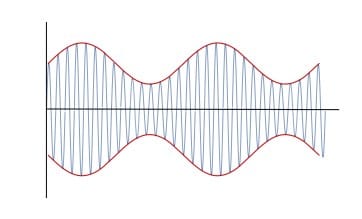
One of the key reasons for the use of amplitude modulation was its ease of use. The system simply required the carrier amplitude to be modulated, but more usefully the detector required in the receiver could be a simple diode based circuit.
This factor meant that AM radios did not need complicated demodulators and costs were reduced - a key requirement for widespread use of radio technology, especially in the early days of radio when ICs were not available.
Amplitude modulation history
The first amplitude modulated signal was transmitted in 1901 by a Canadian engineer named Reginald Fessenden. He took a continuous spark transmission and placed a carbon microphone in the antenna lead.
The sound waves impacting on the microphone varied its resistance and in turn this varied the intensity of the transmission signal sufficiently for the audio sounds to be heard.
Although this was a very crude method of modulation a radio carrier, the signals were audible over a distance of a few hundred metres, although there was a rasping sound caused by the spark.
With the introduction of continuous sine wave signals, transmissions improved significantly, and AM soon became the standard for voice transmissions. Not only was AM used for broadcasting, but it was also used for voice radio communications systems.
Nowadays, amplitude modulation, AM is used for audio broadcasting on the long medium and short wave bands, and for two way radio communication at VHF for aircraft. It is used for very few other applications because better forms of modulation are employed.
However as there now are more efficient and convenient methods of modulating a signal, its use is declining, although it will still be very many years before it is no longer used.
Many of the more efficient methods of modulating signals are based around AM: single sideband and quadrature amplitude modulation, both have amplitude modulation techniques within them.
Where is AM used?
Amplitude modulation is used in a variety of applications. Even though it is not as widely used as it was in previous years in its basic format it can nevertheless still be found.
- Broadcast transmissions: AM is still widely used for broadcasting on the long, medium and short wave bands. It is simple to demodulate and this means that radio receivers capable of demodulating amplitude modulation are cheap and simple to manufacture. Nevertheless many people are moving to high quality forms of transmission like frequency modulation, FM or digital transmissions.
- Air band radio: VHF transmissions for many airborne applications still use AM. . It is used for ground to air radio communications as well as two way radio links for ground staff as well.
- Single sideband: Amplitude modulation in the form of single sideband is still used for HF radio links. Using a lower bandwidth and providing more effective use of the transmitted power this form of modulation is still used for many point to point HF links.
- Quadrature amplitude modulation: AM is widely used for the transmission of data in everything from short range wireless links such as Wi-Fi to cellular telecommunications and much more. Effectively it is formed by having two carriers 90° out of phase.
These form some of the main uses of amplitude modulation. However in its basic form, this form of modulation is being used less as a result of its inefficient use of both spectrum and power.
What is amplitude modulation - the basics
In order that a radio signal can carry audio or other information for broadcasting or for two way radio communication, it must be modulated or changed in some way.
Although there are a number of ways in which a radio signal may be modulated, one of the easiest is to change its amplitude or intensity of the signal in line with variations of the sound.
In this way the amplitude of the radio frequency signal is made to varies in line with the instantaneous value of the intensity of the modulation.
This means that the radio frequency signal has a representation of the sound wave superimposed in it.
In view of the way the basic signal "carries" the sound or modulation, the radio frequency signal is often termed the "carrier".
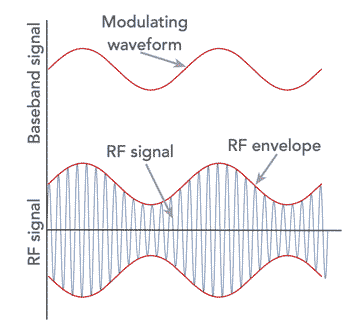
From the diagram, it can be seen that the envelope of the signal follows the contours of the modulating signal.
One of the aspects associated with amplitude modulation is the sidebands that are generated. These govern the bandwidth of the signal and as such they are of great importance.
It is found that if a carrier is modulated with a single tone, e.g. 1 kHz, then two sidebands will appear, one either side of the main carrier spaced by 1 kHz away from it.
Similarly if modulation with a variety of frequencies, e.g. speech or music is used, then the sidebands will spread out either side of the carrier, extended out by an amount equal tot he top frequencies used.
A measure known as the modulation index is also important. This details the level of modulation used and the maximum level to which modulation can be increased before the level of distortion increases and extensive interference is caused to other channels.
The modulation index is generally given as a percentage and can be increased to 100% before unwanted products and interference are caused outside the normal or allocated bandwidth of the signal.
Amplitude demodulation
Amplitude modulation, AM, is one of the most straightforward ways of modulating a radio signal or carrier. It can be achieved in a number of ways, but the simplest uses a single diode rectifier circuit.
Other methods of demodulating an AM signal use synchronous techniques and provide much lower levels of distortion and improved reception where selective fading is present.
One of the main reasons for the popularity of amplitude modulation has been the simplicity of the demodulation. It enables costs to be kept low - a significant advantage in producing vast quantities of very low cost AM radios.
Advantages & disadvantages of amplitude modulation, AM
As with any technology there are advantages and disadvantages to be considered. The summary below gives a highlight of the basic pro's and con's.
Advantages
- It is simple to implement
- it can be demodulated using a circuit consisting of very few components
- AM receivers are very cheap as no specialised components are needed.
Disadvantages
- It is not efficient in terms of its power usage
- It is not efficient in terms of its use of bandwidth, requiring a bandwidth equal to twice that of the highest audio frequency
- It is prone to high levels of noise because most noise is amplitude based and obviously AM detectors are sensitive to it.
Although in the current technological climate, AM in its basic form is not nearly as effective as other modes that can be used, it is still retained in many areas like broadcasting, because of the number of users. However, it is likely that with time, its use will decrease still further and ultimately many AM transmissions will cease. However, its derivatives like quadrature amplitude modulation are widely used as they offer a very effective form of modulation, espceially for data transmission.
Derivatives of Amplitude Modulation
Although the use of amplitude modulation is decreasing, it nevertheless forms the basis of other forms of modulation that are still being widely used, or their use is increasing.
- Single sideband, SSB: Single sideband is widely used for HF communications. It is formed by taking a signal that has the carrier and one sideband removed. In this way it becomes far more efficient in terms of both spectrum and power.
Read more about . . . . Single Sideband, SSB.
- Quadrature amplitude modulation, QAM: This form of modulation is essentially derived from two carriers that are 90° out of phase and adding information, either analogue or digital. Quadrature Amplitude Modulation is widely used for carrying many digital signals, everything from Wi-Fi to Mobile phone communications and very much more.
Read more about . . . . Quadrature amplitude modulation, QAM
AM overview
AM has advantages of simplicity, but it is not the most efficient mode to use, both in terms of the amount of space or spectrum it takes up, and the way in which it uses the power that is transmitted. This is the reason why it is not widely used these days both for broadcasting and for two way radio communication.
Even the long, medium and short wave broadcasts will ultimately change because of the fact that amplitude modulation, AM, is subject to much higher levels of noise than are other modes.
For the moment, its simplicity, and its widespread usage, mean that it will be difficult to change quickly, and it will be in use for many years to come.
More Essential Radio Topics:
Radio Signals
Modulation types & techniques
Amplitude modulation
Frequency modulation
OFDM
RF mixing
Phase locked loops
Frequency synthesizers
Passive intermodulation
RF attenuators
RF filters
RF circulator
Radio receiver types
Superhet radio
Receiver selectivity
Receiver sensitivity
Receiver strong signal handling
Receiver dynamic range
Return to Radio topics menu . . .