Amplitude Modulation, AM: Bandwidth Spectrum & Sidebands
The spectrum of an amplitude modulated is related to the sidebands that are generated and hence to the bandwidth.
Amplitude Modulation, AM Tutorial Includes:
Amplitude modulation, AM
AM basic theory & formulas
AM bandwidth & sidebands
Modulation index & depth
AM efficiency
AM demodulation / detection
Diode detector
Synchronous detector
AM modulators
Single sideband, SSB
SSB demodulation
Modulation formats:
Modulation types & techniques
Frequency modulation
Phase modulation
Quadrature amplitude modulation
The bandwidth of an amplitude modulated signal is of importance for many reasons.
The amplitude modulation, AM bandwidth is important when designing filters to receive the signals, determining the channel spacing, and for a number of other reasons.
The spectrum and bandwidth of a amplitude modulated signal are determined by the sidebands that are generated when amplitude modulation is applied to the carrier.
Amplitude modulation sidebands
When a carrier is modulated in any way, further signals are created either side of the steady carrier. These sidebands carry the actual modulation information.
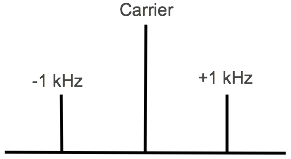
The amplitude modulation sidebands are generated above and below the main carrier. To see how this happens, take the example of a carrier on a frequency of 1 MHz which is modulated by a steady tone of 1 kHz.
The process of modulating a carrier is exactly the same as mixing two signals together, and as a result both sum and difference frequencies are produced. Therefore when a tone of 1 kHz is mixed with a carrier of 1 MHz, a "sum" frequency is produced at 1 MHz + 1 kHz, and a difference frequency is produced at 1 MHz - 1 kHz, i.e. 1 kHz above and below the carrier.
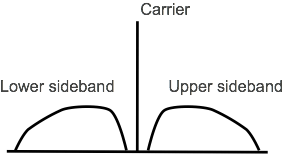
If the steady state tones are replaced with audio like that encountered with speech of music, these comprise many different frequencies and an audio spectrum with frequencies over a band of frequencies is seen. When modulated onto the carrier, these spectra are seen above and below the carrier.
Amplitude modulation, AM bandwidth
It can be seen that if the top frequency that is modulated onto the carrier is 6 kHz, then the top spectra will extend to 6 kHz above and below the signal. In other words the bandwidth occupied by the AM signal is twice the maximum frequency of the signal that is used to modulated the carrier, i.e. it is twice the bandwidth of the audio signal to be carried.
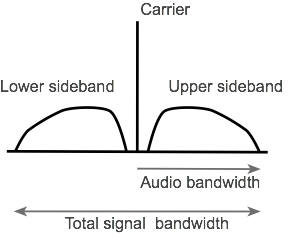
It can be seen that limiting the top frequency of the modulating signal limits the overall bandwidth of the amplitude modulated signal. For audio transmissions, like broadcast transmissions, the overall bandwidth of the signal is dependent upon the highest frequencies to be transmitted.
Broadcast channel spacing varies according to the band used and also the area within the world where the transmission comes from. On the Long waveband broadcast in ITU region 1 (Europe, Africa, and northern and central Asia), the channel spacing is 9 kHz, for the medium wave broadcast band the channel spacing in ITU regions 1 and 3 is 9 kHz spacing, and in ITU region 2 (Americas) it is 10kHz.
To achieve these channel spacings, the audio spectrum must be limited. If no interference was to be caused to stations on adjacent channels this would severely limit the top audio frequency. On the short wave bands it would be half 5 kHz, i.e. 2.5 kHz. This would clearly not allow sufficient quality for broadcasting and therefore the bandwidth of the signals is a little higher than this and some interference is caused. Similarly on the medium and long wave bands the bandwidth of the AM signal is often higher than half the channel spacing. Interference is managed by not allowing stations in close proximity to occupy adjacent channels.
Typical AM channel and signal bandwidths
Some of the main uses of amplitude modulation these days are for broadcasting and for aeronautical communications. The channel spacing varies according to application, frequency and locations.
| Typical AM channel and signal bandwidths |
||
|---|---|---|
| Applications / Description | Channel spacing (kHz) | Theoretical maximum audio bandwidth (kHz) |
| Long / medium wave broadcasting outside Region 2 (Americas) | 9 | 4.5 |
| Medium wave broadcasting in Region 2 (Americas) | 10 | 5 |
| Short wave broadcasting | 5 | |
The audio bandwidth theoretical limits for amplitude modulated broadcast stations appears far more limited than occurs in reality. Audio bandwidth figures of up to 6 kHz are not uncommon - generally adjacent channels are not allocated so that signals spreading into adjacent channels can be accommodated. This is fine for broadcasting on bands such as the medium wave band during the day, but at night when signals travel further as a result of ionospheric propagation, more interference is experienced.
For the short wave bands interference levels are often high - some broadcast stations have experimented and used single sideband with full carrier. This effectively reduces (halves) the bandwidth of the overall signal for a given audio bandwidth. For this to provide gains within a channelized band plan, all stations need to adopt the same plan.
Aeronautical communications often use amplitude modulation. Channel bandwidths of 25kHz and 8.33 kHz are standard dependent upon the aircraft and location. Audio can be tailored to suit the channel spacing as a typical communications audio bandwidth of 300 Hz to around 3 kHz can be adopted.
The bandwidth of amplitude modulation can be seen to be twice that of the highest audio signal to be carried. This makes in relatively poor in terms of spectral efficiency, but nevertheless AM is still used for some applications in view of its simplicity, especially in terms of demodulation.
More Essential Radio Topics:
Radio Signals
Modulation types & techniques
Amplitude modulation
Frequency modulation
OFDM
RF mixing
Phase locked loops
Frequency synthesizers
Passive intermodulation
RF attenuators
RF filters
RF circulator
Radio receiver types
Superhet radio
Receiver selectivity
Receiver sensitivity
Receiver strong signal handling
Receiver dynamic range
Return to Radio topics menu . . .