Amplitude Modulation Efficiency: AM efficiency
Amplitude modulation, AM offers simplicity but it is not the most efficient form of modulation in terms of power or spectrum usage.
Amplitude Modulation, AM Tutorial Includes:
Amplitude modulation, AM
AM basic theory & formulas
AM bandwidth & sidebands
Modulation index & depth
AM efficiency
AM demodulation / detection
Diode detector
Synchronous detector
AM modulators
Single sideband, SSB
SSB demodulation
Modulation formats:
Modulation types & techniques
Frequency modulation
Phase modulation
Quadrature amplitude modulation
Amplitude modulation, AM was the first form of modulation to be used for voice and audio broadcasting. It has advantages of simplicity, but it does not offer the levels of efficiency provided by many other forms of modulation.
Amplitude efficiency levels fall behind other types of modulation in terms of both spectrum usage and power utilisation.
It was its relative simplicity that enabled it to be used in the early days of wireless communications, but nowadays, other forms of modulation offer much greater levels of efficiency and effectiveness.
AM power efficiency
The power efficiency of amplitude modulation is very low. To see why this is the case, it is necessary to look at the composition of the radio signal and the relative power levels of its constituents: the carrier and the two sidebands.
When a radio frequency signal is modulated by an audio signal the envelope will vary. The level of modulation can be increased to a level where the envelope rises to twice the un-modulated level and then falls to zero. This is called 100% modulation as it is the maximum amount that can be applied.
If the level of modulation is increased beyond the 100% level, then distortion will arise because the envelope cannot fall below zero.
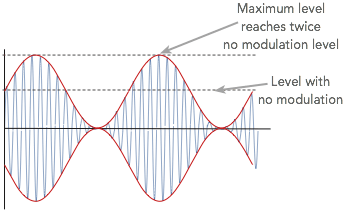
Even with 100% modulation, i.e. modulation index of 1.0, the power utilisation is very poor.
When the carrier is modulated sidebands appear at either side of the carrier in its frequency spectrum. Each sideband contains the information about the audio modulation. To look at how the signal is made up and the relative powers take the simplified case where the 1 kHz tone is modulating the carrier. In this case two signals will be found 1 kHz either side of the main carrier.
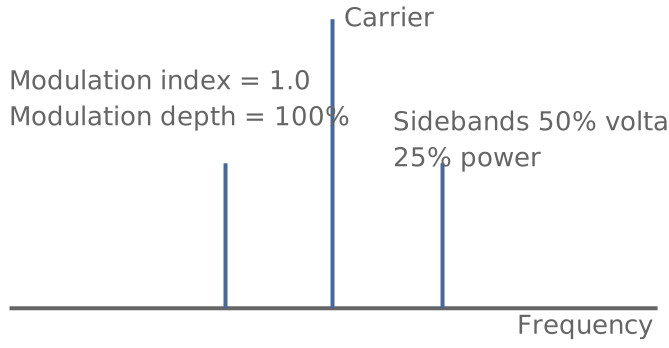
When the carrier is fully modulated i.e. 100% the amplitude of the modulation is equal to half that of the main carrier, i.e. the sum of the powers of the sidebands is equal to half that of the carrier. This means that each sideband is just a quarter of the total power. In other words for a transmitter with a 100 watt carrier, the total sideband power would be 50 watts and each individual sideband would be 25 watts. During the modulation process the carrier power remains constant. It is only needed as a reference during the demodulation process. This means that the sideband power is the useful section of the signal, and this corresponds to (50 / 150) x 100%, or only 33% of the total power transmitted.
Amplitude modulation spectrum efficiency
The spectral efficiency of amplitude modulation is also poor. With pressure on radio spectrum increasing, spectral efficiency is a factor that is of growing importance in areas where the spectrum is required.
To see why the spectral efficiency of amplitude is poor, take the example where an audio signal is applied to the carrier. Under these conditions the audio spreads out either side of the carrier - the audio spectrum being reflected either side of the carrier as shown below.
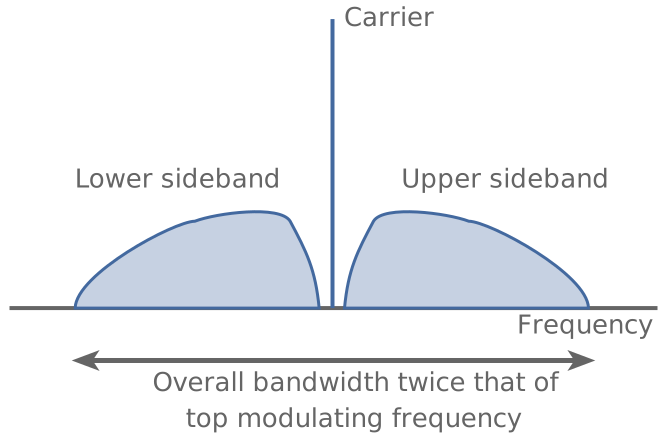
Accordingly the sidebands spread out either side of the carrier as shown and the total bandwidth used is equal to twice the top frequency of the audio or other signal that is modulated onto the transmitted signal. With pressure on the radio spectrum, and other forms of modulation able to achieve far higher levels of spectrum efficiency, amplitude modulation is one of the lowest in this respect.
As a result of its poor efficiency levels, the use of amplitude modulation is dwindling. Its current main uses are for broadcasting on the long, medium and short wave bands as well as some short range use for aircraft communications.
AM broadcasting usage is falling as better forms of broadcasting re available, both with frequency modulation and with digital formats. AM offers low levels of efficiency as well as a low tolerance to interference. Accordingly its use will continue to fall.
More Essential Radio Topics:
Radio Signals
Modulation types & techniques
Amplitude modulation
Frequency modulation
OFDM
RF mixing
Phase locked loops
Frequency synthesizers
Passive intermodulation
RF attenuators
RF filters
RF circulator
Radio receiver types
Superhet radio
Receiver selectivity
Receiver sensitivity
Receiver strong signal handling
Receiver dynamic range
Return to Radio topics menu . . .