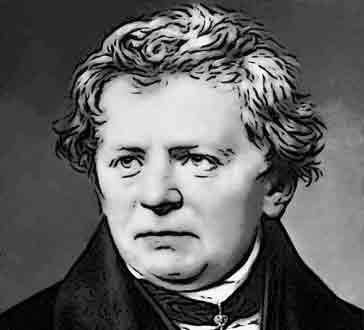
Georg Simon Ohm
A summary of the life of Georg Simon Ohm, the man who discovered electrical resistance and gave his name to Ohm's Law.
Ohm is a name which is synonymous with the most basic electrical and electronic theory.
In fact every person who has studied physics will have heard of Ohm's Law and will be familiar with the ohm as the unit of resistance.
Yet behind the unit and the law was a very real man. Someone who performed experiments with phenomena which were at the forefront of the science of the time. Despite being ridiculed by many, Ohm brought understanding to the phenomenon of electrical resistance.
Ohm was also a person who had a great insight, he was able to develop his theories with only the most basic measuring techniques and equipment.
Ohm's birth
Georg Simon Ohm was born on the 16th March 1789 in a town called Erlangen which is relatively close to Nuremburg and around 200km north of Munich. In those days it was in an area known as Brandenburg-Bayreuth, but is now Germany.
Georg Ohm was the eldest of three children born to Johann Wolfgang and Maria.
His father was a locksmith who had a keen interest in the science of the day. He taught his children a lot of what he had learned and this was to pay dividends for some of them in the years to come.
Johann taught Georg and his brother Martin at home until Georg was 11.
Then young Georg entered secondary school and he showed he was a bright student. He went on from the secondary school to University at Erlangen in Bavaria in 1805.
Ohm made a good start here, but like so many young people today the social life seemed to have far greater attractions and his studies took second place. After just over a year he had to leave and bear the anger of his father who had so many hopes for his eldest son. This was particularly annoying because the family had struggled to provide the finances for his education.
Ohm had a rather chequered career. He took up teaching as he had a firm grounding in the science and mathematics of the day from his earlier years. He started in Switzerland and remained here for five years.
Ohm returned to Erlangen having learnt some of the hard truths about life. This time he set to work and soon obtained a PhD, although to fund his studies, Ohm took on several teaching posts in both Germany and Switzerland.
Having graduated, Ohm decided that he wanted to make something of his career. He continued his teaching but with the aim of becoming a University professor. He spent a few years moving from one post to another without any real degree of success.
To try to break his lack of progress, Ohm decided to publish a book on geometry to gain more recognition. This he did and it worked as he soon became a teacher in Cologne at the Jesuit's College which was very well respected.
Electrical experimentation starts
It was 1820 and the phenomenon of electromagnetism had only just been discovered. Ohm was fascinated by them and started to experiment. He was still teaching at the Jesuit's College and undertook this experimentation in his own time.
He performed many experiments and measured the various effects associated with them. It was a very different science to that of today. At this time, even the most basic measurements were difficult to make with any degree of accuracy. In order to measure current there were no meters as we know them today. Instead the magnetic force around the conductor was measured.
By doing this Ohm noticed that the type of conductor had an effect on the magnetic flux. He performed many experiments to try to determine any relationships that might exist. Despite the many difficulties, Ohm came up with a relationship between the current, voltage and the properties of the wire. Unfortunately it was not Ohms Law as we know it today because it even included a logarithms.
Ohm continued his work and refined his results. He managed to improve the batteries which were a major source of error in his results and he also used several pieces of similar wire, but of different lengths. Using this set up he was able to derive a new relationship and this turned out very much like the form which we all know today.
As he was now certain of his findings he published a paper. In doing this he hoped he would be able to gain recognition. However there were inevitably some of the established scientific community who treated his findings with a great deal of scepticism. They even ridiculed him in the scientific press. Even so a few people recognised his work, and he was able to move onto Berlin to proceed with further research.
Ohm's researches continue
Much of Ohm's time was now devoted to his research. He also wanted to become a professor at a leading university and he accordingly set out to do this.
The first step which Ohm took was to publish a book summarising his work. This he did in 1827 in a book called "Die GalvanischeKette Mathematisch Bearbeitet", (The Galvanic Circuit Investigated Mathematically). He also invited offers of a job from the academic institutions but as his work was received so indifferently none were forthcoming.
In this book he stated that the electromotive force acting between the extremities of any part of a circuit is the product of the strength of the current and the resistance of that part of the circuit.
As a result of this Ohm decided to resign from his post as teacher at Cologne and take up temporary teaching. This would enable him to take up any appointments if they did arise. During this time he found that his work was just beginning to be accepted, but even so nobody wanted to offer him the job he wanted.
Then in 1833 Ohm did manage to secure a better post. It was as professor of physics in Nurnberg at what we would call a polytechnic today.
The true importance of Ohm's work slowly began to be recognised, and with this came a number of honours. In 1839 he became a member of the Berlin Academy. Then in 1841 the Royal Society in London awarded him the Copley Medal and a year later he was made a foreign member.
Ohm's final years
Finally in 1852 he was appointed professor of physics at Berlin University. Unfortunately he was not able to enjoy this for long as he died shortly afterwards on 16th July 1854 in Munich. Little is actually know about the cause of his death, and he was interred in the Alter Sudfriedhof - The Old South Cemetery in Munich.
After his death Ohm's work was fully accepted. Many societies and organisations saw the need for a unit of resistance. In fact it was in Britain that the unit of resistance was first named after Ohm. Then in 1881 the unit was adopted by international agreement and Ohm's name was made immortal.
Finally he had achieved the recognition he wanted during his life time. Today there are statues of him, one notable one is at the Technical University of Munich in Bavaria, Germany.
More Famous Scientists in Electronics and Radio:
Volta
Ampere
Armstrong
Appleton
Babbage
Bardeen
Brattain
Edison
Faraday
R A Fessenden
Fleming
Heaviside
Hertz
Ohm
Oersted
Gauss
Hedy Lamarr
Lodge
Marconi
Maxwell
Morse
H J Round
Shockley
Tesla
Return to History menu . . .