
Inductor Q, Quality Factor
It is possible to measure and quote the Quality Factor or Q Factor for an inductor.
Q, Quality Factor Tutorial Includes:
Q, quality factor basics
Inductor Q
RLC network Q
The Q factor can be applied to an inductor just as it can to a resonant circuit containing inductance, capacitance and resistance.
An inductor Q is a valuable quantity. Often inductors may be thought of as having a pure inductance, whereas in reality they have some resistance.
This resistance causes energy loss and hence the inductor Q is reduced. In fact the inductor resistance is one of the major performance limiting factors for an inductor.
As a result the level of the inductor Q gives a good indication of the overall performance of the component, and it is a factor that is widely used within RF design.
Inductor Q factor basics
When using an inductor in a circuit where the Q or quality factor is important its resistance becomes an important factor. Any resistance will reduce the overall inductor Q factor.
An inductor can be considered in terms of its equivalent circuit. This can be simply expressed as a perfect inductor with a series resistor.
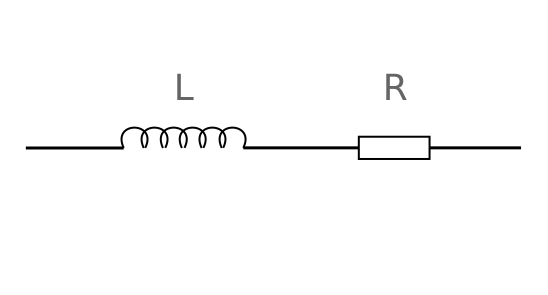
Where:
L is a perfect inductor
R is the resistance of the inductor
The resistance within an inductor is caused by a number of effects:
- Standard DC resistance: The most obvious constituent of the resistance in an inductor results from the standard DC resistance. This is always be present (except in superconductors which are not normally encountered). This is one of the major components of resistance in any coil or inductor and one that can sometimes be reduced. Thicker wires, and sometimes silver or silver plated wires may be used to reduce this and improve the overall inductor Q factor.
- Skin effect: The skin effect affects the inductor Q because it has the effect of raising the resistance. The skin effect results from the tendency of an alternating current flow through the outer areas of a conductor rather than through the middle. This has the effect of reducing the cross sectional area of the conductor through which the current can flow, thereby effectively increasing its effective resistance. It is found that the skin effect becomes more pronounced as the frequency increases.
Specialist forms of wire can be used to reduce the skin effect and thereby improve the inductor Q factor:
- Silver wire: Silver or even silver plated wire can be used to reduce the effects of the skin effect. When compared to copper wire, silver wire has a lower resistance for a given surface area. To reduce the cost, silver plated wire can be used. Silver plated wire is often a very cost effective compromise because the majority of the RF or alternating current is carried towards the outside where the silver plating is as a result of the skin effect.
- Litz wire: Another form of wire that can be used is known as Litz wire. The name comes from the German word Litzendraht meaning braided, stranded or woven wire. It is a form of wire that consists of many thin strands of wire, each individually insulated and then woven together. In this way the surface area of the wire is considerably increased, thereby reducing the resistance to RF or alternating currents. Typically Litz wire is used for frequencies above about 500kHz, but below around 2 MHz. The drawback of using Litz wire is that it is very expensive.
- Core losses: Many inductors have ferrite or other forms of core. These cores introduce losses as a result of various factors, each of which affects the inductor Q factor:
- Hysteresis losses: Magnetic hysteresis is another effect that causes losses and can reduce inductor Q factor values. The hysteresis of any magnetic material use as a core needs to be overcome with every cycle of the alternating current and hence the magnetic field. This expends energy and again manifests itself as another element of resistance. As ferrite materials are known for hysteresis losses,, the effect on the inductor quality factor can be minimised by the careful choice of ferrite or other core material, and also ensuring that the magnetic field induced is within the limits of the core material specified.
- Eddy currents: It is a commonly known fact that eddy currents can flow in the core of an inductor. These are currents that are induced within the core of the inductor. The eddy currents dissipate energy and mean that there are losses within the inductor which can be seen as an additional level of resistance that will reduce the inductor Q factor.
- Radiated energy: When an alternating current passes through an inductor, some of the energy will be radiated. Although this may be small, it still adds to the losses of the coil and in exactly the same way as occurs in an antenna this is represented by a radiation resistance. Accordingly this is a component of the inductor resistance and will reduce the inductor Q factor.
Minimising the resistance effects reduces the losses and increases the inductor Q factor.
Inductor Q factor formulas
In order to calculate the Q, quality factor for an inductor, the formula or equation below can be used:
As the resistance is equal to 2 π f L, this can be substituted in the formula to give:
Looking at these formulas it can be seen that the overall, inductive reactance, X varies according to the frequency. This means that the inductor Q factor will also change with frequency.
In addition to this, the resistive losses which are made up from the skin effect, radiation losses, eddy current, and hysteresis are also frequency dependent, even though they are resistive losses. These effects too will also affect the inductor Q factor.
It is for this reason that when the inductor Q factor is stated, it must include the frequency for which it has been determined.
More Basic Electronics Concepts & Tutorials:
Voltage
Current
Power
Resistance
Capacitance
Inductance
Transformers
Decibel, dB
Kirchoff's Laws
Q, quality factor
RF noise
Waveforms
Return to Basic Electronics Concepts menu . . .