
PN Photodiode & PIN Photo Diode
PN and PIN photodiodes are one of the popular forms of photo diodes. They have their own characteristics that make them very suited to many applications.
Photo Diode Tutorial Includes:
Photo diode technology
PN & PIN photodiodes
Avalanche photodiode
Schottky photodiode
Other diodes: Diode types
The PN photodiode and the PIN photodiode are two of the most common formats for photdiodes.
Both the PIN photodiode and PN photodiodes are widely used for a variety of photo-detection applications because of their characteristics.
PN photodiode
The basic PN photodiode is used in a number of instances. The photo detection occurs within the depletion area of the diode. As this is relatively small, the sensitivity is not as great as that for some other forms of photo diode.
PIN photodiode basics
The PIN photodiode provides additional sensitivity and performance over that of the basic PN junction photodiode.
One of the key requirements for any photodetector is a sufficiently large area in which the light photons can be collected and converted.
This is achieved by creating a large depletion region - the region where the light conversion takes place - by adding an intrinsic area into the PN junction to create a PIN junction.
One of the key parameters within the design of the PIN photodiode is to enable the light to enter the intrinsic region. The physical design of the photodiode needs to take account of this so that the light collection is optimised.
Photodiodes in general and in this case the PIN photodiode will respond differently to different light wavelengths.
It is generally the thickness of the top p type region or layer that is one of the key parameters in determining the response sensitivity.
PIN / PN photodiode operation
The photodiode is operated under a moderate reverse bias. This keeps the depletion layer free of any carriers and normally no current will flow.
However when a light photon enters the intrinsic region it can strike an atom in the crystal lattice and dislodge an electron. In this way a hole-electron pair is generated.
The hole and electron will then migrate in opposite directions under the action of the electric field across the intrinsic region and a small current can be seen to flow.
It is found that the size of the current is proportional to the amount of light entering the intrinsic region. The more light, the greater the numbers of hole electron pairs that are generated and the greater the current flowing.
Operating diodes under reverse bias increases the sensitivity as it widens the depletion layer where the photo action occurs. In this way increasing the reverse bias has the effect of increasing the active area of the photodiode and strengthens what may be termed as the photocurrent.
It is also possible to operate photodiodes under zero bias conditions in what is termed as a photovoltaic mode. In zero bias, light falling on the diode causes a current across the device, leading to forward bias which in turn induces "dark current" in the opposite direction to the photocurrent.
This is called the photovoltaic effect, and is the basis for solar cells. It is therefore possible to construct a solar cell using a large number of individual photodiodes.
Also when photodiodes are used in a solar cell, the diodes are made larger so that there is a larger active area, and they are able to handle higher currents. For those used for data applications, speed is normally very important and the diode junctions are smaller to reduce the effects of capacitance.
When not exposed to light the photo diode follows a normal V-I characteristic expected of a diode.
In the reverse direction virtually no current flows, but in the forward direction it steadily increases, especially after the knee or turn on voltage is reached. This is modified in the presence of light. When used as a photo-diode it can be seen that the greatest effect is seen in the reverse direction. Here the largest changes are noticed, and the normal forward current does not mask the effects due to the light.
PN & PIN photodiode structures
The standard PN junction diode can provide the functions of a photodiode. However one of the key requirements for a photodiode is a suitable area for collection of the light.
Within a standard PN junction this is relatively small, but the area can be increased by using a PIN diode. As the intrinsic area is included in the active junction for light collection, there is a much larger area for light collection, making the PIN photodiode more effective.
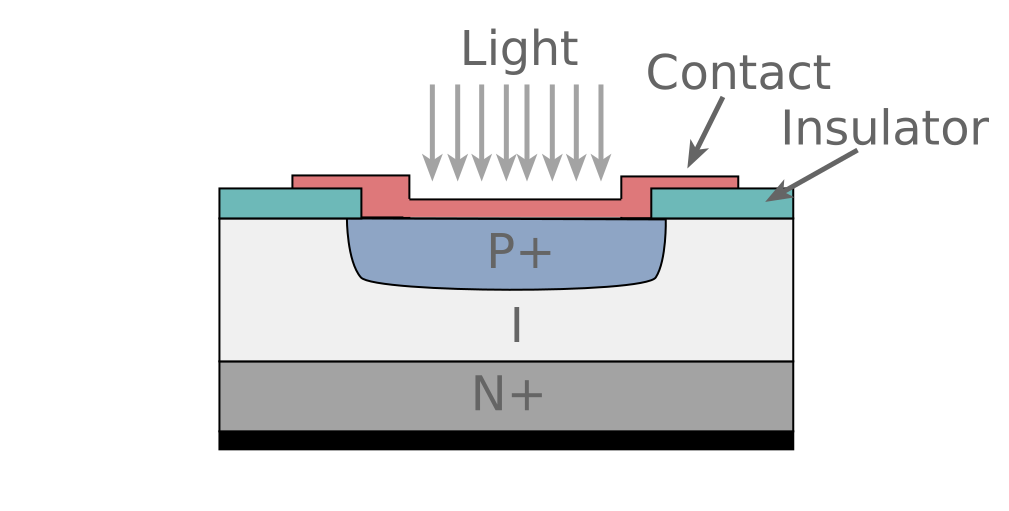
In the photodiode fabrication process a thick intrinsic layer is inserted between the P type and N type layers. This middle intrinsic layer may be either completely instrinsic, or very lightly doped to make it and N- layer. In some instances it may be grown as an epitaxial layer onto the substrate, or alternatively it may be contained within the substrate itself.
One of the main requirements of the photodiode is to ensure that the maximum amount of light reaches the intrinsic layer. One of the most efficient ways of achieving this is to place the electrical contacts at the side of the device as shown. This enables the maximum amount of light to reach the active area. It is found that as the substrate is heavily doped, there is very little loss of light due to the fact that this is not the active area.
As light is mostly absorbed within a certain distance, the thickness of the intrinsic layer is normally made to match this. Any increase in thickness over this will tend to reduce the speed of operation - a vital factor in many applications, and it will not improve the efficiency greatly.
It is also possible to have the light enter the photo diode from the side of the junction. By operating the photo diode in this fashion the intrinsic layer can be made much less to increase the speed of operation, although the efficiency is reduced.
In some instances a heterojunction may be used. This form of structure has the additional flexibility that light can be received from the substrate and this has a larger energy gap which makes it transparent to light.
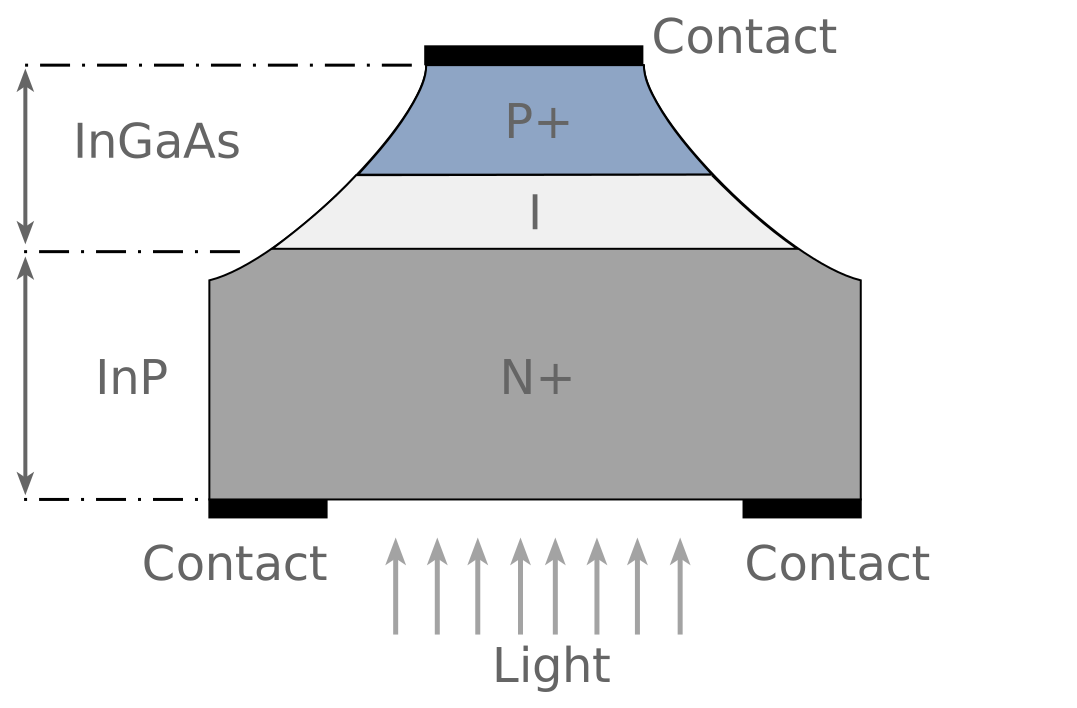
The heterojunction format for a PIN photodiode uses less standard technology often using materials such as the InGaAs and InP depicted in the diagram. Being a less standard process, it is more expensive to implement and as a result tends to be used for more specialist products.
PN / PIN photodiode materials
The materials for the photodiodes determine many of its characteristics. One of the key properties or characteristics is the wavelength of light to which the diode responds. Another is the level of noise. Both of these are governed to a large extent by the material used in the photodiode.
The varying response to the wavelength caused by the use of the different materials occurs because only photons with sufficient energy to excite an electron across the bandgap of the material will produce significant energy to develop the current from the photodiode.
| Wavelength ranges for commonly used photodiode materials | |
|---|---|
| Material | Wavelength sensitivity (nm) |
| Germanium | 800 - 1700 |
| Indium gallium arsenide | 800 - 2600 |
| Lead sulphide | ~1000 - 3500 |
| Silicon | 190 - 1100 |
While the wavelength sensitivity of the material is very important, another parameter that can have a major impact on the performance of the photodiode is the level of noise that is produced. Because of their greater bandgap, silicon photodiodes generate less noise than germanium photodiodes. However it is also necessary to consider the wavelengths for which the photodiode is required and germanium photodiodes must be used for wavelengths longer than approximately 1000 nm.
PIN photodiode applications
The PIN photo-diode does not have any gain, and for some applications this may be a disadvantage. Despite this it is still the most widely used form of diode, finding applications in audio CD players, and DVD drives, etc. In addition to this they are used in optical communication systems.
PIN photodiode are also used as nuclear radiation detectors. There are several types of nuclear radiation. The radiation may be in the form of high energy charged or uncharged particles, or it may also be electromagnetic radiation. The diode can detect all these forms of radiation. The electromagnetic radiation, of which light is a form, generates the hole-electron pairs as already mentioned. The particles have exactly the same effect. However as only a small amount of energy is required to generate a hole-electron pair a single high-energy particle may generate several hole-electron pairs.
PN / PIN photodiode comparison
Both PN photodiodes and PIN photodiodes can be obtained from many suppliers. When designing photo detector circuit, it is necessary to choose the correct type of photo diode dependent upon the performance and characteristics needed:
PN photodiode:
- A PN photodiode does not require a reverse bias and as a result is more suitable for low light applications as a result of the improved noise performance.
PIN photodiode:
- Reverse bias required by the PIN photodiode introduces a noise current which reduces signal to noise ratio
- The reveres bias offers better performance for high dynamic range applications
- The reverse bias required offers better performance for high bandwidth applications as the capacitance between the P and N regions as well as charge storage is small.
In this way it can be seen that the PN photodiode and PIN photodiode have different characteristics that enable them to be used in different applications.
More Electronic Components:
Batteries
Capacitors
Connectors
Diodes
FET
Inductors
Memory types
Phototransistor
Quartz crystals
Relays
Resistors
RF connectors
Switches
Surface mount technology
Thyristor
Transformers
Transistor
Unijunction
Valves / Tubes
Return to Components menu . . .