Gunn Diode: microwave diode tutorial
The Gunn diode forms an easy method of generating microwave signals using a single diode element.
Gunn Diode Tutorial Includes:
Gunn diode
Other diodes: Diode types
Gunn diodes have been available for many years and they form a very effective method of generating microwave signals anywhere from around 1 GHz up to frequencies of possibly 100 GHz.
Gunn diodes are also known as transferred electron devices, TED. Although is referred to as a diode, the devices does not possess a PN junction. Instead the device uses an effect known as the Gunn effect (named after the discoverer, J B Gunn).
Although the Gunn diode is normally used for generating microwave RF signals, the Gunn diode may also be used for an amplifier in what may be known as a transferred electron amplifier or TEA.
As Gunn diodes are easy to use, they form a relatively low cost method for generating microwave RF signals, often being mounted within a waveguide to form a simple resonant cavity.
Gunn diode symbol
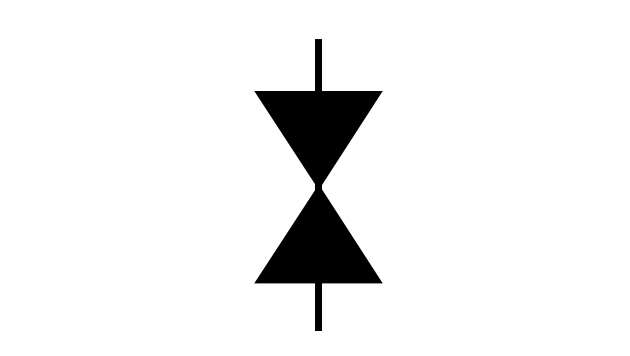
There is a variety of Gunn diode symbols that may be seen used within circuit diagrams. Possibly the most widely used Gunn diode symbol uses two filled in triangles with points touching is used as shown below.
Gunn diode basics
The Gunn diode is a unique component - even though it is called a diode, it does not contain a PN diode junction. The Gunn diode or transferred electron device can be termed a diode because it has two electrodes.
The Gunn diode operation depends on the fact that it has a voltage controlled negative resistance – this being dependent upon the fact that when a voltage is placed across the device, most of the voltage appears across the inner active region. This inner region is particularly thin and this means that the voltage gradient that exists in this region is exceedingly high.
The device exhibits a negative resistance region on its V/I curve as seen below. This negative resistance area enables the Gunn diode to amplify signals, enabling it to be used in amplifiers and oscillators. However it is the Gunn diode oscillators are the most commonly used.
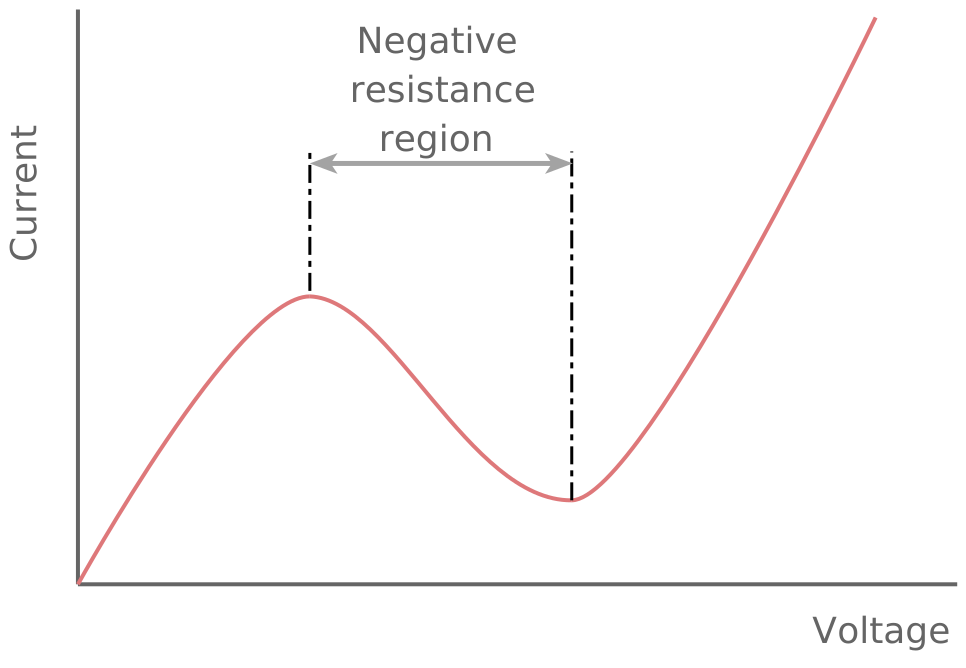
This negative resistance region means that the current flow in diode increases in the negative resistance region when the voltage falls - the inverse of the normal effect in any other positive resistance element. This phase reversal enables the Gunn diode to act as an amplifier and as an oscillator.
How a Gunn diode acts as an oscillator
Whilst the Gunn diode has a negative resistance region, it is interesting to see a little more about how this happens and how it acts as an oscillator.
At microwave frequencies, it is found that the dynamic action of the diode incorporates elements resulting from the thickness of the active region.
When the voltage across the active region reaches a certain point a current is initiated that travels across the active region. During the time when the current pulse is moving across the active region the potential gradient falls preventing any further pulses from forming. Only when the pulse has reached the far side of the active region will the potential gradient rise, allowing the next pulse to be created.
It can be seen that the time taken for the current pulse to traverse the active region largely determines the rate at which current pulses are generated. It is this that determines the frequency of operation.
To see how this occurs, it is necessary to look at the electron concentration across the active region. Under normal conditions the concentration of free electrons would be the same regardless of the distance across the active diode region. However a small perturbation may occur resulting from noise from the current flow, or even external noise - this form of noise will always be present and acts as the seed for the oscillation. This grows as it passes across the active region of the Gunn diode.
The increase in free electrons in one area cause the free electrons in another area to decrease forming a form of wave.
The peak will traverse across the diode under the action of the potential across the diode, and growing as it traverses the diode as a result of the negative resistance.
A clue to the reason for this unusual action can be seen if the voltage and current curves are plotted for a normal diode and a Gunn diode. For a normal diode the current increases with voltage, although the relationship is not linear. On the other hand the current for a Gunn diode starts to increase, and once a certain voltage has been reached, it starts to fall before rising again. The region where it falls is known as a negative resistance region, and this is the reason why it oscillates.
Gunn diode construction
Gunn diodes are fabricated from a single piece of n-type semiconductor. The most common materials are gallium Arsenide, GaAs and Indium Phosphide, InP. However other materials including Ge, CdTe, InAs, InSb, ZnSe and others have been used. The device is simply an n-type bar with n+ contacts. It is necessary to use n-type material because the transferred electron effect is only applicable to electrons and not holes found in a p-type material.
Within the device there are three main areas, which can be roughly termed the top, middle and bottom areas.
The most common method of manufacturing a Gunn diode is to grow and epitaxial layer on a degenerate n+ substrate. The active region is between a few microns and a few hundred micron thick. This active layer has a doping level between 1014cm-3 and 1016cm-3 - this is considerably less than that used for the top and bottom areas of the device. The thickness will vary according to the frequency required.
The top n+ layer can be deposited epitaxially or doped using ion implantation. Both top and bottom areas of the device are heavily doped to give n+ material. This provides the required high conductivity areas that are needed for the connections to the device.
Devices are normally mounted on a conducting base to which a wire connection is made. The base also acts as a heat sink which is critical for the removal of heat. The connection to the other terminal of the diode is made via a gold connection deposited onto the top surface. Gold is required because of its relative stability and high conductivity.
During manufacture there are a number of mandatory requirements for the devices to be successful - the material must be defect free and it must also have a very uniform level of doping.
Gunn diode advantages & disadvantages
Like any form of component, the Gunn diode has a number of advantages and disadvantages that need to be considered when looking at suitable components for a particular circuit design.
Gunn diode advantages
- High bandwidth
- High reliability
- Low manufacturing cost
- Fair noise performance (does not use avalanche principle).
- Relatively low operating voltage
Gunn diode disadvantages
- Low efficiency below about 10 GHz
- Poor stability – frequency varies with bias and temperature
- FM noise high for some applications
- Small tuning range
Gunn diode history
The Gunn diode is named after a researcher at IBM who in 1962 is credited with having been the first person to notice the effect.
The mechanism behind the transferred electron effect was first published by Ridley and Watkins in a paper in 1961. Further work was published by Hilsum in 1962, and then in 1963 John Battiscombe. J. B. Gunn independently observed the first transferred electron oscillation using Gallium Arsenide, GaAs semiconductor.
Gunn diodes provide an easy and useful method of generating microwave signals. Simply by pacing the Gunn diode in a resonant waveguide cavity and applying a voltage to the diode, it is able to generate the signal.
More Electronic Components:
Batteries
Capacitors
Connectors
Diodes
FET
Inductors
Memory types
Phototransistor
Quartz crystals
Relays
Resistors
RF connectors
Switches
Surface mount technology
Thyristor
Transformers
Transistor
Unijunction
Valves / Tubes
Return to Components menu . . .