
Op Amp Bistable Multivibrator Circuit Design
Bistable circuits can be sued as convenient switches, triggering on incoming pulses and remaining in that state until reset.
Op-amp Circuits Include:
Introduction
Circuits summary
Inverting amplifier
Summing amplifier
Non-inverting amplifier
Inverting vs non-inverting circuits
Variable gain amplifier
High pass active filter
Low pass active filter
Bandpass filter
Notch filter
Comparator
Schmitt trigger
Multivibrator
Bistable
Integrator
Differentiator
Wien bridge oscillator
Phase shift oscillator
Bistable circuits are a widely used form of logic circuit. The circuit can be built using a variety of different types of semiconductor device. In this instance an op amp or comparator is used.
Flip flop or bistable circuits can be used for many applications, and whwn associated with analogue circuitry, the use of a comparator or op amp can be convenient.
What is a bistable
A bistable is an electronic circuit also referred to as a flip-flop or latch. It is a circuit that has two stable states and can be used to store state information.
A flip-flop is a bistable multivibrator and it can be made to change state by signals applied to one or more control inputs and will have one or two outputs. The bistable has two stable states - hence the name bistable. It can be flipped from one state to another by incoming pulses.
Flip-flops and latches are a fundamental building block of digital electronics systems. One of their chief applications is in storing data and as such they are widely used in computers and processor systems of all sorts.
Op amp bistable
This is easy to use an operational amplifier as a bistable multivibrator. An incoming waveform is converted into short pulses and these are used to trigger the operational amplifier to change between its two saturation states. To prevent small levels of noise triggering the circuit, hysteresis is introduced into the circuit, the level being dependent upon the application required. The operational amplifier bistable multivibrator uses just five components, the operational amplifier, a capacitor and three resistors.
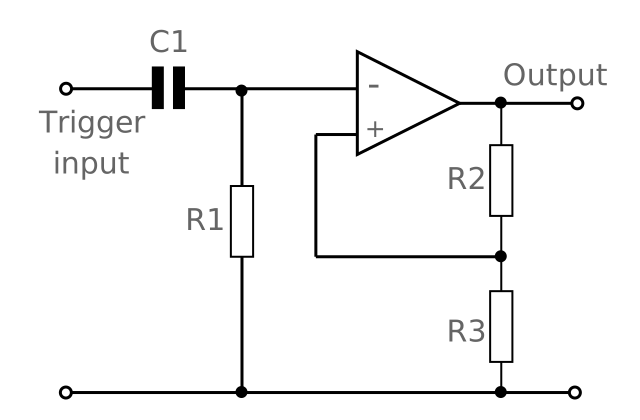
The bistable circuit has two stable states. These are the positive and negative saturation voltages of the operational amplifier operating with the given supply voltages. The circuit can then be switched between them by applying pulses. A negative going pulse will switch the circuit into the positive saturation voltage, and a positive going pulse will switch it into the negative state.
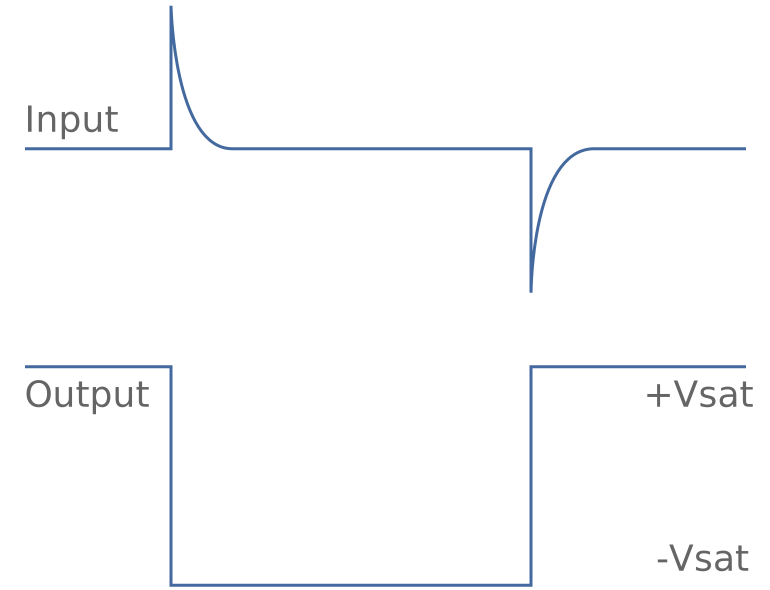
It is very easy to calculate the points at which the circuit will trigger. The positive going pulses need to be greater than Vo-Sat through the potential divider, i.e. -Vsat x R3 / (R2 + R3), and similarly the negative going pulses will need to be greater than +Vsat through the potential divider, i.e. +Vsat x R3 / (R2 + R3). If they are not sufficiently large then the bistable will not change state.
When requiring a switching circuit, comparators are normally better than op amps as they do not exhibit the tendency that some op amps have to latch up. Also comparators are much faster. That said, for some applications an op amp can work well enough.
More Circuits & Circuit Design:
Op Amp basics
Op Amp circuits
Power supply circuits
Transistor design
Transistor Darlington
Transistor circuits
FET circuits
Circuit symbols
Return to Circuit Design menu . . .