
Double Balanced Mixer: circuit, theory, operation
Double balanced RF or frequency mixers are able to provide high levels of performance and they are used in many exacting RF applications.
RF Mixers & Mixing Tutorial Includes:
RF mixing basics
Theory & math
Specs & data
How to buy select mixer
Transistor mixer
FET mixer
Double balanced mixer
Gilbert cell mixer
Image reject mixer
Double balanced mixers are able to provide very high levels of performance in RF or frequency mixing applications.
The action of the double balanced mixer means that the input RF and local oscillator signals are “balanced out” and their level is considerably reduced at the output by having differential circuits on their inputs.
This reduces the need to remove the often unwanted RF and local oscillator signals at the output and reduces the effect of these input signals causing intermodulation distortion.
Double balanced mixers can either be made from the basic electronic components, or they may also be bought as modules for inclusion in a circuit - the latter approach is often adopted because the purchased modules will have been designed, optimised and manufactured by specialist manufacturers ensuing the highest performance.
In view of the level of their usage, double balanced mixers are widely available from a number of specialist RF component suppliers. These suppliers have a wide range of double balanced mixers both as hybrid diode and FET based mixers as well as fully integrated MMIC based devices that should meet the requirements for the majority of RF circuit design applications.
Need for balanced mixers
Many forms of mixer are not balanced and as a result they allow through considerable levels of the local oscillator and RF signals. These are normally not wanted and normally they would have to be removed by filtering which is often inconvenient and expensive. The solution is to balance the mixer to remove the input signals.
There are two types of RF mixer that are balanced:
- Single balanced mixer: Often called just a balanced mixer, this type of mixer will suppress either the LO or RF signal but not both
- Double balanced mixer Unlike the single balanced mixer, the double balanced mixer suppresses both of the input signals.
While single balanced mixers offer many advantages over simpler designs, the double balanced mixer is more widely used. However there are a number of advantages and disadvantages over a single balanced mixer to consider:
Double balanced mixer advantages.
- Increased linearity.
- Better suppression of spurious products - all even order products of the LO and RF inputs are suppressed.
- Isolation between all ports.
Double balanced mixer disadvantages.
- Higher level LO drive level is often required.
- At least two baluns are required within the design - these add cost and complexity
Despite the increased complexity, double balanced mixers are more widely used for applications where high performance is paramount.
RF / frequency mixer ports
Like all other RF mixers, double balanced mixers have the same three ports or connections.
- RF input: This port on the mixer is connected to the incoming signal that is to have its frequency converted.
- Local Oscillator or LO input: This port takes in the internal local oscillator signal that is used to convert the RF signal to the new frequency.
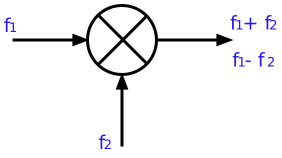
- IF output: The third port of the double balanced mixer is normally referred to as the IF or intermediate frequency output. The signal on the output of an ideal RF mixer should contain only the mixer products, i.e. the sum and difference frequencies of the two input signals.
Types of double balanced mixer
Double balanced mixers come in a variety of forms using different types of electronic component and having some slightly different formats.
Hybrid based diode double balanced mixer: This type of double balanced mixer is the stereotypes double balanced mixer. It uses two main electronic components namely a ring of four diodes, which are normally Schottky diodes and baluns on two or more ports. It is primarily these baluns that add the cost and also limit the frequency response of the RF mixer.
Hybrid based active double balanced mixer: This form of double balanced mixer replaces the diodes with an active device to act as the switching elements within the ring circuit. Again hybrid baluns are used on both input circuits, but the format is again the same. The electronic components include the expensive wound baluns as well as the active devices, e.g. FETs which have a good switching performance.
Active double balanced mixer: Using active differential amplifier circuits, it is possible to achieve the balanced operation for the RF mixer. This enables the complete mixer circuit to be fabricated on a single semiconductor chip. Most high performance RF mixers, as well as many lower performance ones use this technology. The cost of the high performance active double balanced mixers is much less than those using wound components, and they offer a much wider bandwidth.
In view of the better RF performance and lower cost of active double balanced mixers using no hybrids, this type of mixer is used in most RF circuit design applications these days. Mixers are available in standard surface mount technology packages for many applications and for more exacting ones, special monolithic microwave ICs, MMICs are available for RF mixers.
Reversing switch mixers
Double balanced mixers are a form of what is termed a "reversing switch mixer." Reversing switch mixers operate by using electronic switches in a bridge formation to reverse the input RF signal under the action of the local oscillator used as a square wave switching signal. They normally offer significant advantages over analogue mixers for radio communications and general RF design applications as they are able to offer better levels of dynamic range and noise. In view of this fact, they are normally used in high performance applications where noise and dynamic range are of importance - e.g. in the front end of a radio receiver or spectrum analyzer.
Double balanced mixer basics
The most common form of double balanced mixer is the diode double balanced mixer. In its simplest form it consists of two unbalanced to balanced transformers and a diode ring consisting of four diodes as shown.
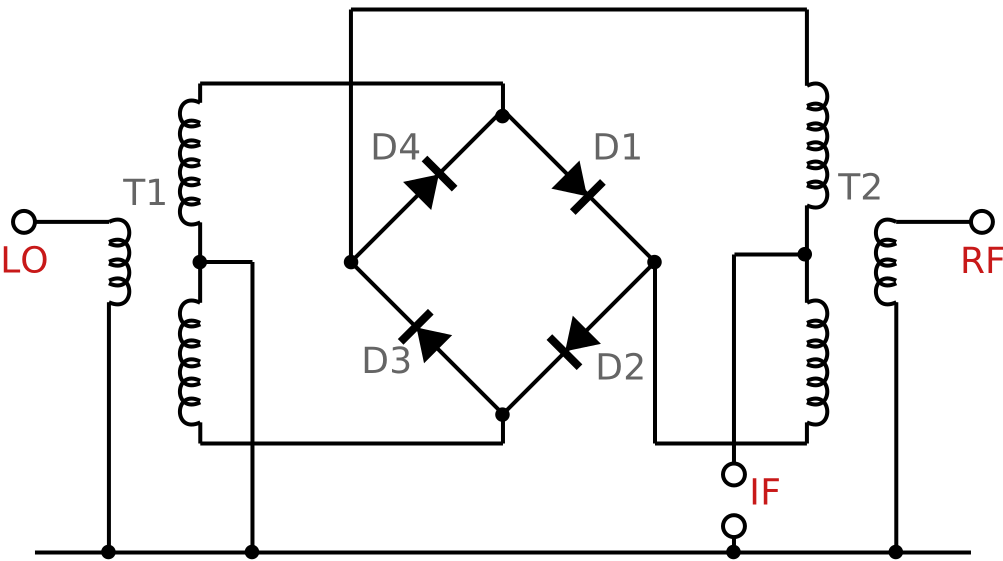
Although the design of the RF mixer looks straightforward, high performance mixers are designed and built to exacting standards to achieve the high levels of performance needed.
One of the key specifications for a double balanced mixer is whether any of the LO or RF signals appear at the IF port. This depends upon the diode and transformer uniformity. In addition to this the circuit offers high isolation between the RF and IF ports because the balanced diode switching precludes direct connection between T1 and T2.
Double balanced mixer components
Although there are comparatively few components in a double balanced mixer, their individual performance is crucial to the performance of the RF mixer as a whole.
Normally Schottky barrier diodes are used for the diode ring. They offer a low on resistance and they also have a good high frequency response. Ordinary signal diodes may be used for low performance applications, although the cost difference is small. It is found that the diode forward voltage drop for the diodes determines the optimum local oscillator drive level. RF mixers requiring to handle a high RF input level will need a correspondingly high LO input level. As a rule of thumb the LO signal level should be a minimum of 20dB higher than either the RF or IF signals. This ensures that the LO signal rather than the RF or IF signals switch the RF mixer, and this is a key element in reducing intermodulation distortion, IMD, and also maximising the dynamic range.
To increase the required drive level, it is possible to place multiple diodes in each leg. The most common LO drive level for a double balanced mixer is probably +7dBm. However they can be obtained with a variety of drive levels. Values of 0, +3, +7, +10, +13, +17, +23, and +27 dBm are normally available.
In order to provide the required level of performance, the quad diodes used win these mixers are generally fabricated monolithically. By doing this they will have very closely matched performance parameters, and in particular the level of forward voltage will be virtually identical in all the diodes.
The transformers are also critical to the performance of the RF mixer. Creating a wideband balun for the mixer is one of the key elements within the overall mixer design and achieving the required bandwidth and performance can be difficult to achieve.
The matching of the transformers and the individual legs are important in determining the balance of the RF mixer. The transformer also plays an important role in determining the conversion loss and drive level of the RF mixer. As the transformers are wound on a ferrite core, the core loss, copper loss and impedance mismatch all contribute to the transformer losses.
Double balanced mixer operation
The operation of the double balanced mixer is relatively easy to understand. The local oscillator, LO, signal turns on first one arm (D3, D4), and then the other (D1, D2) within the diode ring.
As the points where the LO signal enters the diode ring at the junction of D1 and D4 appear as a virtual earth to the RF signal, this means that the points where the RF signal enters are alternatively connected to ground as the diodes turn on and off.
The operation of the mixer means that the RF signal with alternating inverse phases is routed to the IF port according to the switching action of the local oscillator - in other words the signal at the IF port has been multiplied by the local oscillator waveform.
Double balanced FET mixer
While diode mixers are able to offer excellent performance, the increase in use of wireless and general radio communications systems means that receivers need to be able to accommodate a larger number of local strong signals than may have been the case previously. Better low end noise performance along with higher third order intercept points are required. The performance figures required by double balanced diode mixers cannot always meet the requirements for some designs, unless significant tailoring is undertaken and this increases the costs beyond economic viability. Conventional double balanced diode mixers can offer a third order intercept performance up to figures of between about +25 and +30 dBm.
To offer an alternative to the diode mixer, it is possible to use a double balanced FET mixer. Well-designed FET mixers are able to offer extremely linear performance along with high third order intercept points - some as high as +38dBm.
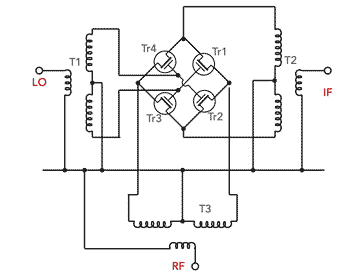
The diagram shows the basic concept of a double balanced FET mixer. However some mixers require the application of a DC bias to ensure the correct switching of the diodes, and some mixers show a high conversion loss or noise figure. Double balanced FET mixers using discrete components can sometimes be optimised to provide better performance figures, and newer commercially available items are also offering better performance.
Practical aspects for double balanced mixers
Using double balanced mixers enables very high levels of performance to be achieved. However a few useful hints and tips ensure that the mots can be made from using them.
- Use the right drive level: In order to ensure the correct operation of the mixer it is necessary to ensure that the correct specified drive level is used. In this way the diodes in the RF mixer will switch correctly.
- Choose the right level mixer for the RF design: In a similar vein to using the specified drive level, the particular RF mixer should be chosen so that the drive level is sufficiently high for the particular RF design. Normally the LO drive should be at least 20 dB higher than the highest expected RF or IF signal anticipated. This will ensure the optimum IMD and dynamic range.
- Ensure the ports are accurately matched: Diode double balanced mixers are termination impedance sensitive. They must be terminated with the correct resistive load or source impedance (normally 50 ohms). A wideband resistive output is particularly important if it is to achieve the highest dynamic range. This can be achieved by using an attenuator pad in the line. Although this can be used for the LO port, this approach is not normally suitable for the RF and IF ports as it would impair the noise figure. Instead accurate matching of the amplifier stages preceding and following the mixer is one solution.
- Tap off the IF from the RF balun: By tapping of the IF output from the RF input, it is possible to achieve a far greater level of LO rejection - typically 20dB.
Double balanced mixers are widely used in RF applications where performance is paramount. Although they are more costly than many other forms of frequency mixer, they offer the performance that is often required Typically these mixers are bought from specialist manufacturers because they have the expertise and the manufacturing capability for the transformers and other components that are required. Additionally the development and optimisation cost is spread over a large number of units.
More Essential Radio Topics:
Radio Signals
Modulation types & techniques
Amplitude modulation
Frequency modulation
OFDM
RF mixing
Phase locked loops
Frequency synthesizers
Passive intermodulation
RF attenuators
RF filters
RF circulator
Radio receiver types
Superhet radio
Receiver selectivity
Receiver sensitivity
Receiver strong signal handling
Receiver dynamic range
Return to Radio topics menu . . .