What is HSPA: Tutorial
High speed packet access, HSPA is an upgrade to 3G UMTS to provide very high higher data rates in both uplink and downlink.
3H HSPA includes:
3G HSPA introduction
HSDPA
HSDPA channels
HSDPA categories
HSUPA
HSUPA categories
HSUPA channels
Evolved HSPA (HSPA+)
Dual carrier HSPA
3G UMTS enabled mobile communications to move from voice-centric systems to data centric ones. However the speeds that could be supported wee nowhere near sufficient to enable Internet surfing and video downloads.
To overcome this 3G UMTS was upgraded with high speed packet access, HSPA to provide a major leap in performance and make it suitable to cover its requirements.
Initially the downlink was addressed using high speed downlink packet access, HSDPA and then upgrades were added to the uplink with high speed uplink packet access.
Further upgrades were added later with dual carrier and MIMO capabilities to raise the data speeds hugely above those first envisaged for 3G.
HSPA features
The system provides an enhancement on the basic 3G WCDMA / UMTS cellular system, providing data transfer rates that are considerably in excess of those originally envisaged for 3G as well as much greater levels of spectral efficiency.
The system provides many advantages for users over the original UMTS system.
As the 3GPP standards evolved, so did the performance available.
| 3G HSPA Speed & Highlight Features | ||||
|---|---|---|---|---|
| 3GPP Release | Technology | Downlink Speed (MBPS) | Uplink Speed (MBPS) | |
| Rel 5 | HSDPA | 14.4 | 0.384 | |
| Rel 6 | HSUPA | 14.4 | 5.7 | |
| Rel 7 | 2xdata capacity 2x voice capacity |
28 | 11 | |
| Rel 8 | Multi-carrier | 42 | 11 | |
| Rel 9 | Multicarrier, 10 MHz, 2x2 MIMO UL, 10 MHz & 16-QAM D/L |
84 | 23 | |
| Rel 10 | 20 MHz 2x2 MIMO in UL, 10 | 168 | 23 | |
| Rel 11 | 40 MHz 2x2 / 4x4 MIMO UL, 10 MHz 64-QAM MIMO DL |
336 - 672 | 70 | |
3G HSPA benefits
The UMTS cellular system as defined under the 3GPP Release 99 standard was orientated more towards switched circuit operation and was not well suited to packet operation. Additionally greater speeds were required by users than could be provided with the original UMTS networks. Accordingly the changes required for HSPA were incorporated into many UMTS networks to enable them to operate more in the manner required for current applications.
HSPA provides a number of significant benefits that enable the new service to provide a far better performance for the user. While 3G UMTS HSPA offers higher data transfer rates, this is not the only benefit, as the system offers many other improvements as well:
- Use of higher order modulation: 16QAM is used in the downlink instead of QPSK to enable data to be transmitted at a higher rate. This provides for maximum data rates of 14 Mbps in the downlink. QPSK is still used in the uplink where data rates of up to 5.8 Mbps are achieved. The data rates quoted are for raw data rates and do not include reductions in actual payload data resulting from the protocol overheads.
- Shorter Transmission Time Interval (TTI): The use of a shorter TTI reduces the round trip time and enables improvements in adapting to fast channel variations and provides for reductions in latency.
- Use of shared channel transmission: Sharing the resources enables greater levels of efficiency to be achieved and integrates with IP and packet data concepts.
- Use of link adaptation: By adapting the link it is possible to maximize the channel usage.
- Fast Node B scheduling: The use of fast scheduling with adaptive coding and modulation (only downlink) enables the system to respond to the varying radio channel and interference conditions and to accommodate data traffic which tends to be "bursty" in nature.
- Node B based Hybrid ARQ: This enables 3G HSPA to provide reduced retransmission round trip times and it adds robustness to the system by allowing soft combining of retransmissions.
For the network operator, the introduction of 3G HSPA technology brings a cost reduction per bit carried as well as an increase in system capacity. With the increase in data traffic, and operators looking to bring in increased revenue from data transmission, this is a particularly attractive proposition. A further advantage of the introduction of 3G HSPA is that it can often be rolled out by incorporating a software update into the system. This means its use brings significant benefits to user and operator alike.
3G UMTS HSPA constituents
There are two main components to 3G UMTS HSPA, each addressing one of the links between the base station and the user equipment, i.e. one for the uplink, and one for the downlink.
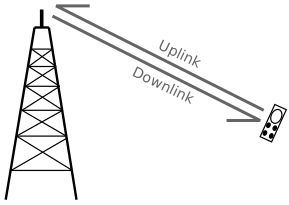
The two technologies were released at different times through 3GPP. They also have different properties resulting from the different modes of operation that are required. In view of these facts they were often treated as almost separate entities. Now they are generally rolled out together. The two technologies are summarised below:
- HSDPA - High Speed Downlink Packet Access: HSDPA provides packet data support, reduced delays, and a peak raw data rate (i.e. over the air) of 14 Mbps. It also provides around three times the capacity of the 3G UMTS technology defined in Release 99 of the 3GPP UMTS standard.
- HSUPA - High Speed Uplink Packet Access: HSUPA provides improved uplink packet support, reduced delays and a peak raw data rate of 5.74 Mbps. This results in a capacity increase of around twice that provided by the Release 99 services.
UMTS HSPA and 3GPP standards
The new high speed technology is part of the 3G UMTS evolution. It provides additional facilities that are added on to t e basic 3GPP UMTS standard. The upgrades and additional facilities were introduced at successive releases of the 3GPP standard.
- Release 4: This release of the 3GPP standard provided for the efficient use of IP, a facility that was required because the original Release 99 focussed on circuit switched technology. Accordingly this was a key enabler for 3G HSDPA.
- Release 5: This release included the core of HSDPA itself. It provided for downlink packet support, reduced delays, a raw data rate (i.e. including payload, protocols, error correction, etc) of 14 Mbps and gave an overall increase of around three over the 3GPP UMTS Release 99 standard.
- Release 6: This included the core of HSUPA with an enhanced uplink with improved packet data support. This provided reduced delays, an uplink raw data rate of 5.74 Mbps and it gave an increase capacity of around twice that offered by the original Release 99 UMTS standard. Also included within this release was the MBMS, Multimedia Broadcast Multicast Services providing improved broadcast services, i.e. Mobile TV.
- Release 7: This release of the 3GPP standard included downlink MIMO operation as well as support for higher order modulation up to 64-QAM in the uplink and 16-QAM in the downlink. However it only allows for either MIMO or the higher order modulation. It also introduced protocol enhancements to allow the support for Continuous Packet Connectivity (CPC).
- Release 8: This release of the standard occurred during the course of 2008 and it defines dual carrier operation as well as allowing simultaneous operation of the high order modulation schemes and MIMO. Further to this, latency is improved to keep it in line with the requirements for many new applications being used.
- Release 9: 3GPP Release 9 occurred during 2009 and included facilities for HPSA including 2x2MIMO in the uplink and a 10MHz bandwidth in the downlink. The uplink carriers may be from different bands.
- Release 10: HSPA Release 10 utilises up to 4-carriers, i.e. 20 MHz bandwidth which may be from two separate bands. In addition to this 2x2 MIMO in the downlink provides data rates up to 168 Mbps. This figure equates to that obtained for LTE Release 8 when using comparable bandwidth and antennas configurations.
- Release 11: Release 11 occurred during 2011 / 2012. It provided the facility for 40MHz bandwidth in the uplink along with up to 4x4 MIMO. The downlink was upgraded to accommodate 64-QAM modulation and MIMO.
- Release 12: This 3GPP release is occurring in 2013 / 2014.
3G HSPA provides a major improvement in performance to the 3G UMTS mobile telecommunications system. The top data rates for HSPA compete well with the 4G LTE technology. As such the 3G infrastructure usage was prolonged and enabled many operators to maximise the use of their investment before having to add the capability for 4G.
Wireless & Wired Connectivity Topics:
Mobile Communications basics
2G GSM
3G UMTS
4G LTE
5G
Wi-Fi
Bluetooth
IEEE 802.15.4
DECT cordless phones
Networking fundamentals
What is the Cloud
Ethernet
Serial data
USB
LoRa
VoIP
SDN
NFV
SD-WAN
Return to Wireless & Wired Connectivity