
What is ZigBee Technology
Zigbee has been established for many years as an IoT network standard for remote control and sensing applications.
Zigbee Includes:
Zigbee technology basics
The Zigbee standard is a standard built on top of IEEE 802.15.4 which provides the upper layers for control and sensor applications.
It has been designed to be very robust so that it can operate reliably in harsh radio environments, providing security and flexibility.
As an open standard, Zigbee is able to operate using items from a variety of manufacturers.
ZigBee Alliance
As Zigbee is an open standard it is developed and maintained by an industry alliance called the Zigbee Alliance. This was initially set up in 2002 and since then its membership has grown considerably as the adoption of the standard has increased.
The Zigbee Alliance has three levels of membership:
- Adopter: The Adopter Zigbee Alliance members are allowed access to completed Zigbee specifications and standards
- Participant: Participant members have voting rights, play a role in Zigbee development, and have early access to specifications and standards for product development.
- Promoter: The Promoter membership of the Zigbee Alliance provides automatic voting rights in all work groups, final approval rights on all standards and a seat on the Alliance Board of Directors.
A further advantage of Zigbee Alliance membership is the benefits of the global marketing efforts of the Alliance which actively promotes use of Zigbee standards.
ZigBee basics
The distances that can be achieved transmitting from one station to the next extend up to about 70 metres, although very much greater distances may be reached by relaying data from one node to the next in a network.
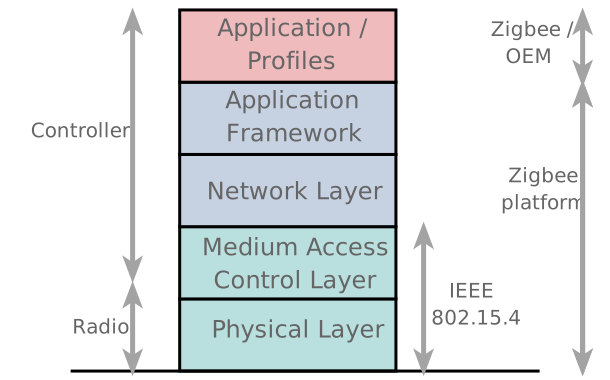
The main applications for 802.15.4 are aimed at control and monitoring applications where relatively low levels of data throughput are needed, and with the possibility of remote, battery powered sensors, low power consumption is a key requirement. Sensors, lighting controls, security and many more applications are all candidates for the new technology.
Physical and MAC layers
The system is specified to operate in one of the three license free bands at 2.4 GHz, 915 MHz for North America and 868 MHz for Europe. In this way the standard is able to operate around the globe, although the exact specifications for each of the bands are slightly different. At 2.4 GHz there are a total of sixteen different channels available, and the maximum data rate is 250 kbps. For 915 MHz there are ten channels and the standard supports a maximum data rate of 40 kbps, while at 868 MHz there is only one channel and this can support data transfer at up to 20 kbps.
The modulation techniques also vary according to the band in use. Direct sequence spread spectrum (DSSS) is used in all cases. However for the 868 and 915 MHz bands the actual form of modulation is binary phase shift keying. For the 2.4 GHz band, offset quadrature phase shift keying (O-QPSK) is employed.
In view of the fact that systems may operate in heavily congested environments, and in areas where levels of extraneous interference is high, the 802.15.4 specification has incorporated a variety of features to ensure exceedingly reliable operation. These include a quality assessment, receiver energy detection and clear channel assessment. CSMA (Carrier Sense Multiple Access) techniques are used to determine when to transmit, and in this way unnecessary clashes are avoided.
Data transfer
The data is transferred in packets. These have a maximum size of 128 bytes, allowing for a maximum payload of 104 bytes. Although this may appear low when compared to other systems, the applications in which 802.15.4 and ZigBee are likely to be used should not require very high data rates.
The standard supports 64 bit IEEE addresses as well as 16 bit short addresses. The 64 bit addresses uniquely identify every device in the same way that devices have a unique IP address. Once a network is set up, the short addresses can be used and this enables over 65000 nodes to be supported.
It also has an optional superframe structure with a method for time synchronisation. In addition to this it is recognised that some messages need to be given a high priority. To achieve this, a guaranteed time slot mechanism has been incorporated into the specification. This enables these high priority messages to be sent across the network as swiftly as possible.
Upper layers (ZigBee)
Above the physical and MAC layers defined by 802.15.4, the ZigBee standard itself defines the upper layers of the system. This includes many aspects including the messaging, the configurations that can be used, along with security aspects and the application profile layers.
There are three different network topologies that are supported by ZigBee, namely the star, mesh and cluster tree or hybrid networks. Each has its own advantages and can be used to advantage in different situations.
The star network is commonly used, having the advantage of simplicity. As the name suggests it is formed in a star configuration with outlying nodes communicating with a central node.
Mesh or peer to peer networks enable high degrees of reliability to be obtained. They consist of a variety of nodes placed as needed, and nodes within range being able to communicate with each other to form a mesh. Messages may be routed across the network using the different stations as relays. There is usually a choice of routes that can be used and this makes the network very robust. If interference is present on one section of a network, then another can be used instead.
Finally there is what is known as a cluster tree network. This is essentially a combination of star and mesh topologies.
Both 802.15.4 and ZigBee have been optimised to ensure that low power consumption is a key feature. Although nodes with sensors of control mechanisms towards the centre of a network are more likely to have mains power, many towards the extreme may not. The low power design has enabled battery life to be typically measured in years, enabling the network not to require constant maintenance.
ZigBee standards and releases
The Zigbee standards are developed and maintained by the Zigbee Alliance and over the years there have been several releases of the Zigbee standard.
| Summary of Zigbee Standards & Releases | |
|---|---|
| ZigBee version | Comments and details |
| ZigBee 2004 | This was the original release of ZigBee - defined as ZigBee 1.0 which was publicly released in June 2005. |
| ZigBee 2006 | This release of the ZigBee standard introduced the concept of a cluster library and was released in September 2006. |
| ZigBee 2007 | The next version of the ZigBee standard was released publicly in October 2008 and contained two different profile classes |
| ZigBee PRO | ZigBee PRO was a profile class that was released in the ZigBee 2007 release. ZigBee PRO provides additional features required for robust deployments including enhanced security. |
| RF4CE | RF4CE - Radio Frequency for (4) Consumer Electronics was a standard that was aimed at audio visual applications. It was taken on board by the ZigBee Alliance and the Version 1.0 of the standard was released in 2009. |
Zigbee has gained a place in the marketplace where it is aimed at providing reliable mesh networking to enable a network to operate over a wide area, whilst also providing low power communications. In this way, Zigbee is an ideal IoT technology.
Wireless & Wired Connectivity Topics:
Mobile Communications basics
2G GSM
3G UMTS
4G LTE
5G
Wi-Fi
Bluetooth
IEEE 802.15.4
DECT cordless phones
Networking fundamentals
What is the Cloud
Ethernet
Serial data
USB
LoRa
VoIP
SDN
NFV
SD-WAN
Return to Wireless & Wired Connectivity