
IEEE 802.11g Wi-Fi
Introduced in 2003 IEEE 802.11g Wi-Fi became the main standard for a number of years providing high speed wireless data
WiFi IEEE 802.11 Types Includes:
Standards
802.11a
802.11b
802.11g
802.11n
802.11ac
802.11ad WiGig
802.11af White-Fi
802.11ah Sub GHz Wi-Fi
802.11ax Wi-Fi 6
802.11be Wi-Fi 7
802.11 topics:
Wi-Fi IEEE 802.11 basics
Standards
Wi-Fi Alliance generations
Security
Wi-Fi Bands
Router location & coverage
How to buy the best Wi-Fi router
IEEE 802.11g was one of the main Wi-Fi standards to follow on from 802.11a and 802.11b. It built on the performance and played a pivotal role in further establishing Wi-Fi as a major wireless communications standard.
IEEE 802.11g had the advantage that it could support the high data speeds using 2.4 GHz which had previously only attainable using 802.11a within the 5GHz ISM band.
In doing this it further established wireless technology as a viable standard for data communications using wireless LANs at home and in the office.

The lower cost of chips using 2.4GHz combined with the higher speed meant that for many years it became the dominant Wi-Fi technology. Although 5 GHz was less congested and had greater bandwidth which gave better performance for wireless LANs, the additional cost for chips at 5 GHz was still a major factor.
802.11g specifications
The "g" standard for Wi-Fi offered a good number of highlight features, and it was a major leap forward over the previous 802.11b version that standard the use of 2.4 GHz for wireless LAN usage.
The 802.11g standard provided a number of improvements over the 802.11b standard which was its predecessor. The highlights of its performance are given in the table below.
| IEEE 802.11g Wi-Fi Features | |
|---|---|
| Feature | 802.11g |
| Date of standard approval | June 2003 |
| Maximum data rate (Mbps) | 54 |
| Modulation | CCK, DSSS, or OFDM |
| RF Band (GHz) | 2.4 |
| Channel width (MHz) | 20 |
802.11g physical layer
Like 802.11b, its predecessor, 802.11g operates in the 2.4 GHz ISM band. It provides a maximum raw data throughput of 54 Mbps, although this translates to a real maximum throughput of just over 24 Mbps. In fact the raw data rate is the same as the older 802.11a version for WLANs that was launched at the same time as 802.11b.
Although the system is compatible with 802.11b, the presence of an 802.11b participant in a network significantly reduces the speed of a wireless network. In fact it was compatibility issues that took up much of the working time of the IEEE 802.11g committee.
In order to provide resilience against multipath effects while also being able to carry the high data rates, the main modulation method chosen for 802.11g was that of OFDM - orthogonal frequency division multiplex, although other schemes are used to maintain compatibility, etc.
OFDM is now a popular waveform for high data rate wireless communications and it is used for the 4G and 5G mobile communications systems.
The OFDM waveform or signal format uses a large number of close spaced carriers, each carrying a low data rate. The carriers can be close spaced by matching the reciprocal of the time period for the data rate to the spacing frequency of the carriers.
By matching the carrier spacing in this way, the sidebands from the carriers have minimal mutual interference.
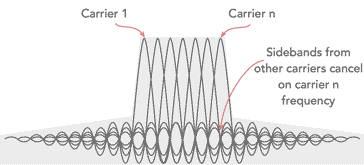
The advantages of using OFDM for wireless networks and wireless communications in general include the high level of spectrum efficiency, the resilience to multi-path effects as well as the selective fading caused by multipath and reflections, etc.
Note on OFDM:
Orthogonal Frequency Division Multiplex, OFDM is a form of signal format that uses a large number of close spaced carriers that are each modulated with low rate data stream. The close spaced signals would normally be expected to interfere with each other, but by making the signals orthogonal to each other there is no mutual interference. The data to be transmitted is shared across all the carriers and this provides resilience against selective fading from multi-path effects.
Read more about OFDM, Orthogonal Frequency Division Multiplexing.
In addition to the use of OFDM, DSSS - direct sequence spread spectrum is also used.
To provide the maximum capability while maintaining backward compatibility, four different physical layers are used - three of which are defined as Extended Rate Physicals, ERPs.
These different physical layers coexist during the frame exchange so that the sender can use any one of the four, provided they are supported at each end of the link. The link will performance data exchanges to determine what can be used.
The four layer options defined in the 802.11g specification are:
- ERP-DSSS-CCK: This layer is that used with 11b. Direct sequence spread spectrum is used along with CCK - complementary code keying. The performance is that of the legacy 802.11b systems.
- ERP-OFDM: This physical layer is a new one introduced for 802.11g where OFDM is used to enable the provision of the data rates at 2.4 GHz that were achieved by 11a at 5.8 GHz.
- ERP-DSSS/PBCC: This physical layer was introduced for use with 802.11b and initially provided the same data rates as the DSS/CCK layer, but with 802.11g, the data rates have been extended to provide 22 and 33 Mbps. As indicated by the title, it uses DSSS technology for the modulation combined with PBCC coding for the data.
- DSSS-OFDM: This layer is new to 11g and uses a combination of DSSS and OFDM - the packet header is transmitted using DSSS while the payload is transmitted using OFDM
802.11g occupies a nominal 22 MHz channel bandwidth, making it possible to accommodate up to three non-overlapping signals within the 2.4 GHz band. Despite this, the separation between different Wi-Fi access points means that interference is not normally too much of an issue.
| IEEE 802.11g Wi-Fi Physical Layer Summary | ||
|---|---|---|
| Physical Layer | Use | Data Rates (Mbps) |
| ERP-DSSS | Mandatory | 1, 2, 5.5, 11 |
| ERP-OFDM | Mandatory | 6, 9, 12, 18, 24, 36, 48, 54 |
| ERP-PBCC | Optional | 1, 2, 5.5, 11, 22, 33 |
| DSSS-OFDM | Optional | 6, 9, 12, 18, 24, 36, 48, 54 |
802.11g packet structure
As with all data transmissions these days, the data is split into packets so that these can be transported over the wireless network interfaces in a manageable fashion and with error detection and correction.
It is customary for data packets to be split into different elements. For Wi-Fi systems the data packets sent over the radio interface can be thought of as consisting of two main parts:
- Preamble / Header: As with any other preamble / header, it serves to alert receivers, in this case radios, that a transmission is to start, and then it enables them to synchronise. The preamble consists of a known series of '1's and '0's that enable the receivers to synchronise with the incoming transmission. The Header element immediately follows the pre-amble and contains information about the data to follow including the length of the payload.
- Payload: This is the actual data that is sent across the radio network and can range from 64 bytes up to 1500 bytes. In most cases the preamble/header are sent using the same modulation format as the payload, but this is not always the case. When using the DSSS-OFDM format, the header is sent using DSSS, while the payload uses OFDM.
The initial 802.11 standard defined a long preamble PLCP frame set. In the later 802.11b standard, an optional short preamble was defined. Then for 802.11g the short preamble PPDU was defined as mandatory.

Abbreviations
PPDU: This is the format into which data is converted by the PLCP for transmission.
PLCP: This is the PHY Layer Convergence Procedure and it transforms each 802.11 frame that a station wishes to send into a PLCP protocol data unit, PPDU.
PDSU: This is the Physical Layer Service Data Unit, it represents the contents of the PPDU, i.e., the actual data to be sent.
Service: This field is always set to 00000000. The802.11 standard reserves its data and format for future use.
For the ERP-OFDM PHY option an ERP packet must be followed by a 6 µs period of no transmission called the signal extension period. The reason for this that for a 16 µs period was allowed in 802.11a to enable convolutional decode processing to finish before the next packet arrived.
Within 802.11g, the ERP-OFDM modulation scheme still requires 16 µs to ensure that the convolutional decoding process is able to be completed within the overall process timing. To enable this to occur, a signal extension of 6 µs is included. This enables the transmitting station to compute the Duration field in the MAC header. In turn this ensures that the NAV value of 802.11b stations is set correctly and compatibility is maintained.
IEEE 802.11g was a very successful wireless LAN standard. It provided a significant enhancement in performance over 802.11b, whilst still carrying its wireless communications data over channels int he 2.4 GHz licence free ISM band.
At this time, there was still a cost penalty for using 5GHz as the higher frequency required the use of most expensive techniques in the IC fabrication process.
Nowadays, 802.11g is not widely used, although some legacy products may still require it, and many more modern devices with wireless connectivity can fall back to use it if required. The technology has moved on to use much more advanced wireless LAN and wireless communications standards which providde much higher data rates and much lower levels of latency. But for its time, 802.11g was widely used and gave a significant leap in performance over previous variants.
Wireless & Wired Connectivity Topics:
Mobile Communications basics
2G GSM
3G UMTS
4G LTE
5G
Wi-Fi
Bluetooth
IEEE 802.15.4
DECT cordless phones
Networking fundamentals
What is the Cloud
Ethernet
Serial data
USB
LoRa
VoIP
SDN
NFV
SD-WAN
Return to Wireless & Wired Connectivity