Spectrum Analyzer Tracking Generator
Tracking generators form an additional option available with many spectrum analyzers that enable them to be used as scalar RF network analyzers.
Spectrum Analyzer Tutorial Includes:
What is a spectrum analyzer
Spectrum analyzer types and technologies
Superheterodyne / sweep spectrum analyzer
FFT spectrum analyzer
Realtime spectrum analyzer
USB spectrum analyzer
Spectrum analyzer tracking generator
Specifications
Spectrum analyzer operation
Noise figure measurements
Phase noise measurements
Pulsed signal spectrum analysis
The tracking generator is an additional option that is available with some spectrum analyzers that enables them to be used as a scalar network analyzer for applications like measuring the response of filters and other networks.
In this way a spectrum analyzer tracking generator is able to extend the capability of basic spectrum analyzers, making them more flexible and versatile.
Spectrum analyzer tracking generator basics
When using a spectrum analyzer to analyzer the spectrum of a signal from a circuit under test in its traditional way, it can be considered as a passive instrument. It is only receiving a signal and analysing it.
However it is possible to add an extra capability to a spectrum analyzer to enable it to make circuit response measurements, i.e. scalar network analyzis.
To provide this capability it is necessary to introduce a signal source to stimulate the device under test – the spectrum analyzer can then be used to measure the response of the network under test. In this way it is possible to make a variety of network measurements including frequency response, conversion loss, return loss, and other measurements such as gain versus frequency, etc..
Normally an RF network analyzer might be used to make network measurements, but these are normally vector instruments measuring both amplitude and phase. As such they are expensive and may not always available. Using a spectrum analyzer with tracking generator enables many scalar measurements to be made.
As many laboratories will already use a spectrum analyzer, the tracking generator approach is particularly attractive. In addition to this, tracking generators are incorporated into many spectrum analyzers as standard. This means that it is possible to use these test instruments to make many network measurements at no additional cost.
What is a spectrum analyzer tracking generator?
A spectrum analyzer tracking generator operates by providing a sinusoidal output to the input of the spectrum analyzer. The by linking the sweep of the tracking generator to the spectrum analyzer, the output of the tracking generator is on the same frequency as the spectrum analyzer, and the two units track the same frequency.
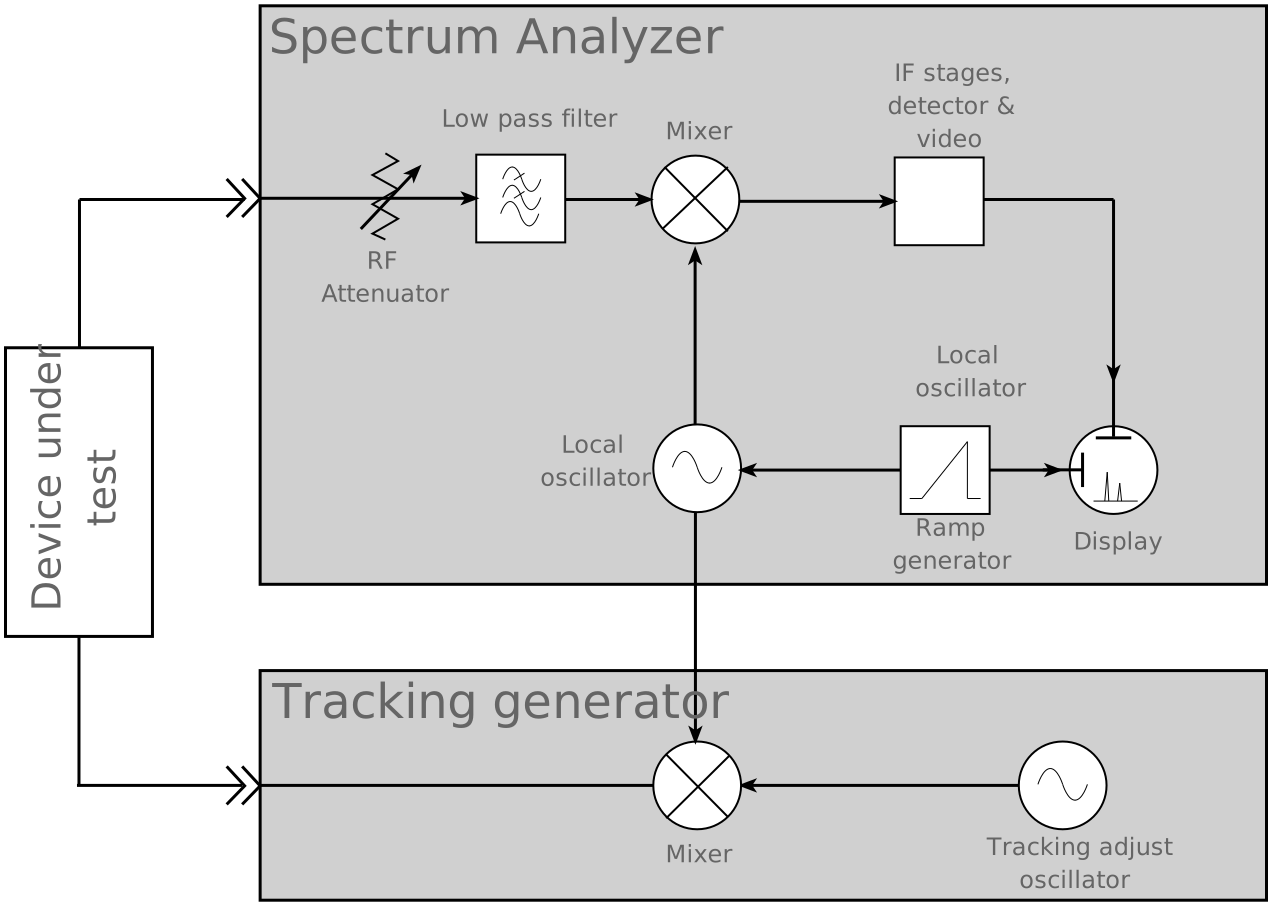
As a result, if the output of the spectrum analyzer tracking generator was connected directly to the input of the spectrum analyzer, a single flat line would be seen with the level reflecting the output level of the tracking generator.
If the direct connection between the generator output and the analyzer is replaced by a network, then the scalar response of the network will alter the level of the tracking generator signal seen by the spectrum analyzer. In this way the response of the network under test will be seen on the spectrum analyzer screen.
Using a spectrum analyzer tracking generator
Typically tracking generators are either built into the spectrum analyzer, or they are available as a companion unit for a particular test instrument. This means that they are normally very easy.
However there are a few standard precautions to remember when using a spectrum analyzer tracking generator:
- Calibrate system using direct connection: To ensure that any cable losses are known, it is always wise to replace the device under test with a back-to-back connector, or other short connecting line. In this way, the system will reveal any losses which it may be possible to "calibrate out".
- Adjust tracking generator to centre of analyse passband: There is often an adjustment for the tracking oscillator to trim its frequency. Before using the tracking generator, it is wise to adjust the frequency trim adjustment to ensure that it is on exactly the same frequency as the spectrum analyzer. This is achieved by maximising the reading on the spectrum analyzer display.
Spectrum analyzer tracking generators can provide a really useful addition to the basic spectrum analyzer functionality. Enabling the measurement of the response of networks of various types, these racking generators can be particularly useful in some applications.
More Test Topics:
Data network analyzer
Digital Multimeter
Frequency counter
Oscilloscope
Signal generators
Spectrum analyzer
LCR meter
Dip meter, GDO
Logic analyzer
RF power meter
RF signal generator
Logic probe
PAT testing & testers
Time domain reflectometer
Vector network analyzer
PXI
GPIB
Boundary scan / JTAG
Data acquisition
Return to Test menu . . .