Oscilloscope Specifications: how to buy the best scope
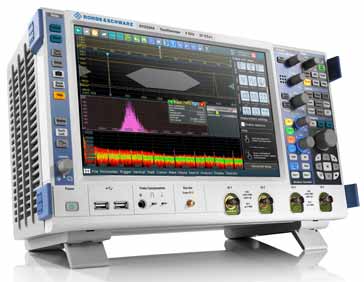
When buying or selecting an oscilloscope it is necessary to match the requirements to the specification - we look at what you need to buy or select the best scope for your applications.
Oscilloscope Tutorial Includes:
Oscilloscope basics
Oscilloscope types
Specifications
How to use an oscilloscope
Scope triggering
Oscilloscope probes
Oscilloscope probe specifications
Scope types includes:
Analogue scope
Analogue storage scope
Digital phosphor scope
Digital scope
USB / PC scope
Mixed Signal Oscilloscope MSO
Oscilloscopes are a very common form of test equipment - possibly the most important type of test equipment.
As a result it is often necessary to be able to choose one either from the test equipment store or as a rental or when buying an oscilloscope.
Video: oscilloscope specifications - a quick guide
When selecting an oscilloscope, whether to buy, rent or even just obtain one from the company store, there are many different specifications and parameters to consider, each one related to the performance.
When selecting an oscilloscope, what are the most important specifications and parameters and which ones will affect the performance of the scope in the particular application. When looking to buy the best oscilloscope, it is necessary to look at all the specifications - everything from the performance specifications to those that may appear less important but can impact their use just as much.
Types of oscilloscope
One of the major specifications associated with buying an oscilloscope is the actual type of oscilloscope that is required. Some types of scope will be able to perform other measurements better than others; some use current technology whereas others are older; and there may be cost implications as well.
Analogue, analogue storage, digital, digital storage, digital sampling, USB scopes and many more types are available.
Oscilloscope bandwidth specification
One important oscilloscope specification is related to the frequency or speed of the waveforms that can be measured. This is determined by the bandwidth of the oscilloscope and it is found that the capability of the oscilloscope to accurately display the waveform falls off with increasing frequency.
The way in which this is specified can be seen in IEEE 1057 which defines electrical bandwidth as the point at which the amplitude of a sine wave input is reduced by 3 dB (i.e. attenuated to 70.7% of the true value of the signal - a fall of approximately 30%) relative to its level at a lower reference frequency.
The oscilloscope specification for bandwidth will typically be quoted in the format: Bandwidth = -3dB at 1500 MHz.
If the oscilloscope specification for the -3dB point is not sufficiently high it will be found that the edges of pulses and square waves will be slowed as a result of the reduction of the high frequency components. Also sine waves above the bandwidth frequency will be significantly attenuated - even those around the bandwidth frequency will suffer some attenuation.
In order to ensure that the oscilloscope specification is adequate it is necessary to ensure that the bandwidth of the scope is higher than the operating frequency.
Often a Five Times Rule is used as a rule of thumb. Here the bandwidth of the oscilloscope should be five times the highest frequency component in the signal. Using this rule, the error due to the frequency limitations will be less than ±2%.
Vertical DC gain accuracy
It is important when measuring the amplitude of signals, to know the accuracy of the measurement that is being made.
As oscilloscopes are not intended to be used instead of digital multimeters, it is not anticipated that the voltage elements of the oscilloscope specification will be as accurate.
Number of channels
Oscilloscopes come with a variety of numbers of channels. Very basic ones may only have a single channel, but this will still enable it to perform many tasks as a single channel is what is used for the majority of measurements and investigations.
However, many scopes will have two or four channels. A very few may have a higher number, but this is not very common and adds considerably to the cost and it may detract from some performance areas.
Some scopes, namely mixed signal oscilloscopes may also have a number of logic inputs in addition to the normal analogue inputs. These are used for checking the states of logic channels and canot be used for measurement of voltages, but just the logic state.
As the timing of allt he channels will be the same, driven by the trigger, it is very useful for checking the correct operation of complex logic boards and the like. The normal analogue channels can be used for viewing the voltages and waveform shapes, etc, and the logic state channels can be used for looking at the states of various lines.
When making any selections, a decisions about the number of analogue channels will be required, two or four is the most likely, although some may require eight. Also whether any logic state inputs are required.
Vertical channel resolution
Digital oscilloscopes need to convert the incoming analogue signal into a digital signal. The vertical channel resolution determines the "granularity" of the signal.
The vertical channel resolution is dependent upon the digital to analogue converter in the scope. For example, eight bits provides 256 digitizing levels (2 to the 8th power), and with a 10bit resolution this gives 1024 different levels.
A scope with only eight bits will give a trace on which the individual steps can be seen very easily. As a result most modern scopes have much great levels of resolution. 10 bits is common even for entry level scopes, with performance ones offering 14bit and there are some that offer fifteen or sixteen bit resolution.
12 or 14 bit resolution is good for most applications, but 15 or 16 bit resolution will provide the greatest detail.
Some high end scopes will offer 14 or 15 bit resolution on all inputs, but may offer the full 16 bit resolution when only one channel is in use. This approach reduces cost and will enable the user to focus on accuracy when only one channel is in use.
Rise time specification
Another important oscilloscope specification which needs to be accommodated is the rise time of the oscilloscope. This is a particularly important specification for any digital circuits where the edges on square waves and pulses are often of great importance. The oscilloscope must have a sufficiently fast rise time to capture the rapid transitions accurately, otherwise important information may not be displayed and the results could be misleading.
The rise time of the oscilloscope is defined as the time it takes for the image to rise from 10% to 90% of the final value.
Although the bandwidth of the scope must be sufficiently high, the rise time is also important. It can be seen as being akin to the slew rate on operational amplifiers where the rate of voltage change is the limiting factor. As a result the rise time of the scope must be sufficiently high to capture the required detail.
There is a relationship between bandwidth and rise time for a first order estimation. To estimate the rise time of an oscilloscope from its bandwidth, it is possible to use a simple formula:
Where:
BW = 3dB bandwidth of the scope
Tr = rise time.
It is worth remembering that this is not an exact equation, but a first order approximation . . . but a very useful one.
This relationship for the oscilloscope rise time is used for most high end oscilloscopes. Historically, older types tended to use 0.35 rather than 0.45 as the constant. This corresponds to the roll off of a 1 or 2 pole filter.
Oscilloscope sample rate
With the proportion of digital oscilloscopes rising, the sample rate oscilloscope specification is becoming a more widespread and important specification. The sample rate is specified in samples per second (S/s).
The faster the oscilloscope samples the waveform, the greater the resolution of the detail on the waveform and with greater sample rates the less the likelihood that any critical information will be lost.
While the maximum sample rate tends to be the headline rate, the minimum sample rate may also be important. This is occurs when looking at slowly changing signals over longer periods of time.
It is also important to note that the displayed sample rate changes with changes made to the horizontal scale control. This is to maintain a constant number of waveform points in the displayed waveform display.
For most applications it is necessary to define the minimum number of samples that are required and this should be used when looking at the overall oscilloscope specification.
The oscilloscope takes in the waveform from the voltage input and then digitizes it, after which it is processed. For the display it is necessary to construct the waveform.
To avoid aliasing, the Nyquist theorem dictates that the sampling frequency should be twice that of the highest frequency components to be displayed. However this makes some assumptions about repetitive waveforms, anomalous events such as glitches and interpolation methods.
In reality it is better to assume that when using sin(x)/x interpolation (a common option). As a result the industry has adopted a rule of thumb:
If linear interpolation had been used, then a sample rate should be at least ten times the highest frequency signal component.
Memory depth
This is the memory for storing signals. The greater the memory depth the more signal it is possible to capture at the highest sample rate.
With a 1MSa per channel an oscilloscope can capture 1 ms or time with a 1GSa/s sample rate. Thus sufficient memory must be available to capture this amount of data.
Screen size
Oscilloscope display screens have improved immeasurably over the last few years. Screen sizes have increased significantly and the definition is very much better.
Using modern screens it is possible to see a lot of definition in the waveform, and this could reveal issues that may not have been visible on older scopes.
Physical scope specifications
Apart from purely electrical specifications, some of the physical ones are also important as they can affect the usability as much.
There will be several scope mechanical-type specifications that will be included int he data-sheet.
- Size: The physical size that the scope occupies will have a major bearing on how it can be used. Fortunately today the size of oscilloscopes is very much less than it was before the turn of the century. Gone are the thermionic cathode ray tubes that were used. These needed to be very long, and many scopes were up to a half or three quarters of a metre in depth and as a result they occupied a lot of bench space. Today's scopes are much smaller as they use more up to date technology for the displays.
- Noise : It was surprising when someone mentioned that noise could be a significant issue for an oscilloscope. However some larger scopes may have fans that are activated to keep them cool. The fan noise can be loud on some occasions and it may be distracting to work next to. It is worth considering the specification for the noise level, when buying an oscilloscope or selecting one in case it could be an issue.
Oscilloscope rental or purchase
The required oscilloscope specifications may be governed by decisions about how the test equipment will be obtained. There are several options: buying the oscilloscope new, as a used test equipment purchase, or test equipment rental.
If used test equipment is required then this can provide a good option, especially if it is to be reconditioned test equipment then this can provide an excellent option. Reconditioned test equipment may be relatively new and can be obtained at significant reductions.
When considering the choice between new, used reconditioned test equipment or test equipment rental, this may alter the oscilloscope specification that is required. For the test equipment rental option, the period when the equipment is on site should be relatively short, and therefore the equipment can be matched to the particular requirements in hand. For either buying new or reconditioned test equipment, consideration should be given to other applications that the equipment may be used for.
The oscilloscope specification should not only match the current application but, dependent upon cost, it should include some future-proofing. For specifications such as bandwidth and rise time, especially, some margin to allow for future faster higher speed developments may be applicable. Other specifications should also be viewed with a view to whether they would accommodate the development or measurement of future products.
There are very many specifications that will be seen in the data sheets for the different oscilloscopes. These data sheets can generally be obtained via the Internet. The scope specifications can then be compared and prices obtained to select the most suitable type and model to select, buy or rent for any particular situation.
Careful consideration should also be made to ensure that the right terms are negotiated. Often there may be more options than a straight purchase: rent-buy options, rental, and the like should all be considered as these may offer some very attractive financial options.
More Test Topics:
Data network analyzer
Digital Multimeter
Frequency counter
Oscilloscope
Signal generators
Spectrum analyzer
LCR meter
Dip meter, GDO
Logic analyzer
RF power meter
RF signal generator
Logic probe
PAT testing & testers
Time domain reflectometer
Vector network analyzer
PXI
GPIB
Boundary scan / JTAG
Data acquisition
Return to Test menu . . .