How to Buy the Best DMM
With such a wide range of digital multimeters, DMMs available to buy with hugely different prices it can be daunting to choose the right one.
Multimeter Tutorial Includes:
Test meter basics
Analogue multimeter
How does an analogue multimeter work
DMM digital multimeter
How a DMM works
DMM accuracy & resolution
How to buy best digital multimeter
How to use a multimeter
Voltage measurement
Current measurements
Resistance measurements
Diode & transistor test
Fault finding transistor circuits
Digital multimeters are one of the most widely used electronic test instruments. They are available to buy from many sources, and there is a huge variety to choose from.
The choice of digital multimeters can be a little daunting because some of these test instruments cost as little as $10, £10 or €10, etc, whilst others may be much more than ten times this - what is the difference?
Fortunately when purchasing, even low cost DMMs it is possible to buy very high performance test instruments that are suitable for very many electrical and electronics test applications, although beware of the very low cost test meters if high voltage work is considered.
That said, it is still necessary to have a good look at what is needed and what the real requirements for the digital multimeter are before buying one. In this way, it is possible to buy the best digital multimeter for whatever the situation is.
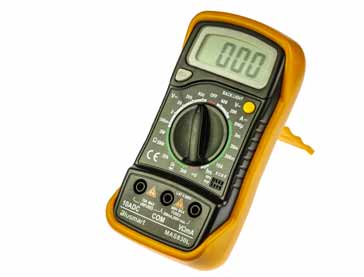
When buying a digital multimeter, it is first determine its usage - what are the real requirements. Understanding this, it is then possible to look at the various DMMs on offer to buy and match the specifications to what is needed.
There are very many places where digital multimeters can be bought. These days it is not necessary to visit an electronics shop. They can be bought on-line very easily, although it is necessary to understand exactly what is needed.
Analysing the requirements for a DMM purchase
Before setting out to buy a digital multimeter, it is first necessary to look at its usage. Will it be used for occasional use, or is it required for a full time professional use. Is it going to require high levels of accuracy and reliability? What measurement capability is needed. These and many more questions may be asked.
... apart from amps, volts, and ohms, many DMMs can measure parameters including frequency, capacitance, continuity, and temperature....
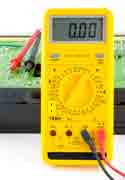
It is also necessary to look at other requirements including the type of measurements that will need to be made and other requirements. A careful analysis if these against the estimated cost is always useful: a careful analysis of the measurements to be made, the conditions under which they will be made and any safety / regulatory requirements. Safety, although invisible in many ways, is an important factor for the test equipment when mains / supply high voltage measurements are to be made.
Buying a DMM – key issues
There are several specific points to consider when buying a digital multimeter. There is no single answer and no single best digital multimeter. It is necessary to work out what is required and then choose the best test meter before purchasing the item.
Some of the key points include:
General usage: Consider if the digital multimeter is to be used for home / hobby use or for more exacting professional use. If it is to be used for home / hobby, it is unlikely to need the same level of robustness, accuracy and reliability as one used for industrial or professional use. There is a considerable difference between the cost of the entry levels meters and those used for professional use.
Some entry level digital multimeters can be bought for as little as around $10, £10, etc. These DMMs are unlikely to have the same level of functionality, robustness and capability as the more expensive ones. Safety certifications, etc required for professionals working on mains equipment will not be available on these very low end models.
The accuracy and overall reliability will not be as great for the low end DMMs, and even things like the robustness of the case, leads and connections will not be there. However for occasional home use, these low end meters offer very good value for money and it often makes good sense not to spend too much money buying an expensive DMM.
Amps, Volts and Ohms: All digital multimeters will be able to offer the basic measurements of amps volts and ohms. These are the basic measurements that are included in any multimeter that you will want to buy. However check that the ranges that you may need are available on the DMM. The available ranges is one of the most basic specifications, so check this out before buying the digital multimeter.
Although all DMMs have the basic amps, volts and ohms measurements, as well as AC and DC for the volts and amps, make sure you check out the exact ranges before buying the DMM. Most of these test instruments will be able to measure volts up to 250V or even 1kV, but also check that it can measure the small voltages you want as well.
Also the DC and AC ranges may be different. As AC requires the waveform to be rectified, the ranges may be different. Make sure you don't only check the DC ranges, but also the AC ranges.
Additional ranges: Today, digital multimeters are able to provide a number of ranges beyond the basic Amps, Volts and Ohms. Ranges may include a buzzer for continuity, ranges for temperature, capacitance, diode and transistor measurements, as well as frequency and several other measurements. As different DMMs will offer different capabilities, it is necessary to consider what might be needed when buying a digital multimeter.
Although very simple, the buzzer function for continuity testing is particularly useful. Often you will be working head-down making sure that the probes do not slip, you won't want to lift your head up to view the reading on the meter. A simple buzzer can easily give all the indication of continuity that is required.
Also, there may be some of these additional ranges that may be particularly useful for your envisaged usage. Capacitance is useful for general testing of capacitors, although the ranges tend to be a little limited. Frequency can be useful as well, especially for RF applications (ham radio), although the accuracy may not be wonderful, and sending RF along the probe leads is not always very good.
Bear in mind what additional ranges might be useful, but also remember they will not normally be as accurate as the readings from dedicated instruments like a capacitance meter, frequency counter, etc.
True RMS: When measuring AC waveforms, the actual shape of the waveform has a major effect on the reading. Often it is assumed that an AC waveform will be a sine wave, but this is not always the case. As the waveform shape is crucial, it is necessary to take this into account.
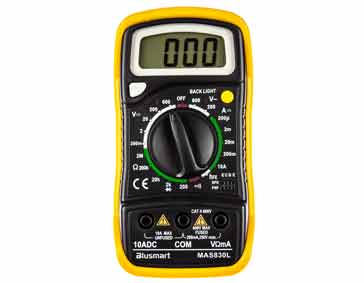
Many digital multimeters only provide an average reading of an AC waveform that may be calibrated as RMS - these are often called average responding meters. This will not provide an adequate reading for sine waves, but if waveform differs from a sine wave, then errors will be introduced. The standard for measuring AC waveforms is to use RMS - root mean square because the RMS value of an AC voltage or current has the same effect as a DC voltage or current of the same value.
Average responding meters can give significant errors when used with waveforms other than sine waves. A square wave will read around 10% high, and other AC waveforms, especially those associated with AC power supply can give up to 40% low. A true True RMS reading will give the correct readings.
If a true RMS reading is needed, this should be checked so that the correct digital multimeter is bought. Typically DMMs that are able to provide true RMS readings are more expensive than those that do not. If this is required then check that it says ‘True RMS’ and not just RMS. If it only mentions RMS, this may be a marketing-speak way of trying to indicate it is an average responding meter calibrated as for RMS when using a sine wave.
- Accuracy and resolution: Accuracy and resolution are two key aspects associated with any digital test instrument. When choosing a digital multimeter it is necessary to distinguish between the two aspects and determine whether the performance is adequate.
Auto-ranging: One useful facility that is available, typically on higher end digital multimeters is the auto-range facility. This capability enables the DMM to select the right range. You only need to select DC / AC and Amps / Voltes / Ohms, etc and the meter will do the rest. This can be a very useful capability when undertaking a lot of measurements. When holding onto two probes, it can be disruptive or sometimes it can be difficult to let one go to alter the range and then replace the probes.
It is worth considering whether it is a requirement when buying digital multimeter. This is capability particularly useful for applications like field service where it may not be convenient to keep selecting a range to obtain the optimum reading. Unfortunately, this capability tends to come with the much higher priced DMMs, so it is worth considering whether this capability os worthwhile when buying the DMM.
Safety ratings: When measuring voltages, particularly on electrical installations it is necessary to ensure that the digital multimeter has an adequate safety rating. IEC 1010 categorises meters according to their safety ratings. These not only take into account the working voltage, but also the resilience to peak transients that often occur on the lines. It is necessary to ensure that any meter being used for these applications is suitably rated. This may result in needing to buy a more expensive meter.
These specifications and certifications are normally only available for the top DMMs. Companies who produce DMMs to these specifications need to have them tested and this costs time and money. The low end DMMs for occasional use are imports and neither the manufacturers nor importers are generally set up to gain these certifications, and also it would not be financially viable for them.
Safety ratings are required for applications where the engineers are working on high voltages and it is essential that the meter is guaranteed to be safe under all conditions. For normal low voltage occasional use, these ratings are normally not considered to be necessary. However the build quality and component ratings for some low cost imports are not likely to meet the rigorous standards needed for high voltage use. Even small surface mount components are used on occasions for the high voltage ranges, so it is best to avoid these meters where there is any likelihood of them being used for high voltages.Probes: Most digital multimeters arrive with a set of probes. However make sure that these are of the required type. Normally probes are used to probe various points on the circuit, but on occasions clips, etc may be needed.
Normally a meter comes with a pre-determined set of probes. Despite this make sure that they cater for what you need and if not it is often possible to buy separate probes that meet your requirements.
Although many years ago, probes were connected to the meter using a simple banana connector, these days, the connections are protected much better as seen in the photo below. This type of protection ensures that even when the lead is disconnected from the DMM, it is not easy to touch the connection or cause a short if it is still connected to the item under test.
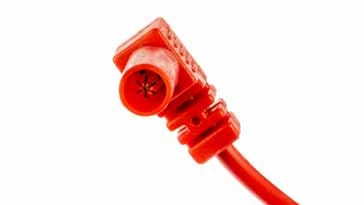
Typical digital multimeter probe connector Although most connectors for probes are protected these days, ensure that any separate probes that are bought conform to this approach to ensure the highest standards of safety especially when using high voltages.
DMM purchase decisions
It is always wise to have a good understanding of what is needed. Often when buying a digital multimeter, the requirements will be fairly straightforward. There may occasionally be a few special requirements, but on the whole, the measurement of amps, volts and ohms coupled with a few additional measurements will suffice.
Having looked at the requirements, and the specifications of various digital multimeters, it is possible to gain a good idea of what test instrument is needed, the costs and the capabilities.
Whilst a low cost digital multimeter may fit the bill for many hobby or home applications, when considering a digital multimeter purchase for a professional or commercial application, or for high voltage work, it is often far more cost effective in the longer term to buy a more expensive test instrument that is better specified, has the required safety ratings and is robustly built.
Essentially, you get what you pay for, so any purchasing decisions should take into account the overall performance and requirement, and not just the basic ranges and cost.
More Test Topics:
Data network analyzer
Digital Multimeter
Frequency counter
Oscilloscope
Signal generators
Spectrum analyzer
LCR meter
Dip meter, GDO
Logic analyzer
RF power meter
RF signal generator
Logic probe
PAT testing & testers
Time domain reflectometer
Vector network analyzer
PXI
GPIB
Boundary scan / JTAG
Data acquisition
Return to Test menu . . .