
What is MSK: Minimum Shift Keying Modulation
MSK, Minimum Shift Keying is a form of continuous phase frequency shift keying, providing spectrum efficiency & enabling efficient RF power amplifier operation.
Frequency Modulation Tutorial Includes:
Frequency modulation, FM
Modulation index & deviation ratio
FM sidebands, bandwidth
FM demodulation
FM slope detector
FM ratio detector
Foster Seeley detector
PLL FM demodulator
Quadrature demodulator
MSK
GMSK
Modulation formats:
Modulation types & techniques
Amplitude modulation
Phase modulation
Quadrature amplitude modulation
Minimum shift keying, MSK, is a form frequency modulation based on a system called continuous-phase frequency-shift keying.
Minimum shift keying, MSK offers advantages in terms of spectral efficiency when compared to other similar modes, and it also enables power amplifiers to operate in saturaton enabling them to provide high levels of efficiency.
Reason for Minimum Shift Keying, MSK
It is found that binary data consisting of sharp transitions between "one" and "zero" states and vice versa potentially creates signals that have sidebands extending out a long way from the carrier, and this creates problems for many radio communications systems, as any sidebands outside the allowed bandwidth cause interference to adjacent channels and any radio communications links that may be using them.
MSK, minimum shift keying has the feature that there are no phase discontinuities and this significantly reduces the bandwidth needed over other forms of phase and frequency shift keying.
Minimum Shift Keying, MSK basics
The problem can be overcome in part by filtering the signal, but is found that the transitions in the data become progressively less sharp as the level of filtering is increased and the bandwidth reduced. To overcome this problem GMSK is often used and this is based on Minimum Shift Keying, MSK modulation. The advantage of which is what is known as a continuous phase scheme. Here there are no phase discontinuities because the frequency changes occur at the carrier zero crossing points.
When looking at a plot of a signal using MSK modulation, it can be seen that the modulating data signal changes the frequency of the signal and there are no phase discontinuities. This arises as a result of the unique factor of MSK that the frequency difference between the logical one and logical zero states is always equal to half the data rate. This can be expressed in terms of the modulation index, and it is always equal to 0.5.
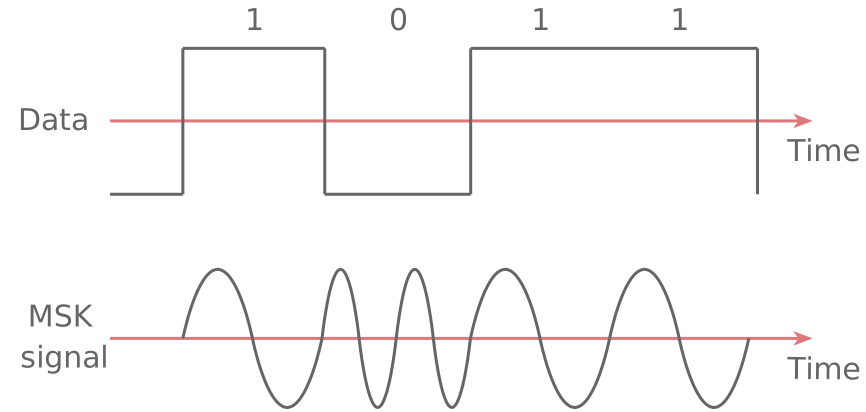
MSK is a particularly effective form of modulation where data communications is required. Although QAM and PSK are used for many other systems, MWK is able to provide relatively efficient spectrum usage. As it is a form of frequency modulation, this enables RF power amplifiers to operate in saturation, thereby enabling them to operate as efficiently as possible. If amplitude variations are present these need to be preserved and amplifiers cannot run in saturation and this significantly limits the efficiency levels attainable.
More Essential Radio Topics:
Radio Signals
Modulation types & techniques
Amplitude modulation
Frequency modulation
OFDM
RF mixing
Phase locked loops
Frequency synthesizers
Passive intermodulation
RF attenuators
RF filters
RF circulator
Radio receiver types
Superhet radio
Receiver selectivity
Receiver sensitivity
Receiver strong signal handling
Receiver dynamic range
Return to Radio topics menu . . .