Phase Noise & Jitter Specifications
Details of the specifications used to define phase noise (dBc/Hz) and phase jitter: rms radians.
Electronic & RF Noise Includes:
What is phase noise
Phase noise / jitter specification
Phase noise / phase jitter conversion
RF noise topics:
Noise basics
Avalanche noise
Burst noise
Flicker noise
Shot noise
Thermal noise
Phase noise and phase jitter have different methods of stating their specifications.
Phase noise measurement can be quite difficult under some circumstances. Fortunately many new spectrum analysers make phase noise measurement very much easier.
Both phase noise expressed as a specification detailing single sideband phase noise and the phase jitter expressed as a specification in radians are valid methods of expressing the performance are equally valid, but tend to be used in different areas.
Phase noise specification
For radio receiver applications the phase noise of oscillators and systems is often quoted in terms of single sideband phase noise. In other words the noise level that appears spreading out from the carrier. The phase noise spreads out equally either side of the carrier but only one side is measured - hence the name single sideband phase noise.
When phase noise is specified in this way there are a number of elements to the specification.
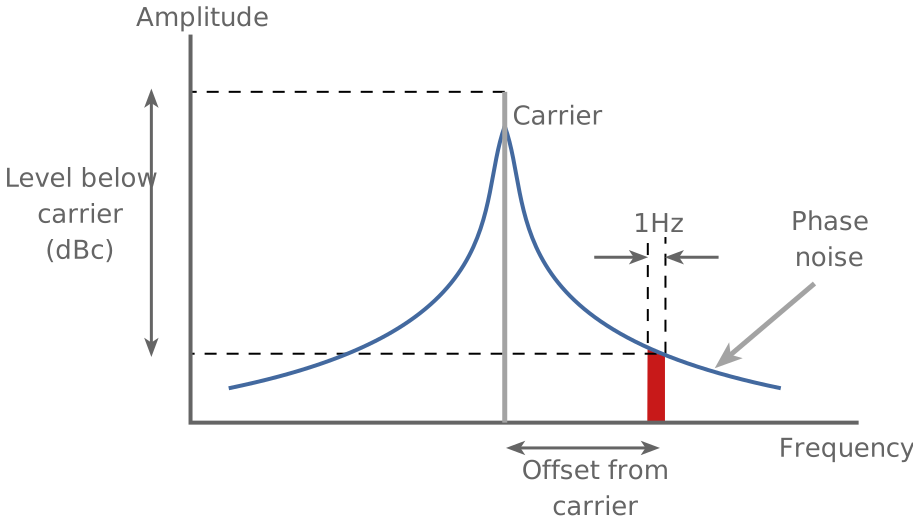
Key specification points
When looking at the noise level there are three elements to the specification:
- Phase noise amplitude: The level or amplitude element of the phase noise specification is expressed in dB relative to the carrier. This is normally denoted as dBc, e.g. -50dBc - 50 decibels down in level from the carrier. This method is adopted because the phase noise normally varies in line with the carrier level. The level of phase noise relative to the carrier is also the important factor. Where the phase noise varies with the carrier level, the specification can state that the phase noise is - n dBc at a given carrier level.
- The offset from the carrier: An essential part of the phase noise specification is the offset from the carrier at which the phase noise was a certain level. This is because the noise level varies according to the frequency offset from the carrier, the frequency offset must be given. Typically the phase noise rises much faster closer in towards the carrier and falls away until it ultimately reaches a noise floor. Offsets of 1 kHz, 10 kHz, 100 kHz etc are commonly quoted offsets.
- The measurement bandwidth: The noise power is proportional to the bandwidth and therefore it is necessary to state the bandwidth that has been used. Obviously the wider bandwidth that is used, the greater the level of noise that will pass through the filter and be measured. Technically the most convenient bandwidth to use is 1 Hz because it is easy to relate the level to other bandwidths. As a result this phase noise specification format has been almost universally adopted. Spectrum analyzers are unable to measure in a 1 Hz bandwidth directly because this would require a very narrow filter bandwidth - therefore they measure the signal in a wider bandwidth and mathematically adjust the level to that of a 1 Hz bandwidth. Using current signal processing technology this is simply a further calculation that is added into the routine.
Thus a typical phase noise specification for a signal generator or other oscillator may be -100 dBc / Hz at a 100 kHz offset. For a complete phase noise specification several points will be specified to give an indication of the phase noise at different points, typically at points varying by a factor of ten: 10 Hz, 100 Hz, 1 kHz, etc.
As the levels vary, sometimes plots of the phase noise performance may be given.
For very approximate calculations the various points at which the phase noise has been specified can be joined to give an indication of the performance of the signal source.
Phase jitter & time jitter specification
Apart from the more usual method of quoting phase noise as the level of the single sideband phase noise at a given offset, it is also possible to look at the phase jitter specification.
It is possible to quote a phase jitter specification in two formats:
- Phase jitter: When phase jitter specifications are needed, they are specified in terms of radians, although occasionally they may be measured in degrees. Normally the figures are quoted in RMS radians. This format for phase jitter is more widely used in applications where the angular or phase element is important. It is particularly important for scenarios where phase modulation is used. As phase shift keying and quadrature amplitude modulation are widely used for data communications, often phase noise is stated in terms of phase jitter for these applications.
- Time jitter: This format for phase jitter specification is often used for clocks were the jitter in terms of a time difference is important. It is may be specified in a number of ways according to what is of interest to the designer - it can be RMS, peak or peak to peak time difference, often measured in picoseconds.
As it can be seen, phase noise and phase jitter, although effectively the same can be specified in a number of ways. The actual method of phase noise specification depends upon the application.
More Basic Electronics Concepts & Tutorials:
Voltage
Current
Power
Resistance
Capacitance
Inductance
Transformers
Decibel, dB
Kirchoff's Laws
Q, quality factor
RF noise
Waveforms
Return to Basic Electronics Concepts menu . . .