RF electronic noise is a major performance limiting factor in many applications which means it needs to be measured to quantify and improve performance.
Noise is a very important factor in most electronic circuits. In many instances the level of noise is important and its level needs to be measured to ensure that it is within acceptable limits, or it needs to be measured so that the levels can be improved.
In view of this it is necessary to have standard methods of assessing and measuring noise levels, and then specifying them.
In this way the RF noise levels can be measured and then compared with other similar circuits and items of test equipment.
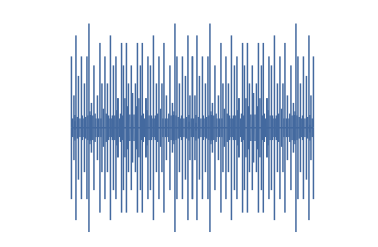
Noise as seen on an oscilloscope
Noise specifications
There are many ways of specifying noise in electronic circuits. The way it is specified depends upon the application.
One of the first ways in which noise was specified was related to radio receivers. Here noise specifications relate to the receiver sensitivity and include specifications including signal to noise ratio, noise figure and the like.
Note on Receiver Sensitivity:
The main limiting factor on receiver sensitivity is noise. Accordingly receiver sensitivity specifications revolve around noise specifications. The chief receiver specifications are signal to noise ratio, SINAD and noise figure. Each looks at the receiver performance with respect to noise.
For many other applications, the noise spectral density is used. This is a measure of the noise power within a certain bandwidth. Noise power density has the dimension of power / frequency.
Typically the specification is specified in dBm and within a 1 Hz bandwidth, i.e. dBm / Hz.
Interestingly the thermal noise in a 50Ω system at room temperature is -174 dBm / Hz.
It is then easy to relate this to other bandwidths:
Bandwidth (Δf) Hz
Thermal Noise Power dBm
1
-174
10
-164
100
-154
1k
-144
10k
-134
Noise measurement techniques
There are many ways of measuring noise in an electronic of RF system. There are specialised meters for measuring noise figure, SINAD, and other figures. Apart from these, standard test equipment may also be used.
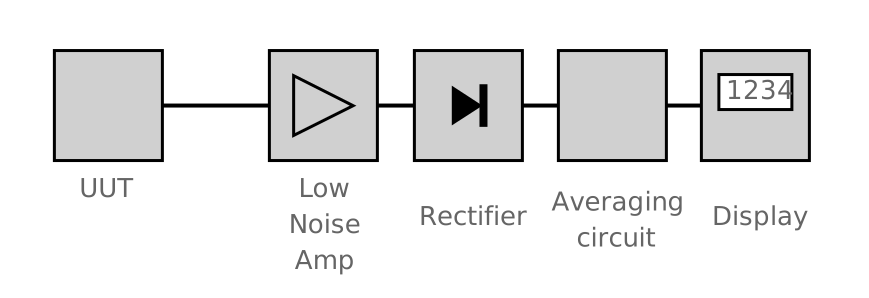
Meter method: It is possible to utilise a simple meter and other elements to measure noise levels. The concept of noise measurement system can be explained by looking at what is required.
Simple noise measurement system
The noise measurement system shows a typical measurement circuit. Noise generated by the unit under test is amplified to a suitable level - the gain of the amplifier must be known.
The meter used should have an averaging capability, because the noise level is random and will vary. While most digital meters have an averaging capability, analogue meters inherently average any changes.
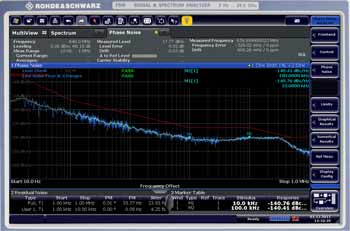
Spectrum analyser: Most modern spectrum analysers have built in capabilities for measuring noise levels. The analyser settings should be selected to ensure that the optimum conditions are set. These will depend to a large degree on the analyser used.
Phase noise as seen on a spectrum analyzer
Noise measurement precautions
One of the easiest ways of measuring noise levels is to use a spectrum analyser. It is able to determine the noise power in a given bandwidth. This can then be related to another bandwidth by scaling the power level measured to the required bandwidth.
However there are other factors to take into account.
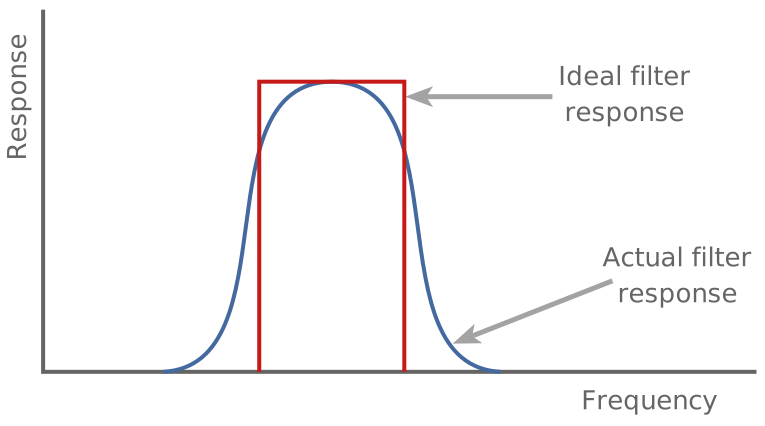
Filter shape: As the spectrum analyser filter shape is not completely square and needs a finite band to change from its pass-band to its stop-band, this shape needs to be accommodated when calculating the noise in a given bandwidth. Filter responses for noise measurement
Fortunately this is a simple calculation for modern analysers that can give readings of noise power in a given bandwidth - this is often normalised to dBm / Hz.
Spectrum analyser noise performance: The noise performance of the spectrum analyser must be better than the noise to be measured. If this is not the case then the readings given will just reflect the performance of the spectrum analyzer and not that of the unit under test..
The noise performance of many electronic and radio frequency circuits is crucial to the operation of the whole item. Everything from radio receivers, to audio amplifiers and then on to items like cameras are all dependent upon the noise performance of various areas of the overall system and it is necessary to noise measurements to be made.
Fact of the day: It was on 24th April 1970 that the People\'s Republic of China launched its first satellite. Then on this day in 1981, IBM first introduced the personal computer or PC.
Quote:If I have seen further than others, it is by standing upon the shoulders of giants. Sir Isaac Newton
Point to ponder: The Eiffel Tower in Paris weighs over 7 000 tons, and it requires over 50 tons of paint when it is painted (every seven years).