Alessandro Volta Biography
During his life Alessandro Volta, contributed a huge amount to the new science of electricity and in honour of his pioneering work his name was given to the unit of electrical potential, the Volt.
Alessandro Volta Biography Includes:
Volta biography
Inventions
Key Facts
It is a widely known fact that the Volt is the unit of electromotive force and that it is named after Alessandro Volta who was an Italian scientist and pioneer of electrical science.
What is a less well known fact about the history of Volta is that he invented the first primary battery and in doing so he moved electrical science from the electrostatic era into electrodynamic age.
His invention of the electrical battery made possible many further developments, and the basic ideas for his electrical batteries are still in use today.
Some years earlier when electrical science was still firmly focussed on electrostatics, he also proposed the idea of a unit of electric tension. Fortunately his suggestion was not taken up because one of these early units equated to 13.3 kV!
In his day Volta was a scientist of great fame. It is a fact that not only was he a leader in the area of electricity, but he also made significant discoveries in the field of chemistry. Volta's history or biography makes interesting reading and provides an understanding of the difficulties faced by these early pioneers in understanding the basics of electricity.
Volta's early life
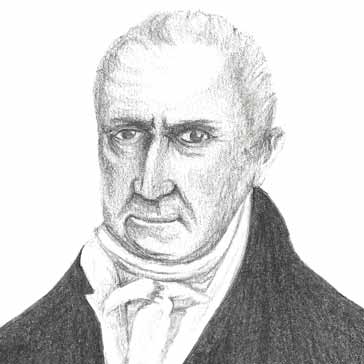
Volta, or to give him his full name Alessandro Giuseppe Antonio Anastasio Volta was born on 18th February 1745 in Como. This is a small town in the duchy of Milan and on the shores of Lake Como in Northern Italy. His father had originally been a member of a Jesuit order, but at the age of 41 he decided to marry a lady who was 22 years younger than himself.
The family was well connected and appeared to be happy even if rather poor. On his father's side he had three uncles. One was a Dominican, one a canon, and the other was an archdeacon. On his mother's side though, the family had more of a leaning toward the law.
The young Alessandro Volta started his education at the school of rhetoric in Como. However shortly after he started there, when Volta was only seven years old his father died. It was said that his father was more accomplished at spending money than making it. In fact Volta said in later years that when his father died he left a small dwelling worth 14 000 lira, and a debt of 17 000 lira.
Then, five years after his father's death his uncles took charge of his education. Initially they sent him to a Jesuit college, but later they changed the course of his education, moving him elsewhere. It was during this period that a friend named Giulio Cesare Gattoni provided books and guidance to help his study of electricity. His uncles had decided it would be best for him to study the law but his interest in the natural sciences was so keen that they allowed him to follow his interests and take up career in physics and chemistry.
Volta became very absorbed in his studies and from the age of about 20 Volta studied science more formally. In particular he took an interest in electricity. He also boldly corresponded with many of the leading scientists of the day. In 1763 when he was just 18 years old, he corresponded with the eminent French physicist and electrical experimenter, the Abbe Antoine Nollet in Paris. Later he wrote to Giovanni Battista Beccaria, professor of physics at the University of Turin and the foremost Italian experimenter in electrostatics. In many of these letters he showed a considerable degree of insight into the phenomenon of electricity that was just beginning to be understood.
First Papers for Volta
Volta even published some papers. His first was in 1769, and was entitled "De vi attractiva ignis electrici." This attracted some attention and helped him gain his first appointment in 1774 when he became a lecturer at the Royal School in Como.
He performed his duties so well that in the following year he was appointed professor of experimental physics. It was whilst he was at Como that he made some important discoveries.
The first of Volta's discoveries occurred in 1775 when he invented the electrophorus, an early form of electrostatic generator. In its original form Volta's new device consisted of a cake of resin, wax, or other non-conducting substance placed between two metal plates. The resin rested on the lower plate and the upper plate had an insulated handle attached to its centre that permitted it to be lifted from the resin cake. The upper metal plate was then removed and the upper surface of the resin was charged by friction. The upper plate, held by the insulated handle, was placed on the resin cake and, by touching the top plate with a finger, the charge was drawn off to ground. On lifting the upper plate, it would thus be charged by induction.
Volta discovers methane
At this time in history electricity and chemistry were considered to be very closely related. Hydrogen, or as it was called then, "inflammable air" had been isolated in 1766, and ten years after this in 1776, Volta discovered a new gas that we know as methane today.
In his researches, Volta became intrigued by the many different kinds of "air" that could be found, one of which could be seen bubbling from lakes and ponds. Although he noted that methane was less explosive than hydrogen, he used it in what was termed an inflammable air pistol that he fired using an electric spark. This contraption was surprisingly effective firing a lead ball and denting wood at a distance of 5 metres. From some related experiments he also discovered that air consisted of around 20% oxygen.
His discovery of methane in particular brought him considerable renown and as a result he received a travel grant from the Austrian government that ruled northern Italy at this time. This enabled him to travel to other countries to meet other notable scientists.
The first of his travels began in early September 1777 with visits to fellow scientists in Switzerland, Alsace and Savoia. He travelled widely and this enabled him to meet with other scientists and discuss their work together.
With the rise of Volta's fame came the offer of a university chair. In 1779 he was appointed to the post of professor of experimental physics at the University of Pavia. This was a position that Volta held for nearly 40 years. Volta obviously gained a taste for travel because he made further trips abroad travelling to France and England in 1781/2 and then in 1784 he travelled to Germany
Volta's battery work
Volta's most ground-breaking work was that lead to the development of the first battery. The roots of this work can be traced back to some investigations performed by a fellow Italian and friend of Volta. He discovered that when an electrical discharge occurred near a frog's leg whilst it was being dissected, the discharge made its leg twitch. The Italian professor made many further researches and this lead to his discovery that when two dissimilar metals were placed on the leg, and electric current was generated. For many years it was believed that this was a new form of electricity that they called "animal electricity".
Volta himself performed many experiments to investigate the phenomenon further. He even started to place dissimilar metals on his tongue and close to his eye with various effects. However as he undertook further experiments he became more convinced that the electricity was being generated by the two dissimilar metals separated by a solution such as brine. Galvani, though continued to defend his idea of animal electricity.
Volta refined his experiments further. He discovered that the pair of metals which produced the best effect was zinc and silver. He also put a number of cells together in series to produce a larger voltage. First Volta did this by making the individual cells out of wine goblets with brine in them. The two electrodes were then dipped into this solution. To increase the voltage he connected several cells in series to give what is often termed Volta's crown of cups.
Volta soon found that this approach was very cumbersome and so he developed another idea. This time the basic cell was made out of two discs of the dissimilar metals with cardboard soaked in brine between them. By stacking several of these cells on top of one another a "pile" of cells could be made up quite easily. The limit of the number of cells in any pile was reached when the weight of the whole battery started to squeeze the brine out of the bottom cells. Even so it was possible to build up voltages large enough to give an electric shock.
Rewards
Volta undertook much of his work against a very changeable political climate. Northern Italy initially came under Austrian rule, but in 1796 they were driven out by the French. Although Volta became an official in the new government he gave up this position soon afterwards as he had a lingering loyalty to the Austrians.
Also the French troops had damaged his laboratory. He made a good choice because when the Austrians returned in 1799 they closed the University, but Volta remained free.
However just over a year later the French were back. They re-opened the University and Volta's position as professor was re-instated. He accepted his position as a citizen of the new republic and visited Paris to express the University's thanks to Napoleon. This visit proved a triumph for Volta, reinforcing his already well known position in the scientific community.
During his life Volta gave many demonstrations throughout Europe and even Napoleon himself was fascinated by his new discoveries. He was so impressed that he gave Volta a substantial salary to carry on with his experiments and investigations. Volta also received other recognition for his work. He was made a count and a senator of the Kingdom of Lombardy and this further increased his wealth. In addition to this he also received international recognition for his work. Interestingly the Emperor of Austria made him a director of the philosophical faculty of the University of Padua in 1815.
Volta did not marry until 1794 when he was nearly 50 years of age. His bride, Signorina Teresa Peregrini was much younger than himself and was the youngest daughter of Count Ludovico Peregrini. The couple had three sons, but to their great sorrow, the middle son died at the age of 18. He had been a very promising mathematician, and Volta writing to a friend later said, "This loss strikes me so much to heart that I do not think I shall ever have another happy day."
After this Alessandro Volta spent more time with his remaining sons, ensuring they received a good education. They both entered the University of Pavia and when they graduated in 1819, the family retired to the ancestral home in Como. The sons remained within the law profession but in later years the brothers published a periodical covering the sciences and industry. The older son was also elected mayor of Como. Apart from his duties as mayor he wrote many studies of his father, many which were published after Volta's death.
Volta's last years
Volta's fame brought him great wealth and he was able to enjoy a very high standard of living. Indeed he lived his last years in great luxury until his death in Como on the 5th May 1827 at the age of 82.
During his life Volta received many honours, being recognised by learned societies around Europe including London, Berlin and Paris He was also asked to give many talks and demonstrations. However the greatest honour came after his death when in 1881 the unit of electromotive force was named the Volt in honour of the important pioneering work he had undertaken. As a result Volta's place in history was assured.
More Famous Scientists in Electronics and Radio:
Volta
Ampere
Armstrong
Appleton
Babbage
Bardeen
Brattain
Edison
Faraday
R A Fessenden
Fleming
Heaviside
Hertz
Ohm
Oersted
Gauss
Hedy Lamarr
Lodge
Marconi
Maxwell
Morse
H J Round
Shockley
Tesla
Return to History menu . . .