
Reflow Soldering for PCB Assembly
Reflow soldering is widely used for PCB assembly and manufacture where it offers the most reliable and effective form of soldering.
Home » Construction & manufacture » this page
SMT Soldering Includes:
SMT soldering techniques
Wave soldering
Reflow soldering
Soldering BGAs
What is solder paste & how to use it
See also: Soldering basics Manual soldering: how to solder Soldering irons Tools for soldering Solder - what it is and how to use it De-soldering - the secrets of how to do it properly Solder joints
Reflow soldering is the most widely used form of soldering used for PCB assembly. It provides reliable soldering for the huge variety of component and pad sizes required, whilst being easy to monitor and control.
Infrared reflow soldering has been used for many years in PCB assembly areas, and it is now able to provide very high quality soldering that can meet the needs to todays electronics production areas.
What is reflow soldering
The basic process behind reflow or to provide its full name, infra-red reflow soldering requires that solder paste is applied to the relevant areas of the board.
The components are then placed, and then the assembly is passed through a tunnel where the board is heated in a controlled manner so that the solder paste melts and the components are electrically secured to the printed circuit board.
Using reflow soldering technology it is possible to reliably solder surface mount components, and particularly those with very fine pitch leads. This makes it ideal for use with the components used in mass produced electronics products.
Preparation
The first stage in reflow soldering for PCB assembly is to apply solder paste and components to the board. These stages are covered in more detail in a separate page on this section of the website.
- Solder paste: In essence solder paste is applied to the board. The paste is only applied to the areas that require soldering. While boards have solder resist layers added to them, it is necessary to only add solder paste to those areas where the solder is actually required. This is achieved by having a solder mask and solder paste "machine". This only allows the solder paste to be added to those areas of the board where it is needed. Once added the solder paste has been added to the board, it can move on to the next stage.
- Pick and place: With the solder paste on the board the components can then be set in place. Normally an automatic pick and place machine is used because the numbers of components used these days and the accuracy required make manual placement non-viable.
The pick and place machine places the components onto the board, and they are held in place by the surface tension of the solder paste. This is quite sufficient for normal handling, although some care is obviously needed. It is possible for the components to be glued to the board, but this makes rework very difficult. Then with all the components in place they can be move to the reflow soldering machine.
Reflow soldering stage
The reflow process itself consists of a number of individual processes. These are required to ensure that the board is brought up to the correct temperature for reflow soldering without applying any unacceptable levels of thermal shock.
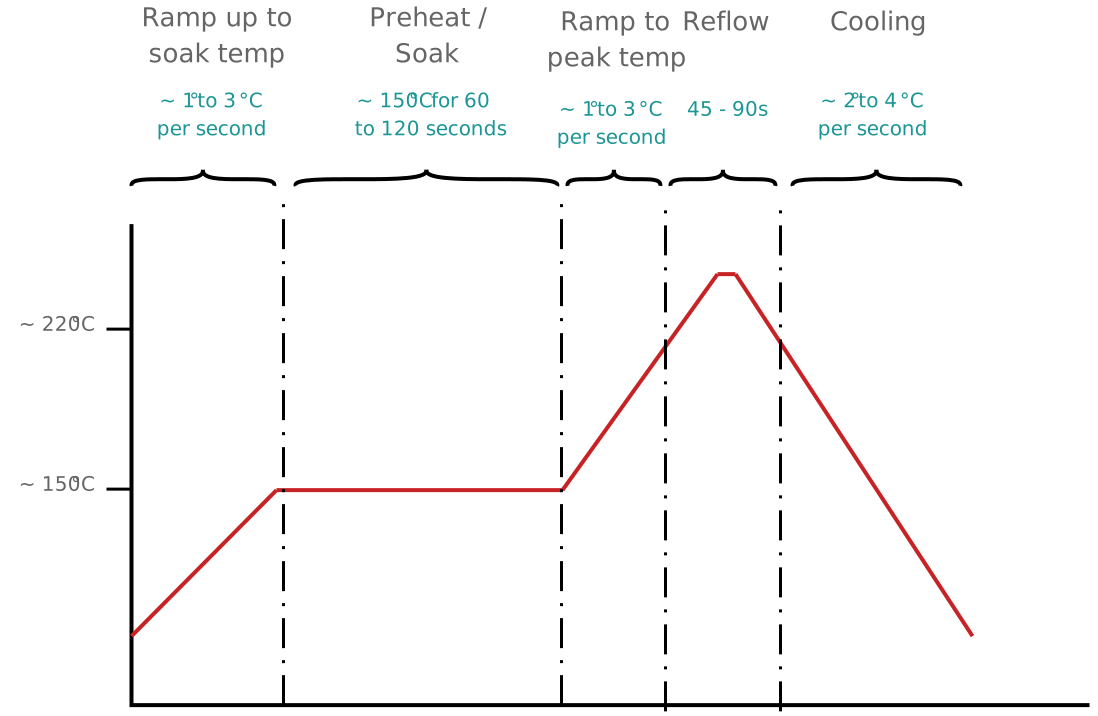
Correctly profiling the temperature of the reflow tunnel or chamber ensures that the resulting solder joints are of the highest quality. The four stages normally used are as follows:
- Preheat: The boards need to be brought steadily up to the required temperature. If the rate is too high, then the board or the components may be damaged by the thermal stress.
Additionally if the printed circuit board is brought up to temperature too quickly then areas may not reach the required temperature because of the thermal mass. If the board is brought u to temperature too slowly then the board may not reach the required temperature.
The temperature rise rate that is often used for infra-red reflow soldering is between 2 and 3°C per second, although rise rates down to 1°C per second may be used on some occasions. - Thermal soak: Having brought the board up to temperature it next enters what is often termed a thermal soak area. Here the card is maintained at temperature for two reasons. One is to ensure that any areas that are not adequately heated because of shadowing effects come up to the required temperature. The other is to remove the solder paste solvents or volatiles and to activate the flux.
- Reflow: The reflow area is the area of the soldering process where the highest temperature is reached. It is here that the solder is caused to melt and create the required solder joints. The actual reflow process involves the flux reducing the surface tension at the junction of the metals to accomplish metallurgical bonding, allowing the individual solder powder spheres to combine and melt.
- Cooling: The cooling for the boards after reflow must be accomplished in a way that does not cause stress to the components. Proper cooling inhibits excess intermetallic formation or thermal shock to the components. Typical temperatures in the cooling zone range from 30 – 100°C (86 – 212°F). The temperature in this zone creates a relatively fast cooling rate and this is chosen to create a fine grain structure in the solder to provide the most mechanically sound joint.
Reflow ovens
Reflow ovens are often considered to be large machines for use on a PCB assembly production floor. There are many of these machines that provide the soldering capability for large and small PCB assembly areas.
It is also possible to buy much smaller reflow machines for small prototype and rework areas. These naturally do not have the capability of the large machines, but instead they are tailored for the small PCB assembly and rework areas.
Reflow soldering is the most widely used form of soldering for PCB assembly both in mass production and for prototype PCB assembly. Reflow soldering enables is reliable and effective for all pitches of leads and pads, enabling very high quality circuit boards to be manufactured.
More Construction Ideas & Concepts:
Soldering
SMT component soldering
ESD - Electro-Static Discharge
PCB manufacture
PCB assembly
Return to Constructional Techniques menu . . .