
Tunnel Diode: Easki microwave diode
The tunnel diode is used in many mmWave and microwave circuit designs where it can be used in oscillator and amplifier circuit designs.
Tunnel Diode Tutorial Includes:
Tunnel diode
Tunnel diode theory
Tunnel diode device structure
Backward diode
Other diodes: Diode types
The tunnel diode is a type of mmWave and microwave semiconductor diode that can be used in microwave oscillators and also microwave amplifiers.
Rather than using the standard physics of the ordinary PN junction, the tunnel diode uses a quantum mechanical effect called tunnelling – from which it gains its name.
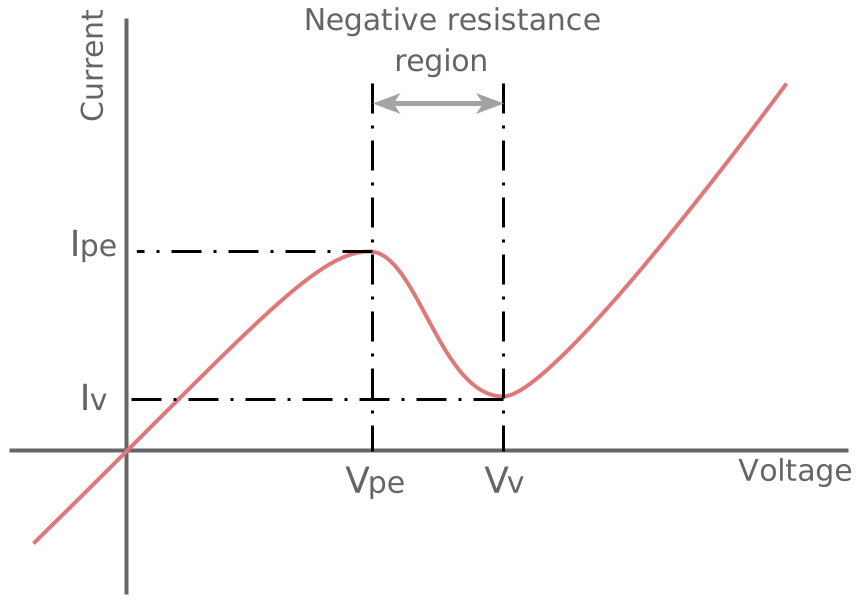
The tunnelling effect gives the tunnel diode a negative resistance region and this enables it to be used as an oscillator and also in pre-amplifier applications at frequencies well into the microwave region.
Although tunnel diodes are not as widely used today, they can still be used in a good number of RF applications. They were used in television receiver front end oscillators and oscilloscope trigger circuits, etc. They have been shown to have a very long life and can offer a very high level of performance when used as an RF pre-amplifier.
However today, tunnel diode applications are less widespread because three terminal devices can often offer better levels of performance in many areas.
Tunnel diode discovery
The tunnel diode was discovered in 1958 by a Japanese Ph.D. research student named Esaki in 1958. As part of his Ph.D. he was investigating the properties and performance of heavily doped germanium junctions for use in high speed bipolar transistors.
Esaki produced some heavily doped junctions for high speed bipolar transistors. When he was testing and using these devices he found that they produced an oscillation at microwave frequencies as a result of the tunnelling effect.
Esaki received the Nobel prize for Physics in 1973 for his work on the tunnel diode.
After the work by Esaki, other researchers demonstrated that other materials also showed the tunnelling effect. Holonyak and Lesk demonstrated a Gallium Arsenide device in 1960, and others demonstrated Indium tin, and then in 1962 the effect was demonstrated in materials including Indium Arsenide, Indium Phosphide and also Silicon.
Tunnel diode circuit symbol
The tunnel diode symbol used on circuit diagrams is based upon the basic diode symbol used. To differentiate the tunnel diode symbol from the standard diode symbol, the bar section of the circuit symbol has additional tails added.

Advantages and disadvantages
The tunnel diode is not as widely used these days as it was oat one time. With the improvement in performance of other forms of semiconductor technology, they have often become the preferred option. Nevertheless it is still worth looking at a tunnel diode, considering its advantages and disadvantages to discover whether it is a viable option.
Advantages
- Very high speed: The high speed of operation means that the tunnel diode can be used for microwave RF circuit designs.
- Longevity: Studies have been undertaken of the tunnel diode and its performance has been shown to remain stable over long periods of time, where other semiconductor devices may have degraded.
Disadvantages
- Reproducibility: It has not been possible to make the tunnel diode with as reproducible performance to the levels often needed.
- Low peak to valley current ratio: The negative resistance region and the peak to valley current is not as high as is often be required to produce the levels of performance that can be attained with other devices.
One of the main reasons for the early success of the tunnel diode was its high speed of operation and the high frequencies it could handle.
This resulted from the fact that while many other devices are slowed down by the presence of minority carriers, the tunnel diode only uses majority carriers, i.e. holes in an n-type material and electrons in a p-type material. The minority carriers slow down the operation of a device and as a result their speed is slower. Also the tunnelling effect is inherently very fast.
The tunnel diode is rarely used these days, even in microwave designs and this results from its disadvantages. Firstly they only have a low tunnelling current and this means that they are low power devices.
While this may be acceptable for low noise amplifiers, it is a significant drawback when they are used in microwave oscillators as further amplification is needed and this can only be undertaken by devices that have a higher power capability, i.e. not tunnel diodes.
The third disadvantage is that they are problems with the reproducibility of the devices resulting in low yields and therefore higher production costs.
Applications
Although the tunnel diode appeared promising some years ago, it was soon replaced by other semiconductor devices like IMPATT diodes for oscillator applications and FETs when used as an amplifier. Nevertheless the tunnel diode is a useful device for certain applications.
One area where the tunnel diode can be usefully used is within military and other equipment that may be subject to magnetic fields, high temperature and radioactivity. The tunnel diode is more resilient to the effects of these environments and as such may still be usefully used.
Another advantages of the tunnel diode which is beginning to be discovered is its longevity and reliability. Once manufactured its performance remains stable over long periods of time despite its use where other devices may degrade or fail.
More Electronic Components:
Batteries
Capacitors
Connectors
Diodes
FET
Inductors
Memory types
Phototransistor
Quartz crystals
Relays
Resistors
RF connectors
Switches
Surface mount technology
Thyristor
Transformers
Transistor
Unijunction
Valves / Tubes
Return to Components menu . . .