Schottky Diode Technology & Structure
- a summary or tutorial of the Schottky Barrier Diode giving its structure and how it can be used RF circuits as well as rectifier and other electronic circuits.
Schottky Barrier Diode Tutorial Includes:
Schottky barrier diode
Schottky diode technology
Schottky diode specifications
Schottky diode power rectifier
Silicon carbide Schottky diode
Other diodes: Diode types
The basic structure and technology of the Schottky diode may appear to be very simple and straightforward.
Whilst the early Schottky diodes were very straightforward, the basic technology has been developed to enable both small signal and power rectifier diodes to use the technology optimised for each application.
Today, many diodes incorporating elements including guard rings and other improvements that enhance the performance in various areas by considerable degrees.
Basic Schottky diode structure
The basis of the Schottky diode is a metal semiconductor interface and this can be created in a number of ways. This simplest is a point contact diode where a metal wire is pressed against a clean N-type semiconductor surface. This method of manufacture is still used occasionally today as it is cheap, but not particularly reliable and repeatable. In fact the diode that is formed may either be a Schottky barrier diode or a standard PN junction dependent upon the way in which the wire and semiconductor meet and the way the resulting forming process occurs.
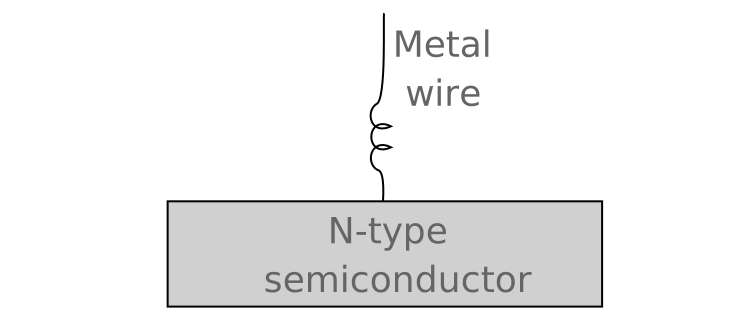
The early Cat's Whisker wireless detectors were made in this way, although using naturally occurring mineral crystals, but it was found with these detectors that the wire had to be carefully positioned for the best results and after a while the performance would fall away and a new position for the whisker was required.
Needless to say, these early techniques are not widely used these days. Other more advanced and reliable Schottky diode technologies and structures are used for current manufacture.
Vacuum deposited Schottky diode structure
The basic Schottky diode manufacture has overtaken the early point contact diodes, and one popular technique is to vacuum deposit a metal onto the surface of the semiconductor. This Schottky diode technology gives far better results than those that could be obtained with early techniques.
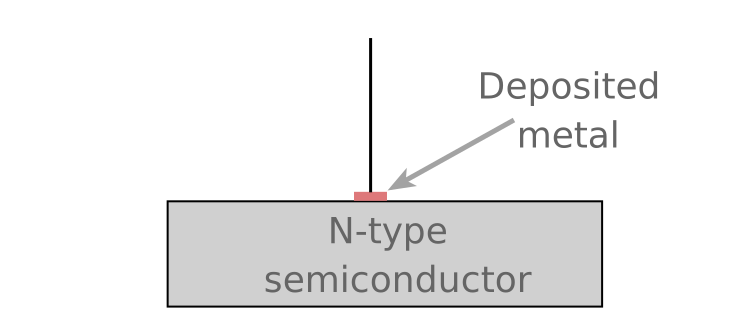
This Schottky diode structure is very basic and is more diagrammatic than actually practical. However it does show the basic metal-on-semiconductor technology for the Schottky diode that is key to its operation.
Schottky diode structure with guard ring
One of the problems with the simple deposited metal diode technology is that breakdown effects are noticed around the edge of the metallised area. This arises from the high electric fields that are present around the edge of the plate. Leakage effects are also noticed.
To overcome these problems a guard ring of P+ semiconductor fabricated using a diffusion process is used along with an oxide layer around the edge. In some instances metallic silicides may be used in place of the metal.
The guard ring in this form of Schottky diode structure operates by driving this region into avalanche breakdown before the Schottky junction is damaged by large levels of reverse current flow during transient events.
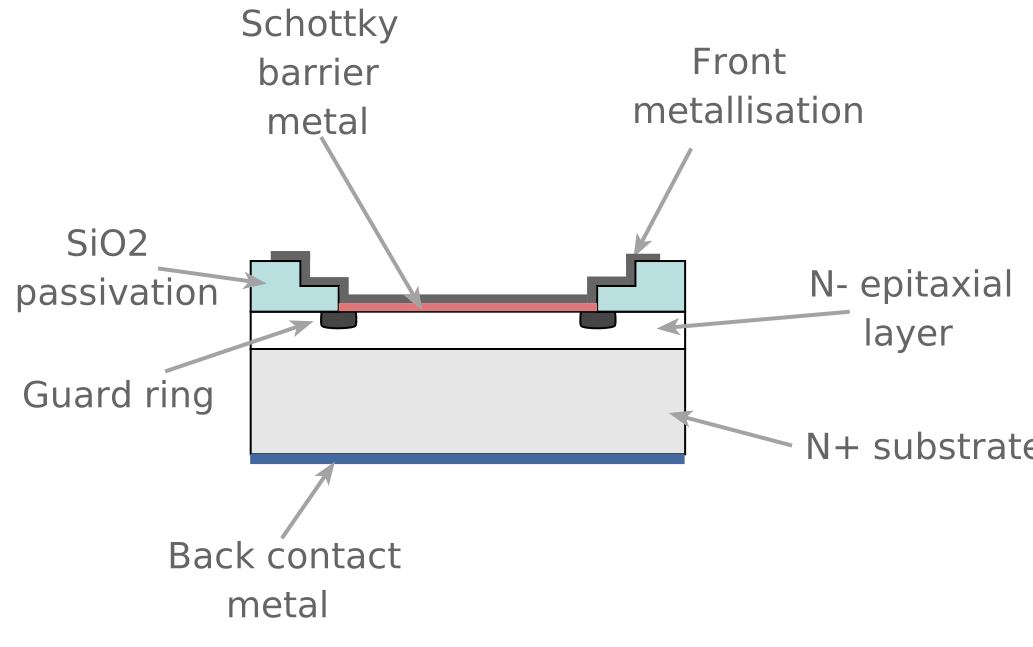
This form of Schottky diode technology is used particularly in rectifier diodes where the voltages may be high and breakdown is more of a problem. It can even be used for some RF Schottky diodes as well.
Schottky diode technology & structure notes
There are a number of points of interest from the fabrication process.
- The most critical element in the manufacturing process is to ensure a clean surface for an intimate contact of the metal with the semiconductor surface, and this is achieved chemically. The metal is normally deposited in a vacuum either by the use of evaporation or sputtering techniques. However in some instances chemical deposition is gaining some favour, and actual plating has been used although it is not generally controllable to the degree required.
- When silicides are to be used instead of a pure metal contact, this is normally achieved by depositing the metal and then heat treating to give the silicide. This process has the advantage that the reaction uses the surface silicon, and the actual junction propagates below the surface, where the silicon will not have been exposed to any contaminants. A further advantage of the whole Schottky structure is that it can be fabricated using relatively low temperature techniques, and does not generally need the high temperature steps needed in impurity diffusion.
The Schottky diode is used in a variety of forms for many different applications. Obviously those used for signal applications are in much smaller packages, often in SMT ones these days. Those devices used for power applications are in much larger packages, often ones which can be bolted to a heat-sink.
Schottky diode technology has advanced significantly as the need for this type of diode has grown. Interestingly, Schottky diode technology is able to cater for both very low and high current applications in a way that no other diode can.
More Electronic Components:
Batteries
Capacitors
Connectors
Diodes
FET
Inductors
Memory types
Phototransistor
Quartz crystals
Relays
Resistors
RF connectors
Switches
Surface mount technology
Thyristor
Transformers
Transistor
Unijunction
Valves / Tubes
Return to Components menu . . .