Avalanche Photodiode
Avalanche photodiodes are used in applications where very sensitive light detection is needed.
Photo Diode Tutorial Includes:
Photo diode technology
PN & PIN photodiodes
Avalanche photodiode
Schottky photodiode
Other diodes: Diode types
Avalanche photodiodes can be used in a number of applications to provide performance that other types of photodiode may mot be able to attain.
As the name implies, the avalanche photodiode uses the avalanche process to provide additional performance, although the avalanche process does have some disadvantages.
In view of the advantage and disadvantages, avalanche photodiodes are used in a number of niche applications where their characteristics enable them to provide the additional sensitivity that may be required.
Avalanche photodiode basics
The avalanche photodiode possesses a similar structure to that of the PN or PIN photodiode. An avalanche diode structure similar to that of a Schottky photodiode may also be used but the use of this version is much less common.
The main difference of the avalanche photodiode to other forms of photodiode is that it operates under a high reverse bias condition. This enables avalanche multiplication of the holes and electrons created by the photon / light impact.
As a photon enters the depletion region and creates a hole electron pair, these charge carriers will be pulled by the very high electric field away from one another. Their velocity will increase to such an extent that when they collide with the lattice, they will create further hole electron pairs and the process will repeat.
The avalanche action enables the gain of the diode to be increased many times, providing a very much greater level of sensitivity.
Avalanche diode operation
Light enters the un-doped region of the avalanche photodiode and causes the generation of hole-electron pairs. Under the action of the electric field the electrons migrate towards the avalanche region. Here the electric field causes their velocity to increase to the extent that collisions with the crystal lattice create further hole electron pairs. In turn these electrons may collide with the crystal lattice to create even more hole electron pairs. In this way a single electron created by light in the un-doped region may result in many more being created.
The avalanche photodiode has a number of differences when compared to the ordinary PIN diode. The avalanche process means that a single electron produced by light in the un-doped region is multiplied several times by the avalanche process. As a result the avalanche photo diode is far more sensitive. However it is found that it is not nearly as linear, and additionally the avalanche process means that the resultant signal is far noisier than one from a p-i-n diode.
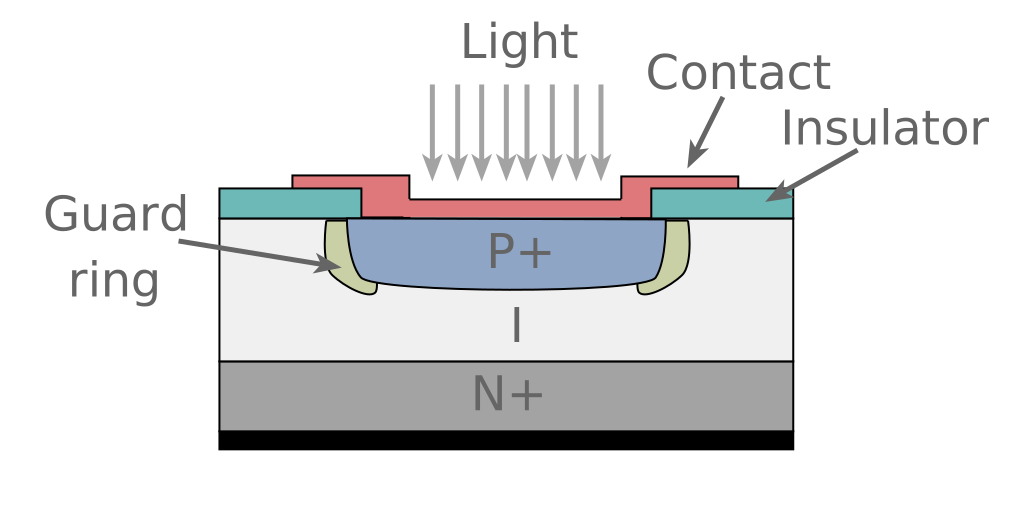
The structure of the avalanche diode is also more complicated. An n-type guard ring is required around the p-n junction to minimise the electric field around the edge of the junction. It is also found that the current gain is dependent not only on the bias applied, but also thermal fluctuations. As a result it is necessary to ensure the devices are placed on an adequate heat sink.
Avalanche photodiode circuit conditions
Avalanche photodiodes require a high reverse bias for their operation. For silicon, this will typically be between 100 and 200 volts. With this level of reverse bias they see a current gain effect of around 100 as a result of the avalanche effect.
Some diodes that utilise specialised manufacturing processes enable much higher bias voltages of up to 1500 volts. As it is found that the gain levels increase when higher voltages are applied, the gain of these avalanche diodes can rise to the order of 1000. This can provide a distinct advantage where sensitivity is of paramount importance, but this is obviously at the expense of all the additional circuitry and safety features needed for the very high voltages.
Avalanche photodiode structure
The avalanche photodiode structure is relatively similar to that of the more commonly used PN photodiode structure or the structure of the PIN photodiode. However as the avalanche photodiode is operated under a high level of reverse bias a guard ring is placed around the perimeter of the diode junction. This prevents surface breakdown mechanisms.
Avalanche photodiode materials
Like the standard PN or PIN photodiodes, the materials used have a major effect on determining the characteristics of the avalanche diode.
| Commonly used avalanche photodiode materials | |
|---|---|
| Material | Properties |
| Germanium | Can be used for wavelengths in the region 800 - 1700 nm. Has a high level of multiplication noise. |
| Silicon | Can be used for wavelengths in the region between 190 - 1100 nm. Diodes exhibit a comparatively low level of multiplication noise when compared to those using other materials, and in particular germanium. |
| Indium gallium arsenide | Can be used for wavelengths to 1600 nm and has a lower level of multiplication noise than germanium. |
For optimum noise performance the large difference in the ionisation coefficients for electrons and holes is needed. Silicon provides a good noise performance with a ratio between the different coefficients of 50. Germanium and many group III-V compounds only have ratios of less than 2. While the noise performance of these materials is much inferior, they need to be used for longer wavelengths that require the smaller energy gap offered.
Avalanche photodiode advantages and disadvantages
Avalanche photodiodes possess a number of advantages and disadvantages. These can be considered in the selection of a suitable photodetector device.
Avalanche photodiode advantages
- High level of sensitivity as a result of avalanche gain
Avalanche photodiode disadvantages:
- Much higher operating voltage may be required.
- Avalanche photodiode produces a much higher level of noise than a PN photodiode
- Avalanche process means that the output is not linear
The avalanche photodiodes are not as widely used as their PIN counterparts. They are used primarily where the level of gain is of paramount importance, because the high voltages required, combined with a lower reliability means that they are often less convenient to use.
More Electronic Components:
Batteries
Capacitors
Connectors
Diodes
FET
Inductors
Memory types
Phototransistor
Quartz crystals
Relays
Resistors
RF connectors
Switches
Surface mount technology
Thyristor
Transformers
Transistor
Unijunction
Valves / Tubes
Return to Components menu . . .