Understanding Diode Specifications, Ratings & Parameters
Diodes may appear straightforward but they have many data-sheet specifications, parameters and ratings which need to be understood when selecting one as a replacement, or for a new electronic circuit design.
Diode Tutorial Includes:
Diode types
Diode specs & ratings
PN junction diode
LED
PIN diode
Schottky barrier diode
SiC diode
Solar cell / photovoltaic diode
Varactor / varicap
Zener diode
Understanding diode specifications, parameters and ratings can be key to selecting the right electronic component for a particular electronic circuit design, whether it is a standard circuit design, power supply design, RF design or whatever.
With a huge variety of diodes available on the market, selecting the required one may not always appear easy, and understanding the specifications and data sheets so the right diode can be selected is crucially important.
Most of the specifications, ratings and parameters are relatively straightforward to understand, especially with a little explanation, but a few may require a little more explanation, or they may be applicable to a limited number of diodes.
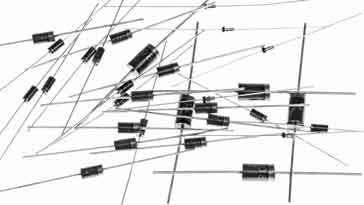
Apart from the specifications addressing the electrical performance, the physical packages are also important. Diodes come in a variety of packages including wire ended packages as well as high power diodes that bolt onto heatsinks and with a the vast amount of highly automated manufacturing and PCB assembly, surface mount technology components - SMD diodes are used in vast quantities.
Accordingly some diode specifications will be applicable to all these electronic components and to general electronic circuit designs; others will be applicable to power supply designs, others to RF designs, and yet other specifications to other specific areas of circuit design.
Diode specifications ratings and parameters
The specifications for diodes appear in data sheets and provide a description of the performance of the particular device. Inspecting the performance parameters will enable the diode to be assessed for whether it will provide the required performance for its intended function within an electronic circuit.
Different specification parameters are more applicable for diodes used in different applications, different electronic circuit designs, etc. For power applications, aspects like the current capability, forward voltage drop, junction temperature and the like will be important, but for RF designs, the capacitance, and turn on voltage will often be of great interest.
The aspects below detail some of the more widely used parameters or specifications used in data sheets for most types of diode.
The list below provides details of the various diode characteristics, and diode parameters found in the data-sheets and specifications for diodes.
Semiconductor material
The semiconductor material used in the PN junction diode is of paramount importance because the material used affects many of the major diode characteristics and properties. Silicon and germanium are two widely used materials:
- Silicon: Silicon is the most widely used material as if offers high levels of performance for most applications and it offers low manufacturing costs. The technology for silicon is well established and silicon diodes can be made cheaply. The forward turn on voltage is around 0.6V, which is high for some applications, although for Schottky diodes it is less.
- Germanium: Germanium is less widely used and but offers a low turn on voltage of around 0.2 to 0.3 V.
Other materials are generally reserved for more specialist diodes. For example LEDs use compound materials to provide the different colours.
Diode type
Although most diodes have a PN junction as the basis of their construction, different types of diode are formulated to provide different characteristics and sometimes they can operate in different ways.
Selecting the right type of diode for any given electronic circuit design is key.
Zener diodes are used for providing reference voltages, whilst varactor diodes are used to provide a variable level of capacitance in an RF design according to the reverse bias provided. Rectifier diodes may use a straightforward PN junction diode, or in some cases they may use a Schottky diode for a lower forward voltage.
Whatever the circuit design is is necessary to use the right type of electronic component to obtain the required functionality and performance.
Forward voltage drop specification, Vf
Any electronics device passing current will develop a resulting voltage across it and this diode characteristic is of great importance, especially for power rectification where power losses will be higher for a high forward voltage drop. Also diodes for RF designs often need a small forward voltage drop as signals may be small but still need to overcome it.
The voltage across a PN junction diode arise for two reasons. The first of the nature of the semiconductor PN junction and results from the turn-on voltage mentioned above. This voltage enables the depletion layer to be overcome and for current to flow.
The second arises from the normal resistive losses in the device. As a result a figure for the forward voltage drop are a specified current level will be given. This figure is particularly important for rectifier diodes where significant levels of current may be passed.
Particularly for power rectification diodes, a graph of the forward voltage drop for various current levels is normally provided within the data sheet. This will have a band of typical figures and using this the range of voltage drop can be determined for the anticipated current levels to be carried. It is possible to then determine the power that will be dissipated in the junction area of the diode.
Peak inverse voltage specification, PIV:
This diode characteristic is the maximum voltage a diode can withstand in the reverse direction. This voltage must not be exceeded otherwise the device may fail.
The PIV specification is particularly applicable to power supply circuit designs where higher voltages are commonly present.
The peak inverse voltage is not simply the RMS voltage of the incoming waveform. Each electronic circuit design needs to be considered on its own merits, but for a simple single diode half wave rectifier with some form of smoothing capacitor afterwards, it should be remembered that the capacitor will hold a voltage equal to the peak of the incoming voltage waveform.
The diode will then also see the peak of the incoming waveform in the reverse direction and therefore under these circumstances it will see a peak inverse voltage equal to the peak to peak value of the waveform.
Reverse breakdown voltage specification, V(BR)R
This specification is a little different to the peak inverse voltage in that this voltage is the point at which the diode will break down.
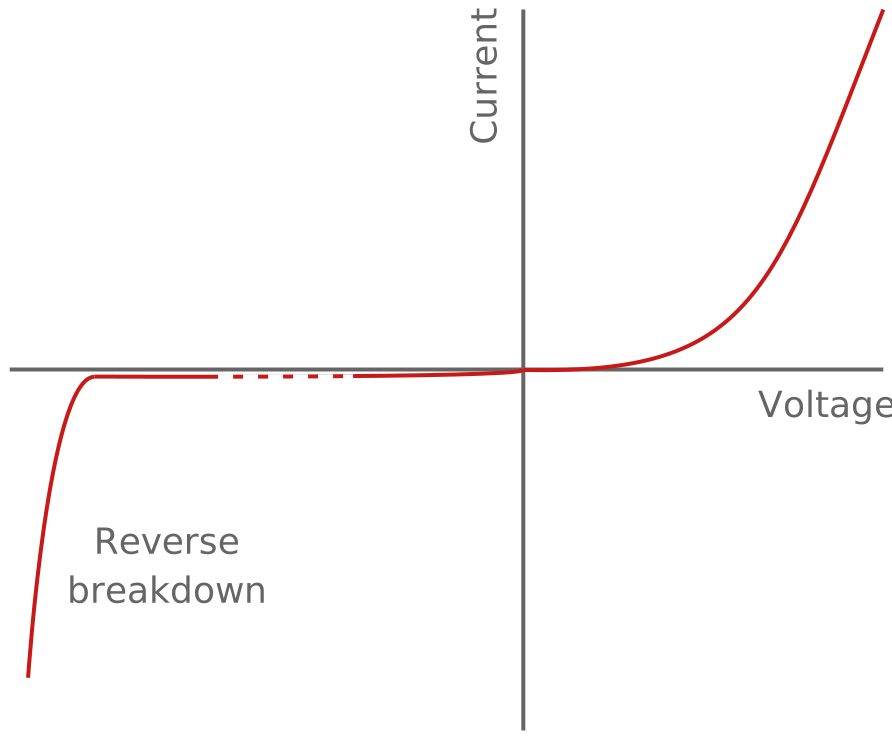
The diode can withstand a reverse voltage up to a certain point, and then it will breakdown. In some diodes and in some circuits it will cause irreparable damage, although for Zener / voltage reference diodes the reverse breakdown scenario is what is used for the voltage reference, although the circuit must be devised to limit the current flowing, otherwise the diode can be destroyed.
Maximum forward current
For an electronic circuit design that carries any significant levels of current it is necessary to ensure that the maximum current levels for the diode are not exceeded.
As the current levels rise, so additional heat is dissipated and this needs to be removed. Alsot he current density within the junction must not be exceeded otherwise burnout could occur.
Selecting a diode for the circuit design that can safely handle the current, also allowing a good margin (typically running at 60% or less) will ensure that the reliability of the overall circuit will be sufficiently high.
Junction operating temperature
Like all electronic components, diodes have a maximum operating temperature. In the data sheet there will be a section outlining the maximum junction temperature. As the junction temperature rises, so the reliability will fall over the long term. If the maximum junction temperature is exceeded, the diode is likely to fail, and could even catch fire.
It should be remembered that the junction temperature relates to the diode junction itself inside the package and not the package temperature. A very good margin should be allowed between the package temperature and the junction temperature in any electronic circuit design.
Often curves will be supplied in the data sheet to enable the junction temperature to be determined. It is also possible to calculate the junction temperature from a knowledge of the current, forward voltage drop and the thermal resistance,: specifications that are mentioned in the data sheets and mentioned here as well.
In view of the long term reliability aspects, it is always best to run the diode well within its ratings. This gives a good margin to ensure reliable long term operation and for the diode to accommodate any short term peaks. This is the same for any electronic component.
Junction to ambient thermal resistance, ΘJA
This diode data sheet specification parameter is measured in °C per watt and it means that for every watt dissipated in the junction there will be a given temperature rise above ambient. This means that for a diode with a junction to ambient thermal resistance of 50 °C/W, the temperature of the junction will rise by 50°C for every watt of power that is dissipated.
The junction to ambient thermal resistance is actually the sum of a series of individual areas of the diode: junction-to-case thermal resistance, case-to-surface thermal resistance, and surface-to-ambient thermal resistance, as shown by this formula: θJA = θJC + θCS + θSA.
This overall specification is key to being able to determine the actual junction operating temperature - a key parameter to monitor when designing a circuit in which diodes carry appreciable current such that the current passed will give rise to power dissipation.
The junction temperature can be calculated using the formula:
Where:
TJ junction temperature
TAMB = ambient temperature
ΘJA = junction to ambient thermal resistance.
Leakage current specification
If a perfect diode were available, then no current would flow when it was reverse biased. It is found that for a real PN junction diode, a very small amount of current flow in the reverse direction as a result of the minority carriers in the semiconductor.
The level of leakage current is dependent upon three main factors. The reverse voltage is obviously significant. It is also temperature dependent, rising appreciably with temperature. It is also found that it is very dependent upon the type of semiconductor material used - silicon is very much better than germanium.
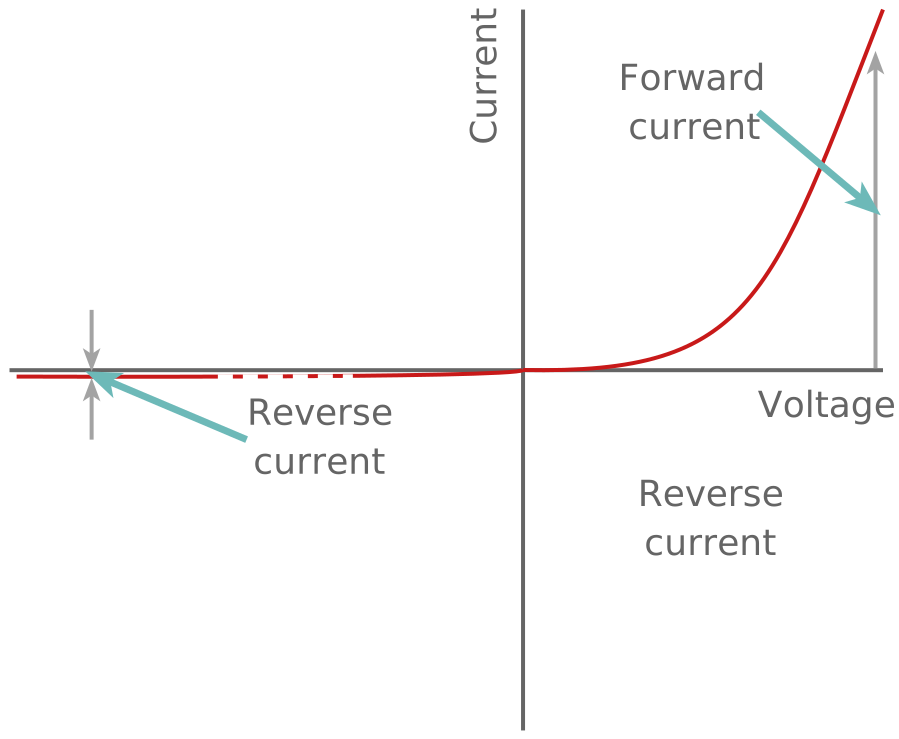
The leakage current characteristic or specification for a PN junction diode is specified at a certain reverse voltage and particular temperature. The specification is normally defined in terms of in microamps, µA or picoamps, pA as the levels are normally very low before reverse breakdown occurs.
It is worth noting that standard silicon diodes which form the vast majority of diodes used have very low levels of reverse current, but germanium diodes and also Schottky diodes have higher levels of reverse current. Both these latter types of diode find uses in RF designs and Schottky diodes also in power applications.
Junction capacitance:
All PN junction diodes exhibit a certain level of junction capacitance. The depletion region is the dielectric spacing between the two plates which are effectively formed at the edge of the depletion region and the area with majority carriers.
The actual value of capacitance is dependent upon the reverse voltage which causes the depletion region to change. Increasing reverse voltage increases the size of the depletion region and the distance between the two conducting regions. Hence this decreases the capacitance.
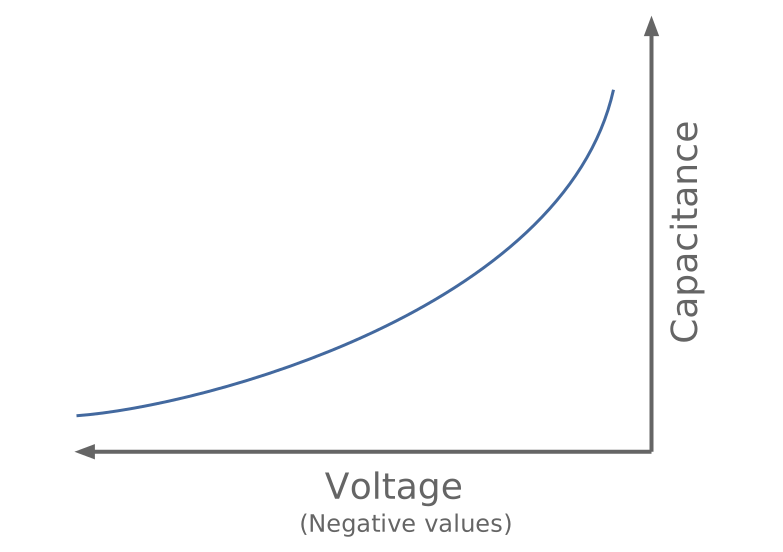
This fact is used in varactor or varicap diodes to good effect, and is widely used in variable frequency oscillator and variable frequency filters and other RF designs.
However for many other applications, especially some RF designs where stray capacitance across the diode could affect the performance, this needs to be minimised. As the capacitance is of importance it is specified.
The parameter is normally detailed as a given capacitance (normally in pF as capacitance levels are relatively low) at a given voltage or voltages. Also special low capacitance diodes are available for many RF applications.
It is worth noting that for many power rectifier applications the capacitance is sufficiently low to not be an issue. As an example the junction capacitance of a 1N4001 and 1N4004 is only 15 pF for a reverse voltage of 4 volts and less as the voltage rises. Higher voltage diodes may be less - a 1N4007 has a junction capacitance of 8 pF for a reverse voltage of 4 volts.
Accordingly it is only as the frequencies rise that the effect of the capacitance is noticed. As the capacitance levels are low, frequencies up to around 100 kHz are often not affected by it, and in most cases it can be ignored up to even higher frequencies.
Package type:
Diodes can be mounted in a variety of packages according to their applications, and in some circumstances, especially RF design applications, the package is a key element in defining the overall RF diode characteristics.
Also for power applications where heat dissipation is important, the package can define many of the overall diode parameters because high power diodes may require packages that can be bolted to heatsinks, whereas small signal diodes where heat dissipation is not an issue may be available in leaded formats or as surface mount devices.
Also high power diodes may be available as bridge rectifiers containing four diodes in a bridge suitable to fun wave rectification applications.
Surface mount diodes, SMD diodes are used in vast quantities because most electronics manufacture and PCB assembly is undertaken using automated techniques and surface mount technology lends itself to this.
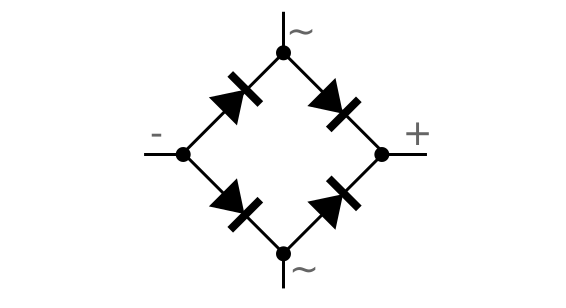
In addition to this, diodes are available in both leaded and those using surface mount technology packages are dependent upon the diode. Most RF and lower power diodes are available in surface mount technology packages making them more appropriate for large scale manufacturing.
Diode coding and markings schemes
Most diodes that are used have part numbers that conform to the JEDEC or Pro-Electron schemes. Numbers like 1N4001, 1N916, BZY88 and many more are very familiar to anyone involved in electronics design and manufacture.
However when using automated printed circuit board PCB assembly techniques and surface mount technology, it is found that many devices are too small to carry the full number that might be used in a data-sheet. As a result, a rather arbitrary coding system has developed, whereby the device package carries a simple two or three character identification code.
This can normally be accommodated on the small surface mount diode packages. However, identifying the manufacturers' type number of an SMD diode from the package code may not be easy at first sight. There are some useful SMD codebooks available that provide the data for these devices. For example the code "13s" indicates a BAS125 surface mount diode in a SOT23 or SOT323 package.
Example of typical diode specifications
Although there are many different diodes with a large number of different specifications, it sometimes helps to see what the various specifications and parameters are and how they are expressed in a similar format to those seen in the data sheets.
| Typical 1N5711 Characteristics / Specifications | |||
|---|---|---|---|
| Characteristic | Typical Value | Unit | Details |
| Max DC Blocking Voltage, Vr | 70 | V | |
| Max forward continuous current, Ifm | 15 | mA | |
| Reverse breakdown voltage, V(BR)R | 70 | V | @ reverse current of 10µA |
| Reverse leakage current, IR | 200 | µA | At VR=50V |
| Forward voltage drop, VF | 0.41 1.00 |
V | at IF = 1.0 mA IF=15mA |
| Junction capacitance, Cj | 2.0 | pF | VR = 0V, f=1MHz |
| Reverse recovery time, trr | 1 | nS | |
The 1N5711 is a fairly standard low curent diode, and the specification indicates the sorts of values that it provides. Matching its performance to that of the circuit design is key. Other semiconductor diodes will have different performance parameters and may be applicable for different applications and circuit designs. This is only an example specification and other diodes may offer quite different performance levels.
Other points to consider
Although the data sheet parameters are very important in selecting the best device to select, there are also several other aspects that can be particularly important, especially when production runs of a design are to be undertaken.
These additional points are often outside the scope of the datasheets, but in many respects thay can be equally as important.
By considering these points, the best diodes can be chosen, not only in terms of the basic parameter specifications, but also in terms of other factors that are equally or even more important giving the best solution for the intention of the whole design.
Key Aspects of Component Selection:
Although it is possible to make many decisions about selecting the right component for a circuit design from the datasheet parameters, this is not the only basis for selecting the right components as there are several other attributes not in the data-sheets that need to be embodied in any decision. These are equally important as the basic specification parameters, but not always taken into account. In our web page, we reveal the key additional aspects to consider so that the overall best choice is made.
Read more about secrets of selecting components.
The vast number of diodes have a vast number of different characteristics. Some diodes may be designed purely for rectification, whereas others may be designed to emit light, detect light, act as a voltage reference, provide variable capacitance and the like. Diodes also come in a variety of packages, with the vast majority these days being sold as surface mount diodes for automated PCB assembly.
Whatever the type of diode, many of the basic specifications, parameters and ratings mentioned above will be important. Understanding the key parameters and ratings of these electronic components when looking at the specifications in the data-sheets is key to selecting the right diode. Understanding the specifications enables wise decisions to be made during the electronic circuit design process for any project using diodes.
More Electronic Components:
Batteries
Capacitors
Connectors
Diodes
FET
Inductors
Memory types
Phototransistor
Quartz crystals
Relays
Resistors
RF connectors
Switches
Surface mount technology
Thyristor
Transformers
Transistor
Unijunction
Valves / Tubes
Return to Components menu . . .