Transistor Long Tailed Pair Circuit
The long tailed pair is a differential amplifier used as the basis of operational amplifier technology - seen with a transistor here it can also be used with FETs and vacuum tubes / valves.
Transistor Circuit Collection Include:
Transistor circuit collection
Common emitter
Emitter follower
Common base
Darlington pair
Sziklai pair
Current mirror
Long tailed pair
Constant current source
Capacitance multiplier
Two transistor amplifier
High pass filter
Switch circuits
Pulse generator
Schmitt trigger
One transistor relaxation oscillator
Transistor crystal-oscillator
See also:
Transistor circuit design
The long tailed pair or differential pair circuit is a form of differential amplifier providing a voltage output proportional to the difference between the two input nodes.
The long tailed pair is often used with bipolar transistors but can equally well be constructed with FETs, and the first long tailed pair circuits were designed using thermionic valves / vacuum tubes.
Long tailed pair development
The long tailed pair circuit has been in existence for many years and was widely used well before the advent of the bipolar transistor or FET.
The circuit was first seen around 1934 and later a circuit that appeared in a patent submitted by Alan Blumlein, the British electronics engineer who invented stereophonic sound.
The long tailed pair configuration was later taken up in a variety of applications including oscilloscope technology> It was also widely used in computer related circuits where it performed well as a switch which was largely independent of the gain and other parameters of the device used.
In the early days of the long tailed pair, tubes or thermionic valves were used.
Later the bipolar transistor version of the circuit found a huge level of use as operational amplifiers started to be used. As the long tailed pair is a form of differential amplifier, it was ideally suited to use in these integrated circuit amplifiers.
Long tailed pair basics
The long tailed pair, LTP or differential pair is shown below in a variant that uses two transistors.
It can be seen from the diagram that the two transistor emitters are connected together and this node is then taken to ground via a large resistor. It is this configuration that gives the circuit configuration its name as it resembles a long tail.
The resistor has a high value and as a result it resembles a current source. In many integrated circuit applications where further transistors can be added very easily, the long tail resistor is often replaced by an active current source to improve the performance.
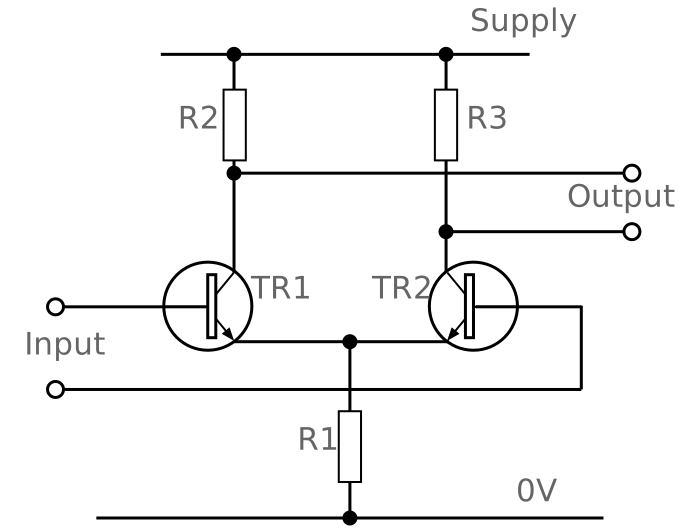
In its operation, one of the key aspects of the long tailed pair is that it is a differential amplifier. The amplifier amplifies the voltage difference between the two inputs. If the same signal is applied to both inputs no output should be seen. In reality some signal will appear, but the level is determined by what is called the Common Mode Rejection Ratio, CMMR. The level is determined mainly by any lack of balance in the circuit.
The common mode rejection ratio is normally expressed as a ratio in decibels. The value indicates the reduction level of a signal applied to both inputs compared to a signal applied to just one input, the other input being grounded.
Long tailed pair gain
As with any form of electronic circuit, the gain is important.
The gain for a perfect differential amplifier can be expressed as below:
Where:
Vout = output voltage
V+in = input voltage on the positive input
V-in = input voltage on the negative input
Ad = differential gain
In reality, there is always some gain from common mode signals. Accordingly the more accurate representation of gain includes both the differential and common mode elements of the output.
Where:
Ac = common mode gain
Emitter current source
One of the developments to the basic long tailed pair circuit shown above, is to use an active current source for the emitter circuit.
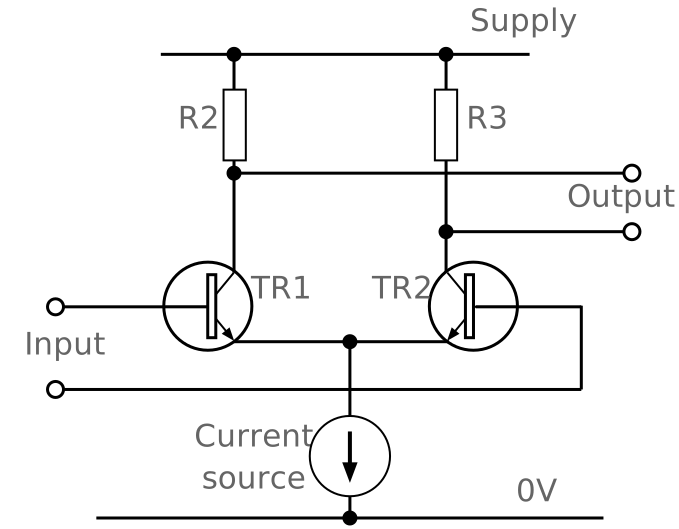
The basic long tailed pair uses a large resistor in the emitter circuit. This approximates to a current source, but is not as good as a full active version. As it is very easy to add transistors into an integrated circuit, it is virtually as easy to have an active current source as it is a resistor. Accordingly all integrated circuits using a long tailed pair will employ a circuit using an active current source.
Long tailed pair collector current mirror
Another improvement to the basic circuit is to employ a current mirror within the collector circuit of the transistors. This enables the differential collector current signal to be converted to a single ended voltage signal without the losses of the resistor while also increasing the circuit gain.
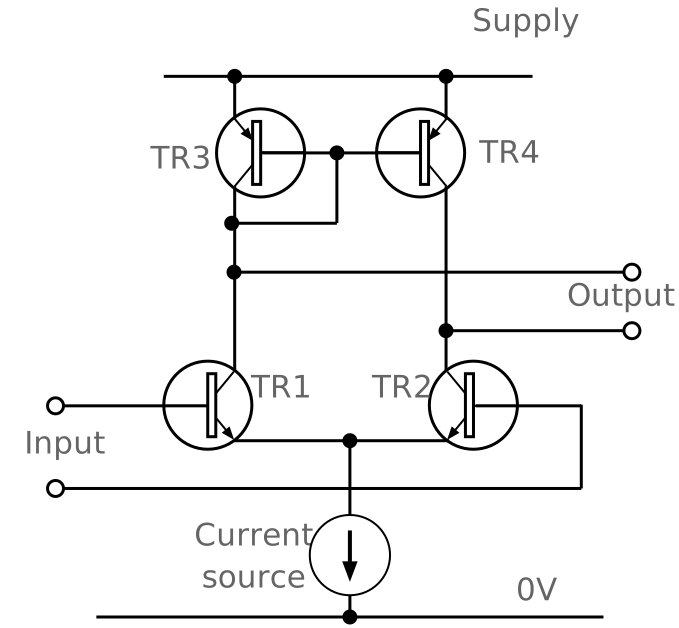
The high effective collector load provided by the current mirror enables voltage gains of 5000 or more to be achieved provided there is no external load placed on the circuit.
The long tailed pair or differential pair is extensively used in integrated circuit technology, especially in operational amplifiers where it provides the basic building block of the whole amplifier. In view of the ease of use of operational amplifiers and their low cost, long tailed pair circuits made from discrete components are seldom seen. This indicates the success of the op amp and its use of the long tailed pair circuit concept.
More Circuits & Circuit Design:
Op Amp basics
Op Amp circuits
Power supply circuits
Transistor design
Transistor Darlington
Transistor circuits
FET circuits
Circuit symbols
Return to Circuit Design menu . . .